





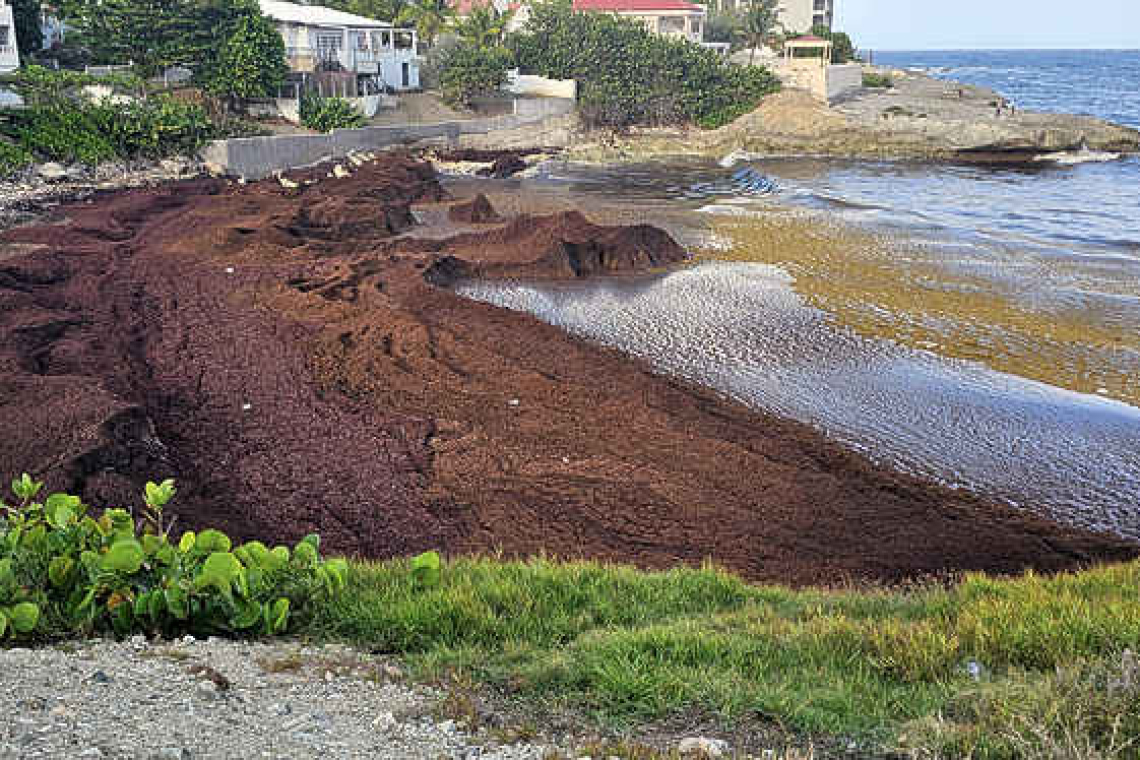
PHILIPSBURG--St. Maarten is on the verge of one of its most severe sargassum seasons on record, with massive volumes of the seaweed already surging across the Atlantic, raising concerns about potential impacts on public health, tourism and marine ecosystems.
Nature Foundation St. Maarten Director Leslie Hickerson said monitoring efforts are already underway as regional data point to significant seaweed activity expected to begin affecting the island as early as March.
“The Nature Foundation has been working with the Ministry of Public Housing, Spatial Planning, Infrastructure and Environment VROMI and our regional partners on activities to monitor the timing, amount, and impact of sargassum landings on St. Maarten,” Hickerson told The Daily Herald. “The goal of our work is to help Government of St. Maarten better manage the landings and their impacts on our community and tourism industry, something that many countries are struggling with.”
She noted that 2026 is likely to have substantial sargassum landings continuing into September. Managing the influx presents significant logistical and financial challenges, particularly for a small and densely developed island already grappling with solid waste management constraints. The collection, processing and disposal of large volumes of seaweed require extensive coordination and resources.
Scientists from the University of South Florida report that the Atlantic Ocean is currently experiencing a surge in sargassum biomass more than 75% above historical averages for this time of year. If the trend continues, researchers warn that 2026 could surpass the record 38 million metric tons recorded in 2023.
The bloom, often described as a vast “brown tide,” forms a continuous belt stretching roughly 5,000 miles from the coast of Africa to the Caribbean. Researchers say this year’s accumulation already exceeds previous peaks recorded in 2018 and 2022, reflecting a pattern that has intensified over the past 15 years. The scale of the Atlantic bloom directly influences how much seaweed ultimately reaches Caribbean shorelines, including St. Maarten.
Scientists attribute the expanding blooms to warming ocean temperatures, changing wind and current patterns, and increased nutrient runoff from major rivers such as the Amazon, Orinoco and Mississippi.
When sargassum accumulates along shorelines and begins to decompose, it releases hydrogen sulfide gas, producing a strong odour similar to rotten eggs. In higher concentrations, exposure can cause eye irritation, headaches and respiratory discomfort. Large deposits also reduce oxygen levels in nearshore waters, damaging coral reefs and seagrass beds, disrupting sea turtle nesting sites and affecting fishing grounds.
Across the wider region, severe sargassum events have forced beach closures and discouraged visitors in major tourism destinations including parts of the Caribbean, Florida, Cancun and the Riviera Maya.
With the first major landings expected within weeks, the effectiveness of monitoring and response measures could prove critical for protecting St. Maarten’s tourism-dependent economy and fragile coastal ecosystems.