





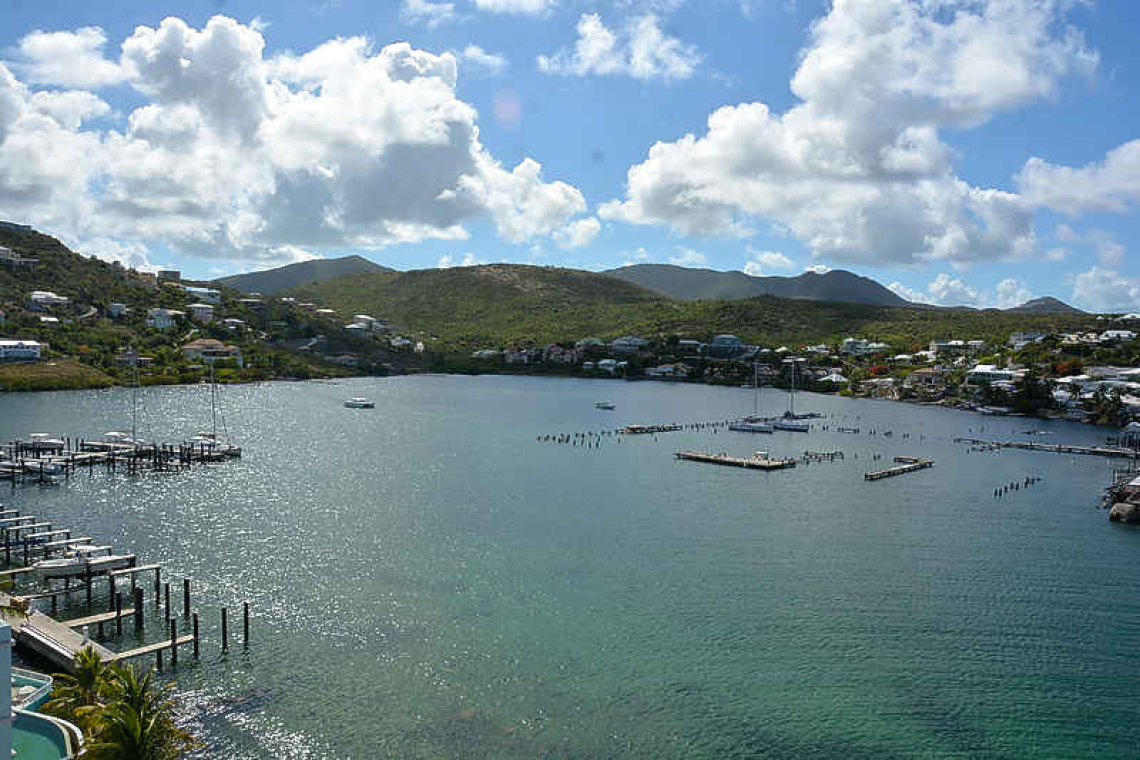
The former Captain Oliver’s Marina.
PHILIPSBURG--France has taken a major step toward formally settling the long-standing border dispute between Dutch St. Maarten and French St. Martin after the French Parliament approved legislation establishing the border on Thursday.
In an invited comment, Prime Minister Dr. Luc Mercelina told “The Daily Herald” that St. Maarten had already completed its part of the process under the previous administration and that the next step now rests with the Kingdom of the Netherlands.
“From our side [St. Maarten – Ed.] this was signed by the former cabinet already. France had to go through their approval process. The approval process by France was ongoing for quite some time. Now that this is done, the Netherlands will finalise their part of the process,” Mercelina said.
The prime minister added that the agreement will provide greater clarity on practical border-related matters, while noting that the island has long enjoyed peaceful relations despite the lack of a formally defined boundary. “Realise though that for many years (since 1648) we lived peacefully with our northern neighbours without this defined clarity. At the end, we are one Island one people.”
According to Dutch news website NU.nl, the agreement, originally signed in 2023, still requires ratification by the Kingdom of the Netherlands before it can enter into force.
The report said the agreement concerns the open border between self-governing St. Maarten and French St. Martin. Although residents move freely between the two sides of the island, each operates under separate customs, immigration and tax systems.
According to NU.nl, the island’s approximately 10-kilometre border dates back to 1648, when France and the Netherlands agreed to divide the island. However, the two countries never formally agreed on the precise location of the border.
Over the centuries, a de facto border developed, but disagreements remained over issues including permits, law enforcement and environmental management.
The report said one of the disputed areas was Oyster Pond, where the exact location of the border remained unclear. France and the Netherlands also disagreed over whether the entire bay belonged to the Dutch side or only part of it.
According to NU.nl, efforts to formally define the border gained momentum following Hurricane Irma in 2017, which destroyed more than 95% of the buildings on the island.
French Member of Parliament Bertrand Bouyx, who guided the legislation through Parliament, said: “France can be proud of the fact that it has resolved one of its oldest territorial disputes.”
According to NU.nl, the agreement will take effect only after it has also been ratified by the Kingdom of the Netherlands.
The border agreement stems from a treaty signed by Dutch and French officials on May 26, 2023 after years of negotiations. The agreement adjusts several sections of the border, with the Dutch side gaining 7,109 square metres of land at various points while the French side gains jurisdiction over part of Oyster Pond, including Captain Oliver’s Marina.
The Oyster Pond boundary was established using the internationally recognised principle of equidistance, effectively dividing the pond between the two sides. At the time, then-Prime Minister Silveria Jacobs said the changes primarily affected public areas and would not alter the overall size of either Dutch St. Maarten or French St. Martin. The agreement followed approximately nine years of negotiations.