





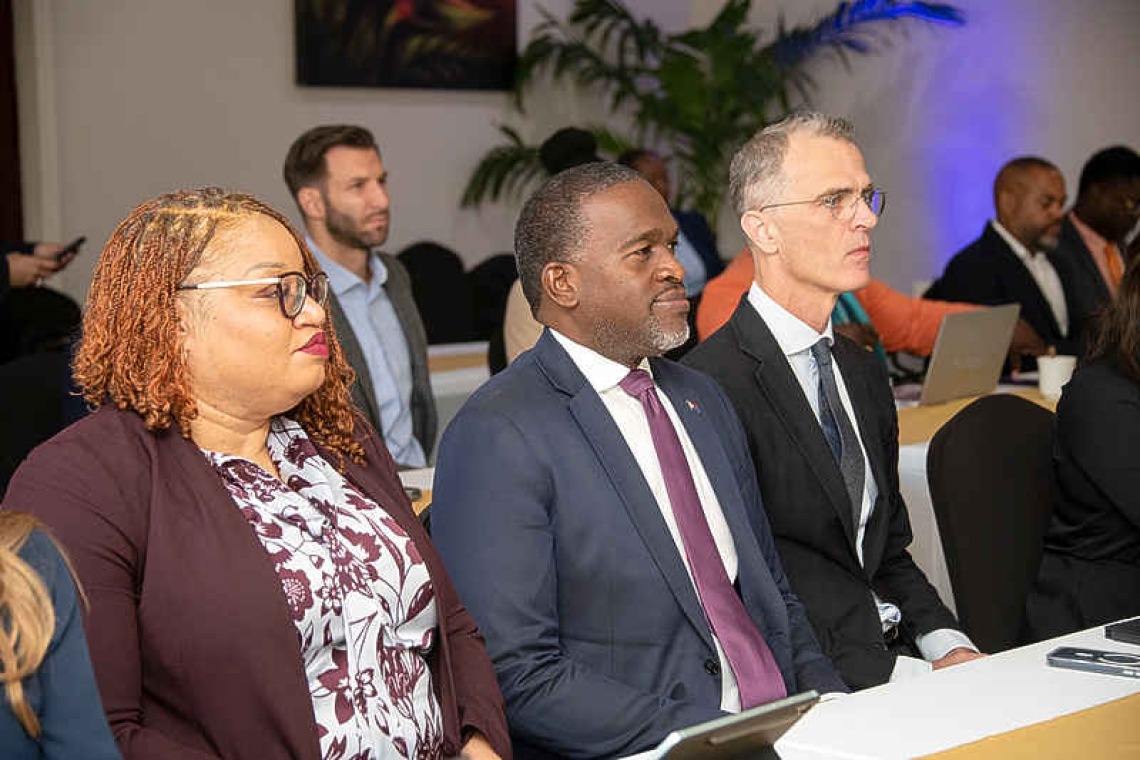
Finance Minister Marinka Gumbs, Governor Ajamu Baly and CBCS President Richard Doornbosch at the event.
PHILIPSBURG--The Central Bank of Curaçao and St Maarten (CBCS) hosted its 3rd Annual Fintech Conference on December 4 and 5, 2025, at Simpson Bay Resort, bringing together central bankers, innovators and fintech specialists from the Caribbean, Latin America, Europe, the Middle East and Asia.
The two-day program opened with a closed regulators’ round-table on Thursday and continued Friday with a public conference focused on the future of finance.
This year’s conference centred on Payments Innovation and Digital Assets Regulation, Fintech as a driver of financial inclusion in Latin America and the Caribbean, Stablecoins and Digital Finance, and The Future of Banking, including developments in the neobank sector.
The overarching theme – “Trust, transparency and technology: regulating the next wave of fintech” – underscored the central bank’s role in developing regulation that protects consumers while enabling innovation.
In his keynote speech, CBCS President Richard Doornbosch spoke of fintech’s potential to expand access to financial services for underserved and unbanked communities. He noted that regulatory frameworks must evolve “in a way that creates space while safeguarding stability and integrity.”
Panel discussions and fireside sessions throughout the day highlighted the need for solutions tailored to local and regional realities. Speakers discussed differences in payment systems across Latin America and the Caribbean and shared success stories from Sint Maarten, Curaçao, Aruba and the Bahamas. Participants also examined digital payment frictions in the still cash-based, tourism-driven economies of Sint Maarten and Curaçao.
The programme briefly addressed the advantages and challenges of Central Bank Digital Currencies, as well as developments in tokenisation and its implications for ownership. Panellists also pointed to the importance of data centres in enabling financial inclusion and emphasised the significance of sovereign control over data.
During discussions on the future of banking, speakers highlighted co-existence and co-creation between traditional banks and neobanks, noting that both play key roles in improving access to financial services and supporting customised financial innovation.
The conference concluded with representatives from the Global Blockchain Business Council and The Luxembourg House of Financial Technology committing to support the region in accelerating its fintech and payments ecosystem. As an initial step, they proposed mapping gaps in existing payments infrastructure based on conference outcomes. The CBCS welcomed the initiative and expressed support for collaboration aimed at strengthening financial resilience within the monetary union.
Through its annual Fintech Conference, the CBCS seeks to bring together innovators, policymakers, regulators and the public to engage in essential discussions surrounding financial innovation and digital finance regulation in Curaçao and St Maarten.