





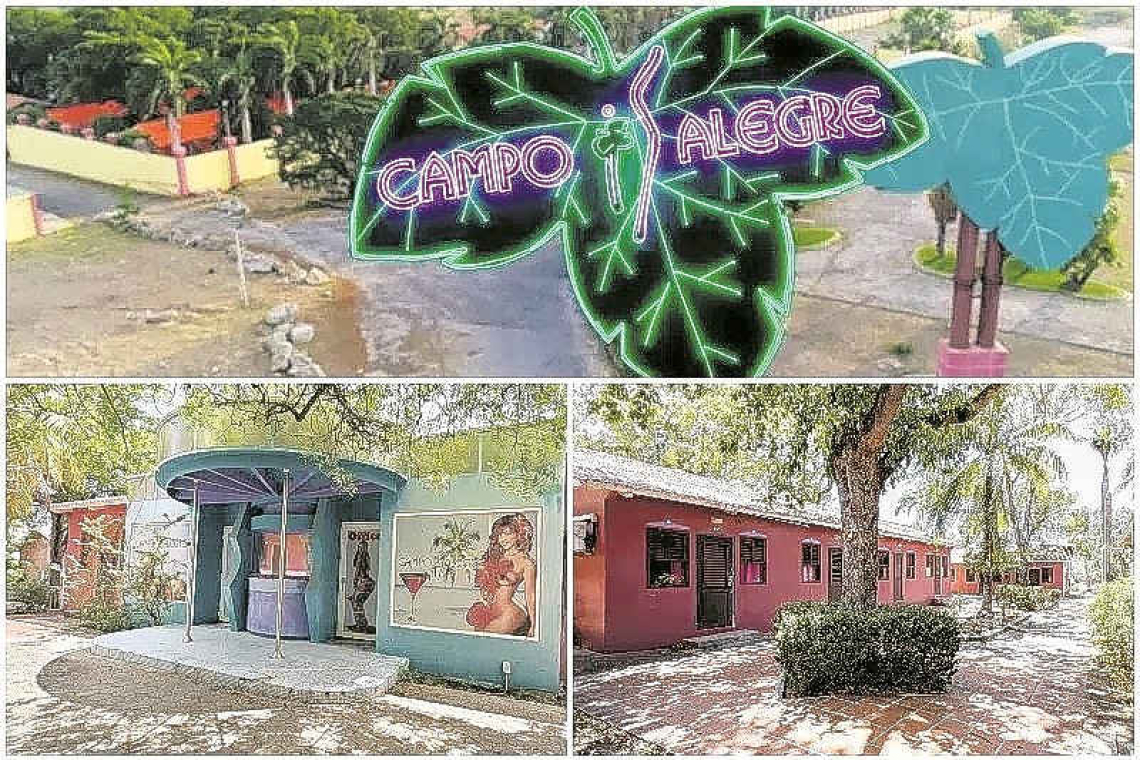
The brothel.
WILLEMSTAD--Visits to Curaçao’s now-defunct brothel Campo Alegre played a significant role in shaping the masculinity, camaraderie, and identity of many Dutch naval officers. At the same time, these practices were intertwined with colonial inequality and institutional risk policy.
This is the conclusion reached by Marie-Louise Janssen and Diede Schaap in the academic study “Doing sexual risk in the Dutch Navy in colonial Curaçao,” conducted for the history and sociology departments at the University of Amsterdam. It was published very recently on the online platform Health, Risk & Society.
Janssen and Schaap interviewed 10 former marines who were stationed in Curaçao between the 1960s and the 1980s. The aim of the research was to show that Dutch naval officers’ visits to Campo Alegre were not only about sex, but also about power, colonialism, risk, masculinity, and institutional policy.
The study aims to contribute to a better understanding of Dutch colonial history on Curaçao and of the way in which governments and military institutions influence sexual norms and risky behaviour. The researchers combined the interviews with archival research into Dutch colonial policy.
Campo Alegre was established in 1949 under a policy of tolerance in which prostitution was viewed as a “necessary evil”. The government, naval leadership, and other institutions regarded regulated sex work by foreign sex workers as a means of serving the large numbers of single men on the island, including military personnel and dockworkers, while simultaneously controlling the spread of sexually transmitted diseases.
Contradictory
According to the researchers, this created a contradictory situation. Officially, visits to brothels were often disapproved of or even prohibited by the navy, but in practice, they were frequently tolerated.
Many of the former navy personnel interviewed describe Campo Alegre as a regular part of their social life during their stay on Curaçao, where they could be found at least five out of seven evenings a week. For young recruits, a first visit to the brothel even constituted a kind of transition from “boy-to-man” ritual.
The marines viewed the greatest risk not so much in potential health problems, but rather the danger of being caught by military authorities. At the same time, taking that risk actually yielded status and prestige within the friendship group. Risky behaviour thus became part of the affirmation of a dominant military masculinity.
Dimensions
The researchers also pay attention to the colonial and racial dimensions of these encounters. The predominantly white Dutch marines came into contact with Latin American sex workers, who often came from countries such as Colombia and the Dominican Republic.
Stereotypes regarding these women, ranging from exotic and hyper-sexual to caring, regularly emerged in the interviews. According to the researchers, this reflects broader colonial power structures in which origin, gender and social position played an important role.
The researchers’ main conclusion is that sex work in colonial Curaçao cannot be viewed in isolation from Dutch colonial administrative traditions, military culture and ideas about masculinity. Campo Alegre was more than a brothel: it functioned as an institutional space where risks, sexuality, colonial power relations and military identity converged.
The researchers argue that through their behaviour, the marines challenged existing norms while simultaneously reproducing colonial and gender inequalities. This resulted in a complex and sometimes contradictory form of masculine identity within the Navy.
The study was funded by an Aspasia grant from the Netherlands Organisation for Scientific Research NWO.