





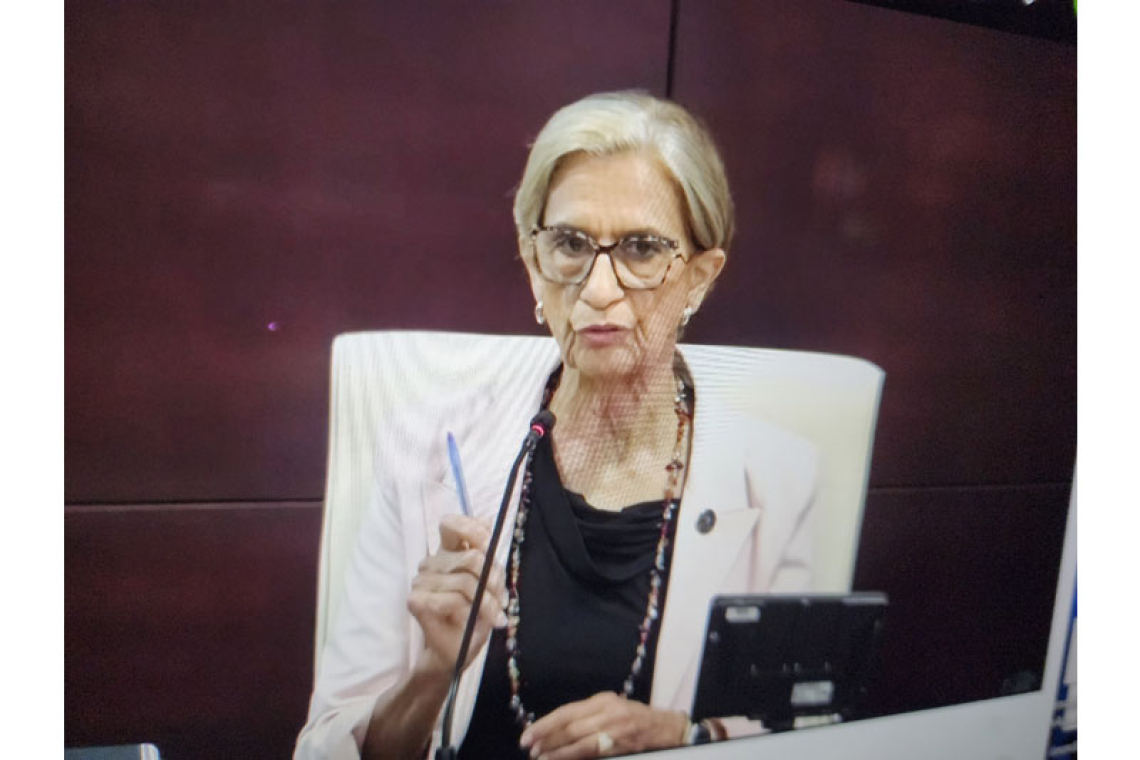
PHILIPSBURG--Debate on the draft 2026 national budget began in a Central Committee meeting of Parliament on Friday with a lengthy disagreement among Members of Parliament (MPs) over a proposal to change how the budget would be scrutinized, with several opposition MPs arguing the new approach would infringe on MPs' rights while others supported it as a more efficient process.
The discussion took place before Finance Minister Marinka Gumbs began presenting the draft Budget 2026.
Chairperson of Parliament Sarah Wescot-Williams proposed a revised procedure under which the minister would first deliver a complete presentation of the budget, after which MPs would be allowed to ask questions seeking clarification on that presentation. Parliamentary factions would then have until July 2 to submit their budget questions in writing, preferably organized by ministry. Parliament would reconvene in a Central Committee meeting on July 6 to ratify the compiled questions before immediately forwarding them to government for written responses ahead of the continuation of the public budget debate on a date to be determined.
Wescot-Williams later suggested allowing government approximately two weeks to prepare its responses so Parliament could resume the public handling of the budget during the third week of July.
National Alliance (NA) MP Egbert Doran strongly opposed the proposal, saying it differed from discussions previously held among faction leaders.
Doran said he supports efficiency but questioned how Parliament could rely on government responding promptly to written budget questions when, according to him, several of his previous letters to Government have remained unanswered for extended periods.
He argued that the proposal amounted to "a gross infringement of the process" and said he was "totally against this proposal," adding that Parliament should not use the country's most important piece of legislation as a pilot project for a new procedure.
Democratic Party (DP) MP Dimar Labega supported the proposal on the condition that Government returns responses in a timely manner. His party colleague, MP Viren Kotai, also expressed support, provided that MPs receive timely answers, adding that Parliament should continue looking at ways to improve its efficiency in the future.
Nation Opportunity Wealth (NOW) MP Lyndon Lewis also voiced reservations, saying he had previously shared similar concerns during the closed-door faction leaders meeting. While supporting efficiency in principle, Lewis argued that the budget process should not be changed while dealing with the country's national budget.
He said MPs' rights were being infringed upon and suggested any procedural changes should instead be introduced at a later stage.
Unified Resilience St Maarten Movement (URSM) MP Veronica Jansen-Webster said she could support the proposal because of the late submission of the budget and the need for ministers to execute government's work. However, she requested clarification on the proposed July 6 meeting and whether MPs would still have an opportunity to seek clarification on their questions. Jansen-Webster also disputed claims that government had failed to answer questions during previous meetings, stating that transcripts showed answers had in fact been provided.
URSM MP Sjamira Roseburg said her main concern was ensuring that all questions submitted by MPs receive answers, regardless of whether they are submitted orally or in writing. She said that once government guarantees answers, she has no objection to the proposed approach, adding that obtaining those answers is essential for MPs to properly prepare for the budget debate.
NA MP Ardwell Irion opposed the proposal, saying he was surprised that Parliament was considering changing its approach to handling what he described as its most important legislation.
Irion argued that moving the questions to a written process could further delay the budget while placing unnecessary pressure on civil servants. He also expressed concern that MPs would lose the opportunity to ask follow-up questions during the Central Committee stage.
NA MP Darryl York also opposed the proposal, saying Parliament should first demonstrate consistency before attempting to introduce a more sophisticated process. York said he still has numerous unanswered letters submitted to ministers and questioned whether government could properly handle written budget questions if it has been unable to consistently answer routine correspondence.
He also said that some of his questions to ministers have previously been skipped. Soualiga Action Movement (SAM) MP Franklin Meyers supported the proposal, saying change is necessary if Government is to become more efficient.
Meyers noted that the previous budget had to be redone because amendments made by MPs could not be implemented as proposed. He said Budget 2026 was already late and urged the Minister of Finance to ensure future budgets are submitted on time.
United People’s party (UP) UP MP Francisco Lacroes questioned whether Parliament could proceed with the proposal, referring to the Rules of Order.
He argued that Parliament can only deviate from its rules if no member objects and said that because several MPs had already voiced objections, he did not understand why the discussion was continuing.
Doran later added that if Parliament adopts the proposed procedure, he would refrain from attending future faction leaders meetings, describing the proposal as "a serious infringement on the rights" of MPs. Irion also questioned whether decisions reached during faction leaders meetings could still be trusted.
Roseburg later sought clarification on whether the proposed Central Committee process was specifically provided for in Parliament's Rules of Order, saying she had reviewed the rules and had not found such a provision.
Responding to members' concerns, Wescot-Williams rejected claims that the proposal deviated from Parliament's Rules of Order or infringed upon MPs' rights. "There is no deviation from the Rules of Order here to start with," she said. She explained that the proposal was intended to improve the legislative handling of the budget while still allowing Parliament to fully exercise its oversight role. Wescot-Williams stressed that if government fails to answer Parliament's written questions, the public budget debate cannot continue. She also rejected suggestions that Parliament was attempting to fast-track the budget, describing such claims as an inaccurate representation of what occurred during consideration of the 2025 budget.
The Chairperson further noted that while unanswered correspondence from ministers is unfortunate, MPs still have other avenues to raise those issues publicly. She maintained that the proposed process would not diminish Parliament's scrutiny of the budget but would instead organize members' questions before Government formally responds.
Following the discussion, Wescot-Williams said the Finance Minister would be allowed to proceed with her presentation, after which Parliament would determine how to move forward with the proposed procedure. She also reminded members that although Parliament would be in recess, meetings could potentially still be held during that period to continue preparations for the Budget 2026 debate.