





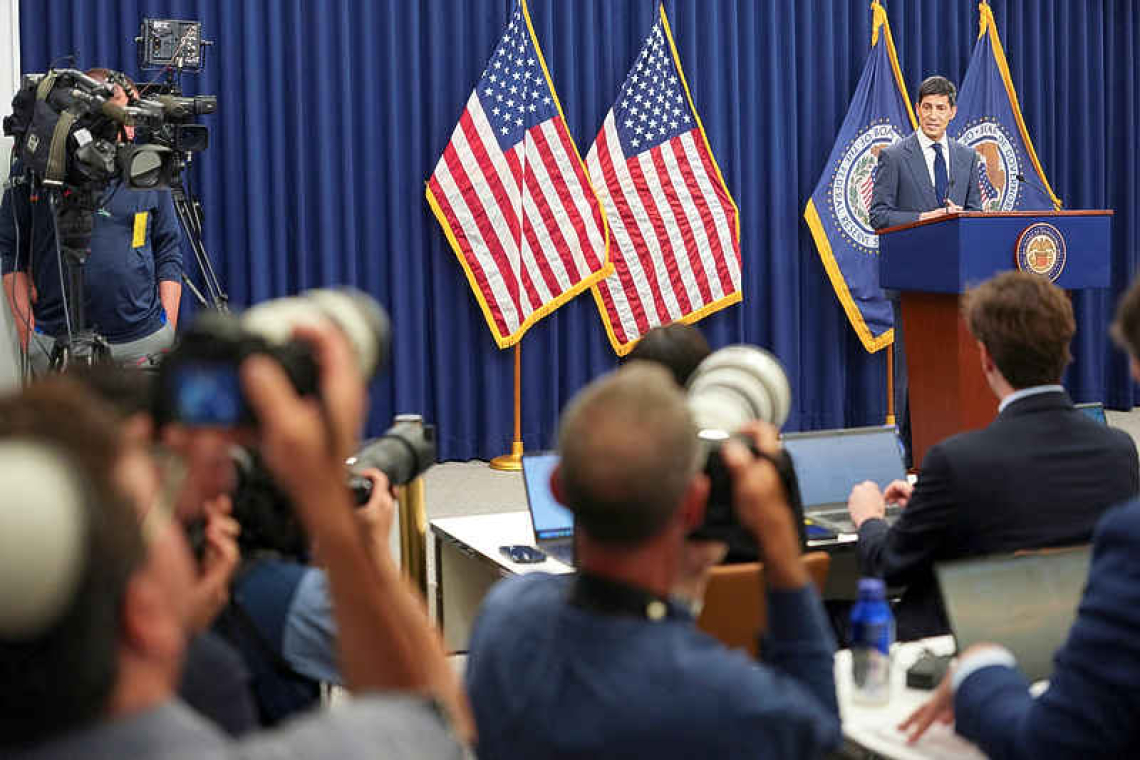
WASHINGTON--Federal Reserve Chairman Kevin Warsh opened a new era of U.S. monetary policy on Wednesday, with officials agreeing to leave interest rates unchanged despite inflation stuck well above their target but also launching an ambitious review that could reshape how the central bank makes decisions and communicates with the public.
Warsh, who took over as Fed chief last month, made an immediate imprint in organizing a unanimous consensus around a stripped-down policy statement that jettisoned any forward guidance on what actions the central bank might take in the near term, although new quarterly projections, eschewed by Warsh himself, showed nine of 19 policymakers now anticipate a rate hike by the end of 2026.
Indeed, the shortened document issued by the policy-setting Federal Open Market Committee heralded a return to a format similar to that used by former Fed Chairman Alan Greenspan and clearly reflected Warsh's disdain for expansive communication about what's to come, and desire to let financial markets act with less input from the central bank.
Forward guidance, Warsh said at his debut press conference, is not "well suited" to the current economic moment. "I can't give you any forward guidance about what we're going to do next," he said. "The good news is we'll be meeting in six weeks," a refrain that may become his calling card when asked about the future.
The statement's description of the economy also showed Warsh's influence, touching on issues he has emphasized in the run-up to his nomination by President Donald Trump. "Productivity growth and capital investment are strong," the statement said, and while acknowledging inflation was "elevated relative to the Committee's 2% goal," it attributed that in part to "supply shocks that have driven price increases in certain sectors, including energy."
In the midst of a hawkish policy turn, the language highlighted forces that Warsh has argued could allow rates to fall over time, if productivity lets companies provide goods and services more efficiently, and the easing of energy costs helps lower inflation.
The statement marks a turning point not just in leadership at the central bank but in a monetary policy outlook that since the fall of 2024 had been geared to lower borrowing costs from the elevated rates used to help tame inflation that hit 40-year highs during the COVID-19 pandemic. Fed observers took immediate note of the shift.
"The changes to the policy statement were profound," Thomas Simons, chief U.S. economist at Jefferies, wrote in a note. "The word count dropped substantially and the modest amount of forward guidance present showed two-way risks to the next move for policy. Policy statements became much wordier after the GFC (Global Financial Crisis), so this is a return to a more Greenspan-era style of post-meeting communications."
Compared to the more business-as-usual transitions between recent Fed chiefs, "this time is different," said Rick Rieder, chief investment officer of global fixed income at BlackRock and one of those short-listed by Trump as a possible replacement for former Fed Chair Jerome Powell before Warsh was nominated.
Investors, Rieder said, will have to learn to make do with less Fed "signaling," a healthy change, he argued, if it comes alongside improved data collection and analytics, areas that are among the focus of five task forces announced by Warsh. But, as Warsh himself said, change can be risky, and his first press conference and policy announcement was met with a selloff on stock markets and a sharp jump in short-term bond yields.
The decision to leave rates unchanged - and the outlook for a possible rate hike from nearly half of the Fed policymakers - means there is very little prospect for Warsh to be able to deliver the rate cuts that Trump has said he expects. Investors now think the Fed might raise rates as soon as September.
"Monetary policy is tightening and fiscal policy is poised to tighten at the turn of the year," pushing short-term interest rates higher in comparison to long-term rates, the bond markets' way of signaling doubts about future growth, Neil Dutta, head of economics at Renaissance Macro Research, wrote in a note. "Flattening is often the road toward inversion, which is the market's way of signaling that the policy stance is becoming restrictive enough to threaten the expansion ... It is fair to conclude that President Trump got duped."