





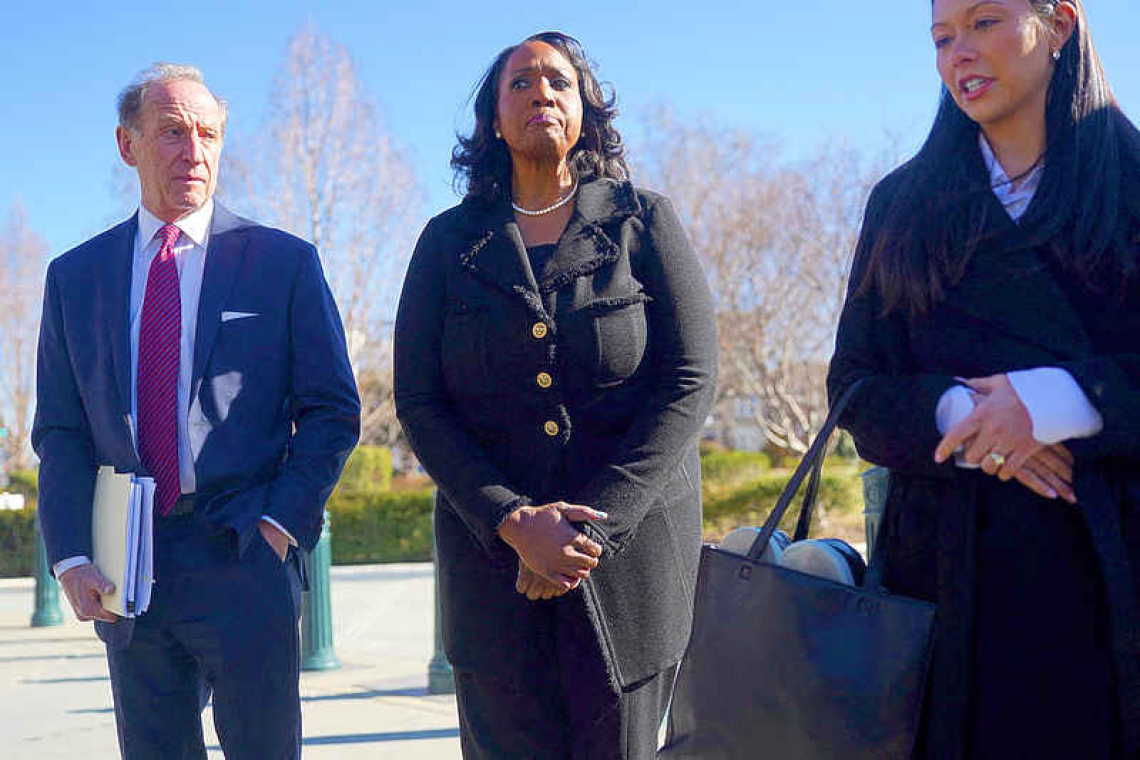
WASHINGTON--U.S. Supreme Court justices signaled skepticism on Wednesday toward President Donald Trump's unprecedented bid to fire Federal Reserve Governor Lisa Cook in a case with the central bank's independence at stake.
During about two hours of arguments, the justices indicated they are unlikely to grant the Trump administration's request to lift a judge's order barring the Republican president from immediately firing Cook while her legal challenge continues to play out. Since the Fed was created in 1913, no president has tried to oust an official from the central bank. Questions posed by the justices - conservatives and liberals alike - reflected this first-ever nature of Trump's action. They debated issues with little legal precedent to guide them, including what constitutes adequate "cause" under federal law to remove a Fed official, or what procedures are needed to ensure fairness for Cook.
The justices expressed unease about the ramifications for the Fed's cherished independence from political influence if they endorse the Trump administration's arguments that the president acted within his powers in seeking to remove Cook. Some pressed U.S. Solicitor General D. John Sauer, arguing for the administration, about why Cook was not given a chance to formally respond to the unproven mortgage fraud allegations - which she has denied - that Trump cited as justification to oust her, and the impact on the economy of a first-ever Fed firing.
"Your position that there's no judicial review, no process required, no remedy available, very low bar for cause that the president alone determines - I mean, that would weaken, if not shatter, the independence of the Federal Reserve," conservative Justice Brett Kavanaugh told Sauer.
The administration's position would create a system that gives a president incentives to come up with "trivial or inconsequential or old allegations that are very difficult to disprove," Kavanaugh added. U.S. District Judge Jia Cobb in September ruled that Trump's attempt to remove Cook without notice or a hearing likely violated her right to due process under the U.S. Constitution's Fifth Amendment. Cobb also found that the mortgage fraud allegations likely were not a sufficient cause to remove a Fed governor under the law, noting that the alleged conduct occurred before Cook held the Fed post. An appeals court declined Trump's request to put Cobb's order on hold. When the Supreme Court, which has a 6-3 conservative majority, agreed in October to hear the case, it left Cook in her job for the time being. This marks the latest case to reach the top U.S. judicial body involving Trump's expansive view of presidential powers since returning to office 12 months ago.
"This case is about whether the Federal Reserve will set key interest rates guided by evidence and independent judgment or will succumb to political pressure," Cook, who attended the arguments, said in a statement afterward. Cook has called the allegations against her a pretext to remove her over monetary policy differences as Trump heaps pressure on the central bank to cut interest rates and lashes out at Fed Chair Jerome Powell for not doing so more quickly. The administration this month opened a criminal investigation into Powell over a Fed building project. Like Cook, Powell called the move a pretext aimed at gaining influence over monetary policy. Sauer told the justices that the allegations against Cook - that she cited two different properties as a principal residence in her mortgage applications - impugn her ability to serve as a Fed governor.
"The American people should not have their interest rates determined by someone who was, at best, grossly negligent in obtaining favorable interest rates for herself," Sauer said. Conservative Chief Justice John Roberts asked Sauer to explain whether his argument that Cook should be immediately removed applies if the mortgage allegations were an "inadvertent mistake contradicted by other documents in the record." Roberts also expressed doubts about Sauer's arguments that the president's assertion of a cause is not reviewable by the courts, or that judges cannot reinstate a fired officer. In creating the Fed, Congress passed a law that included provisions meant to insulate the central bank from political interference, requiring governors to be removed by a president only "for cause," though the law does not define the term nor establish procedures for removal.
Paul Clement, the lawyer arguing for Cook, said that the Fed's unique status means that its officers must have greater protections than the Trump administration suggests. "There's no rational reason to go through all the trouble of creating this unique quasi-private entity that is exempt from everything from the (congressional) appropriations process to the civil service laws just to give it a removal restriction that is as toothless as the president imagines," Clement said.
As a Fed governor, Cook helps set U.S. monetary policy with the rest of the central bank's seven-member board and the heads of the 12 regional Fed banks. Her term in the job runs to 2038. Cook was appointed in 2022 by Democratic former President Joe Biden as the first Black woman to serve in the post. A Supreme Court ruling is expected by the end of June but could come sooner. It was unclear how narrow or broad a ruling favoring Cook might be or how the case would proceed if the justices return it to the lower courts, leaving open the possibility of the matter returning to the Supreme Court on appeal.