





~ St. Maarten’s Backyard Astronomy for June 19 - 21 ~
Sun rises at 5:37am
Sun sets at 6:50pm
Lunar phase: 1st quarter, waxing crescent
Moon rises at 11:09am, Saturday
Moon sets at 11:39pm, Saturday
This weekend, shortly after sunset, look halfway up the sky, in a southward direction for Spica, the brightest star in the constellation Virgo the Maiden. We learn new constellations by a technique called “Star Hopping” and Spica can be located by following the curve of the handle of the Big Dipper.
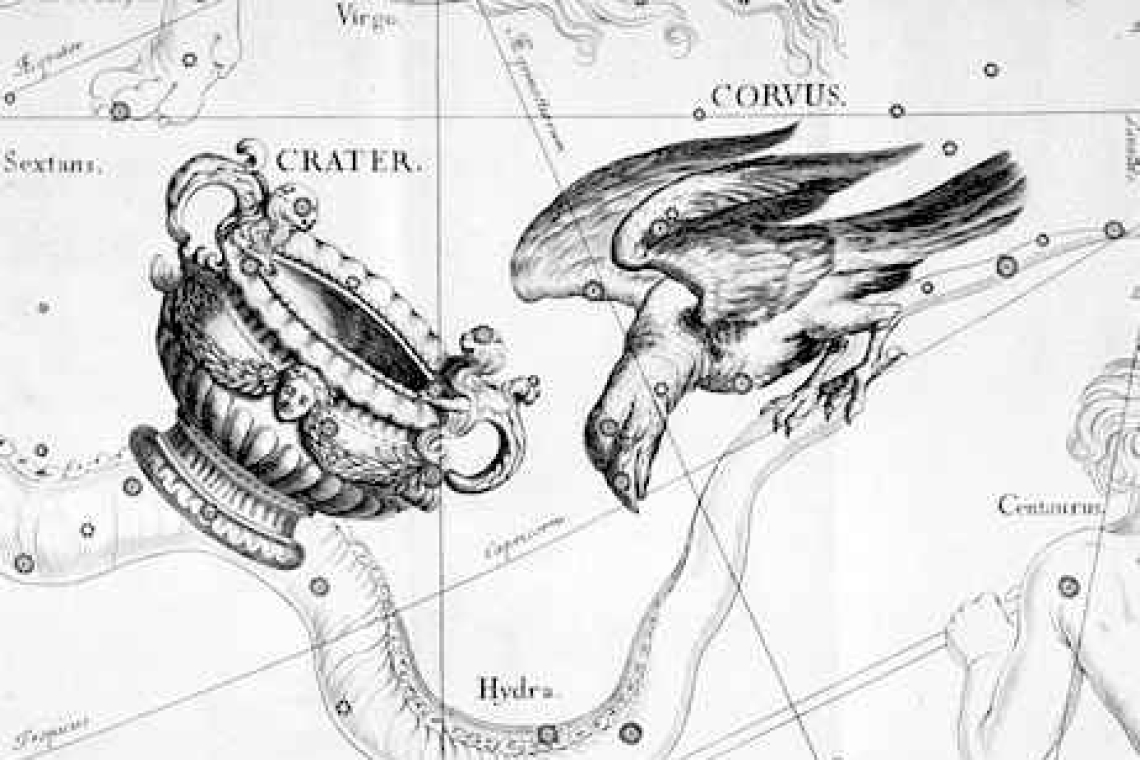
The Big Dipper is located in our Northern sky, but the curve of the dipper’s handle extends across the sky towards the brightest star in the constellation, Bootes. Arcturus is almost directly overhead for us in St. Maarten, if you look soon after sunset. Stargazers use the phrase “Arc to Arcturus and then drive straight to Spica” to help them remember the path across the sky. From Spica, you can locate three faint constellations: Corvus the Crow, Crater the Cup and Hydra the Water Snake.
As nightfall deepens into darkness, watch for a number of fainter stars to become visible. That’s when the Crow, Cup and Water Snake will come into view. These three constellations are related by the old stories of Greek mythology. The Crow, Corvus, was sent to fetch a cup of water for the god Apollo. Corvus, however, got distracted and started eating figs. Finally, he remembered his mission, but he knew Apollo would be angry, so he plucked a water snake from the river and concocted a story about how it had attacked him, causing the delay. Apollo, being a god, was not fooled at all, and so he angrily threw the Crow, Cup and Snake into the sky. Then the god ordered Hydra to never let the Crow drink from the Cup. As a further punishment, he ordered that the Crow could never sing again, only screech and caw.
Meanwhile, you can locate several planets in our night skies this weekend. Venus is dominant after sunset, very bright, hanging in the western sky. But if you are attentive, you can locate Mercury below Venus, near the horizon. Mercury is quite faint and always stays fairly close to the sun, so it’s only visible when the sun is below the horizon, either before sunrise, or in the case of this weekend, after sunset. Jupiter is also visible below Venus, but just above Mercury. Mars and Saturn are visible in the eastern sky in the early morning hours, Saturn rises about 1:30am while Mars rises about 3:30am.
Thank you for keeping up with the Night Sky articles, backyard (or beach) astronomy designed for St. Maarten sky viewing. FYI: If you are out later on in the week, note that each star rises about four minutes earlier each day than written here, and the moon rises 50 minutes later. Night Sky is researched and compiled by Lisa Davis-Burnett. Earthsky.org is a key resource for information and images. Questions or comments? Email This email address is being protected from spambots. You need JavaScript enabled to view it.



