




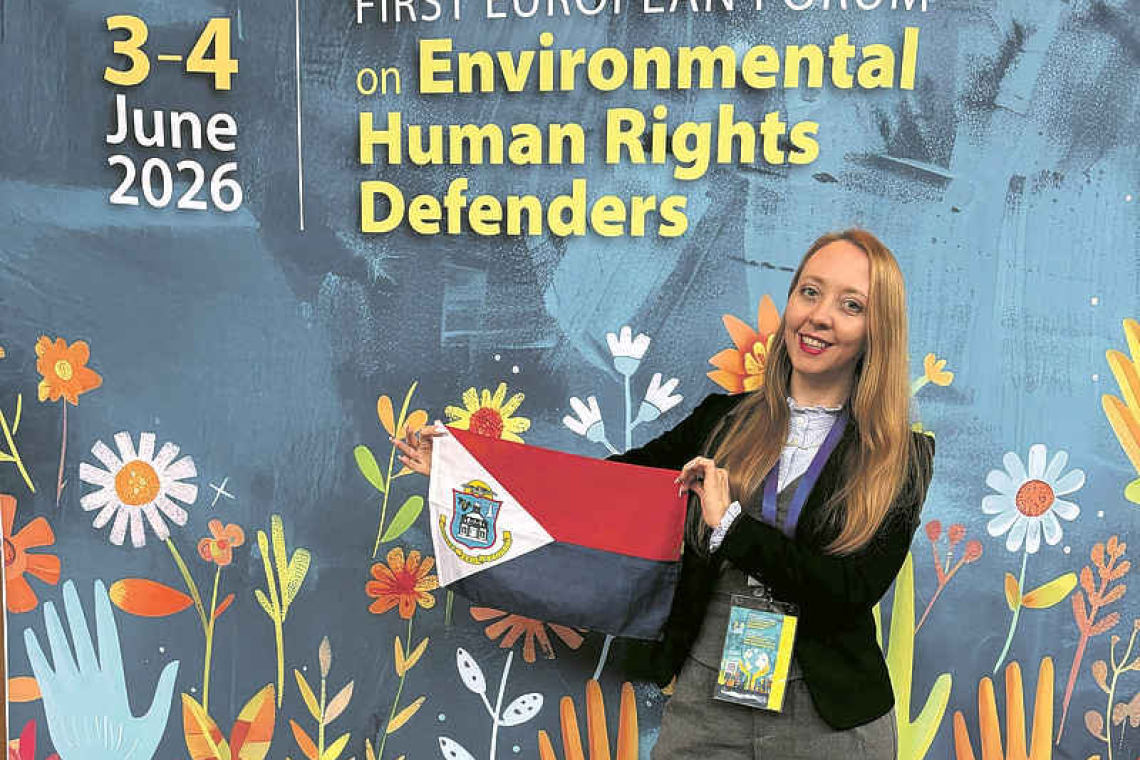
Deedee Johnson has been traveling back and forth between Sint Maarten, the Netherlands, and other countries for work, knowledge and networking over the past eight months. Earlier this month, she participated in a conference which was the first of its kind – this was the First Forum for European Environmental Human Rights Defenders at the Council of Europe in Strasbourg, France.
Graduating in 2024 with a Master of Laws in Public International Law, specializing in oceans, the environment and sustainability and a Master of Science in Environment and Resource Management, specialising in energy and climate, Deedee shared the story of her life-changing, study-abroad experience with The Weekender around a year and a half ago, shortly after having pursued her two Master’s degrees concurrently. She has made a point in remaining audacious when it comes to her career path.
Deedee first took a break, and focused on her wellbeing, traveling, and doing remote work with local environmental NGOs on the island. She then started her own legal and environmental consultancy firm in the Netherlands last year, and began consulting for the NRPB (National Recovery Program Bureau) as an Environmental Specialist.
At the NRPB, she is able to not only utilize both her Master’s degrees, but also contribute to two of the biggest infrastructural projects on Sint Maarten, namely, the Landfill Management and Wastewater Management Projects.
She tells us about her experience taking part in the conference.
Tell me about the forum. Why and how did you apply to go?
I came across the ad for the Forum via LinkedIn and applied. The opportunity felt kismet, as I often delve into the relationship between environmental challenges and human rights in my research, and I continue to work very closely with local environmental NGOs on Sint Maarten. To my surprise, I received an email with an invitation and full funding to attend a few weeks later!
When I applied, I did so as a member of “civil society” and as an Environmental Human Rights Defender (EHRD). While the forum was meant for “European” EHRDs, I argued in my application that the Dutch Caribbean is part of the Kingdom of the Netherlands, which is also part of Europe, and despite this, we are often forgotten and underrepresented in such events.
Although we have one of the most critical environments in the world, and our survival depends on its health; environmental and human rights protection mechanisms implemented by the Netherlands and/or at the EU level do not always extend to us. I further argued that having an opportunity to be part of such a forum would shed light on the importance of our European partner working with us to combat such challenges and ensuring that our islands and our people are protected.
What did you hope to learn or gain from the experience? Did it live up to these expectations?
I hoped to network and contribute to this forum in a meaningful way, to show that small island nations are only small in geographical size, but not in the way we show up in the world!
The forum was amazing! I met many people, including lawyers, UN Rapporteurs, government representatives, NGOs, and members of indigenous groups, including the only recognized group in the EU, the Sámi. I also met a lady who was born in French Guyana and grew up in Martinique. We were so excited to learn that we were both from the Caribbean, as we were two out of only three who attended!
During the two days, I was also able to contribute in a meaningful way by assisting in developing key messages that were delivered to the 46 Member States of the Council of Europe and other stakeholders. These messages are regarding the right to a healthy environment, corporate harm (including the dire need for binding legislation on Environmental Impact Assessments (EIAs)), as well as criminalization and Strategic Lawsuits Against Public Participation (SLAPPs) inflicted upon EHRDs.
With my legal (and environmental) knowledge, I played a key role in assisting in writing the final language of one of these messages. I also discussed ongoing environmental, legal and governmental challenges faced in Sint Maarten and on our sister islands.
I highlighted the need for a de-colonial approach in developing a binding legal framework on the right to a healthy environment, and proposed anchoring such a framework within an existing instrument like the European Convention on Human Rights (ECHR).
On the last day, a large group of us enjoyed dinner hosted by one of the sponsoring NGOs, at which we also brainstormed how to further strengthen the ongoing campaign for the Right to a Healthy Environment at the Council of Europe.
What do you think are the opportunities or challenges in trying to apply global lessons / guidelines in St. Maarten?
Opportunity-wise, we must recognize that Sint Maarten is small enough to make changes faster than larger nations and smart enough to cherry-pick what works. The challenge is that our complexity, including our history, constitutional set-up, demographics, lack of capacity, and singular economic structure, requires significant adaptation of either global frameworks or our own system through legislative reform, with the latter being most feasible.
After a decade in the field of international law, I have learned that every country has its unique context and challenges. There is no one size fits all, nor should that be the goal.
“Global solutions” have often been homogeneous in nature and overlook localized needs like ours. However, when minority nations do advocate for their needs, we see attempts at developing more balanced approaches where the differentiation of nations is considered.
To strengthen this advocacy, we need to be represented more often at international events hosted by institutions such as the Council of Europe or the United Nations, as only then can our voices form part of the development of more balanced “global solutions”. We cannot continue to feel small, simply follow larger countries, or even piggy-back on other small island nations as their context and needs also differ from ours.
Anything else you’d like to add?
I would like to add that it will be my goal to ensure that Sint Maarten is better represented abroad and our voices contribute to evolving global solutions to be less euro-centric and more inclusive by highlighting the need for a de-colonial approach and attaining more balance through differentiation.