





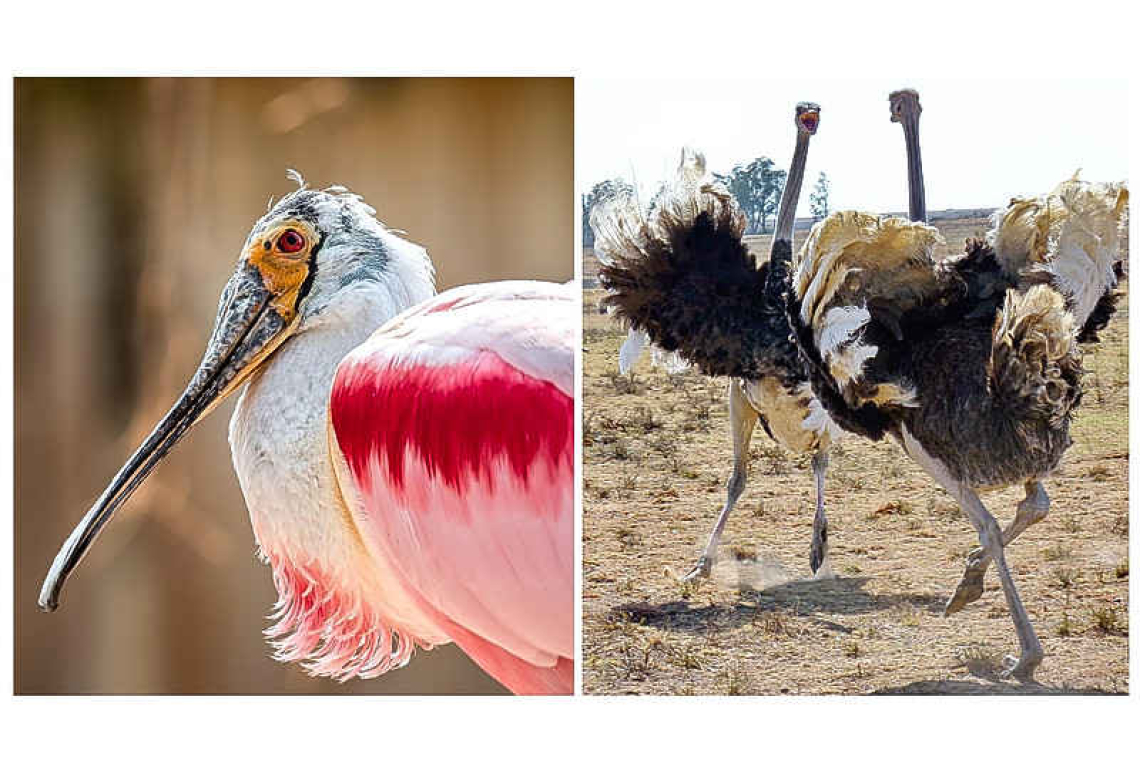
Ever notice that there are so many different birds around us? We see them gliding through the sky, perching in trees, or looking for food in the yard. These winged creatures come in all sorts of shapes and sizes, some with brightly coloured feathers or the ability to make distinct sounds. Pay attention and you might see them sipping on nectar, building nests, or snatching a lizard snack. Around the world, there are more than 11,000 species of birds, and they all have feathers – the defining feature that distinguishes them from all other animals. Here are some fun facts about our feathered friends.
- The ability to fly, means that birds can be found pretty much everywhere on earth. They are diverse, having adapted to all sorts of environments.
- While all birds have wings, there are a few species that cannot fly. These include ostriches and emus which are very large, and penguins that can use their wings just like paddles when swimming underwater.
- Many birds that can fly, can also swim and dive very well. For example, St. Maarten’s national bird, the Brown Pelican, can dive into the water from incredible heights in order to catch fish.
- The few species of birds that cannot fly, descended from birds that could fly: they all share a common flying ancestor. Many flightless birds belong to families that include other bird species that can fly.
- Birds that have lost the power of flight, also lose the limit of the maximum size that they can grow to. The largest living bird is the ostrich. An ostrich can stand up to 2.75 metres (9 feet) tall and weigh 150 kg (330 pounds).
- The smallest bird is found here in the Caribbean, the bee hummingbird in Cuba. It’s just 6.3 cm (2.5 inches) long and weighs less than 3 grams (about 0.1 ounce).
- The largest known flying bird ever, by far, was the Teratornis incredibilis. It looked similar to a condor which lives today. Its wingspan was an incredible 5 metres (16.5 feet). The biggest wingspan of a bird alive today is 3.5 metres (11.5 feet). The Teratornis incredibilis lived during the Pleistocene Epoch: 2.6 million to 11,700 years ago.
- Thanks to fossil remains, more than 1,000 extinct species of birds have been identified.
- Birds have very good vision, relying on it for most information about their environment. In general, their senses of smell and hearing are not quite as good. However, many nocturnal birds (those that are active at night) do have very good hearing, and that helps them to navigate and hunt in the dark. An owl, for example, can hear a tiny mouse moving on the ground from very far away, then hunt it in total darkness.
- The shape of a bird’s beak can tell you something about what type of food it eats. Meat-eating birds have sharp hooks on their beaks. Fruit-eating birds like toucans have large beaks that let them grab fruit and break through its outer skin. A pelican’s bill holds a large fold of skin that is used like a net to catch fish along with a big gulp of water. Birds that feed on nectar tend to have long and fine bills with a little downward curve, that allow them to collect the nectar from the base of a flower. There are may more shapes, and they all serve a specific purpose.
- Have you ever eaten a chicken gizzard? Wonder what a gizzard is? It’s a small muscular organ in birds (and some other animals) that grinds up food. It forms part of the bird’s stomach. Gizzards are needed to break down food, usually swallowed whole, since birds can’t chew food like we do (with our teeth).
- It seems that people have always been interested in birds. They feature prominently in stories and art created by many ancient societies, from the Ancient Egyptians to Pacific Islanders, to prehistoric humans in France.
- In different societies throughout history, birds have symbolically represented many things, for example power and prestige, peace and friendship, prophecies or omens, wisdom, and reminders of death. They were also sometimes seen as messengers.
- Pigeons have been bred and trained to carry messages, especially during times of war. This took place in the World Wars, and even back as far as wartime in the Roman era.
- Bird migration is one of the wonders of the natural world. Around 20% of birds migrate, at special times of the year, some of them travelling thousands of miles, even crossing oceans and deserts. They do this to survive, breed, and access resources, especially food.
- Feathers are not just beautiful, but their structures are complex. They enable birds to fly and also serve other purposes such as keeping in heat and repelling water. Some long-extinct dinosaurs that walked the earth had feathers. They did not survive the end of the Cretaceous Period (millions of years ago), but birds did. The complex and incredible designs of feathers are the products of hundreds of millions of years of evolution.