





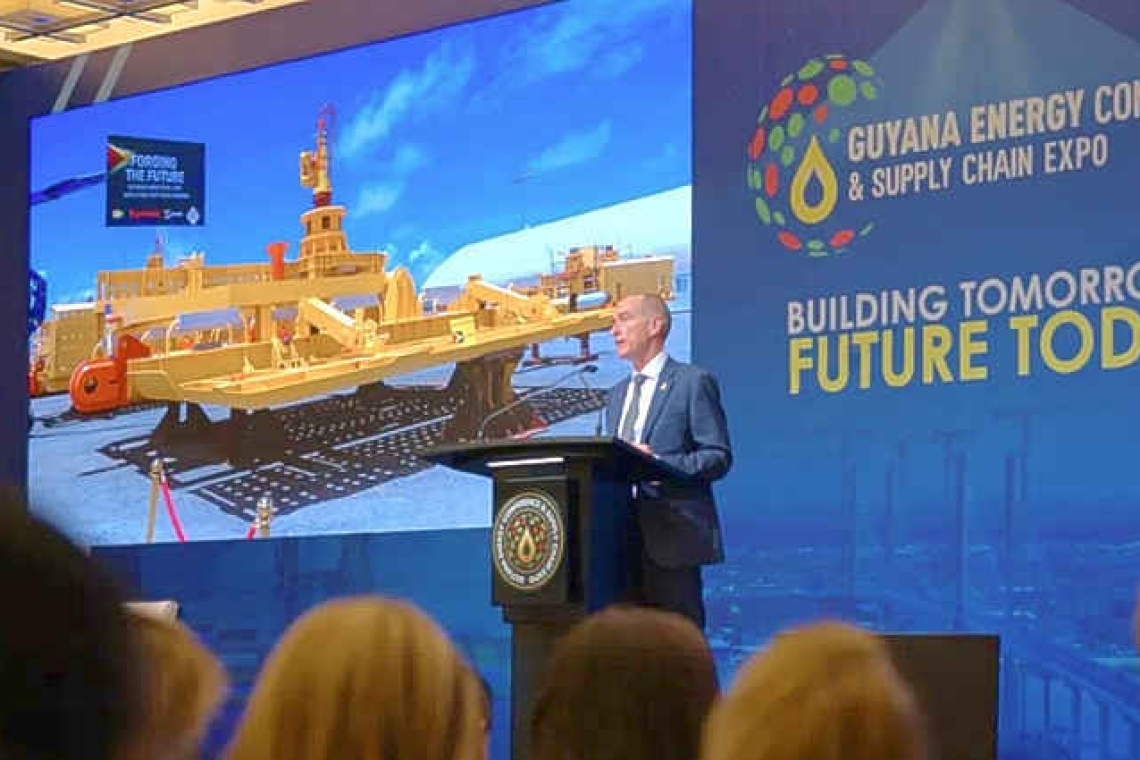
President of ExxonMobil Guyana, Alistair Routledge at the 2026 Guyana Energy Conference and Supply Chain Expo.
GEORGETOWN, Guyana--With interest pouring in from across the world to utilize Guyana’s gas, ExxonMobil is eager to lay a second pipeline from the Stabroek Block to Berbice, a structure that can cost Guyanese over US$2B.
This was revealed by President of ExxonMobil Guyana Limited (EMGL), Alistair Routledge during a media conference last week.
He told reporters that both the government and Exxon have been receiving letters from companies around the world that are interested in using Guyana’s gas to develop projects such as data centers, converting bauxite to alumina and more power generation.
Given the significant interest, Routledge explained that large gas resources will be required to supply and sustain these developments.
He said, “So we can see real interest in building a domestic gas market, which in the early stages will require us to have some large anchor projects, and when I say that, an anchor project, these are projects that are large enough to give us the demand needed from an offshore gas supply point of view to make it worthwhile investing in significant infrastructure.”
The company however indicated that such pipeline will require not come at a “small investment” but can cost US$2B or more, which is twice as much spent on the 225-kilometer pipeline from the Liza Fields to Wales, West Bank Demerara. That pipeline, constructed and completed by Exxon since 2024 will support the Gas-to-Energy (GTE) project in Wales which aims to produce 300 MW of electricity in this first phase. A second phase could see another 300MW of power being added along with other facilities to produce Natural Gas Liquids (NGL). Government has already invited bids for a cooking gas and fertilizer plant.
The second pipeline according to Routledge will be larger in size. Considering inflation over the years as well, he pointed out that there is no hope in the structure costing US$1B.
As such, the Country Manager noted, “So, as you know, it costs roughly a billion dollars to lay a pipeline and put the rises in, in order to supply gas from the Liza field to Wales in Region 3. To do similar for Berbice in larger volumes, a larger pipeline could easily be US$2 billion or more.”
Before making such an investment, Exxon said it is ensuring that there is a market for the gas which can be sold at a price to ensure its feasibility.
To this end, he explained, “So that’s why it’s so important that we work with these other companies- their interest in making these other investments in the country. So, we can line out that commercial value chain, they’ll be looking to us to have surety of supply of gas, and we’ll be looking to them to make sure that they’re gonna be ready to take the gas from us.”
The company has not yet worked out details surrounding the size of pipeline that would be constructed as discussions are ongoing with Suriname. “There was some engagement with
Suriname around would they be interested to share a pipeline because it could be economies of scale to do that and that discussion is ongoing,” the EMGL President noted.
Routledge added that since gas development would be new to the Berbice area, Exxon will be engaging communities and businesses.
Once operational, he pointed out that potential exists for other small industries such as glass manufacturing or a small manufacturing plant that does not require much gas. These investments according to him would be more efficient for Guyana compared with importing liquid fuels.
Gas from the seventh and eight oil projects- Hammerhead and Longtail, respectively- could be used to supply the pipeline. Hammerhead could deliver around 80-90 million cubic feet of gas per day. Meanwhile, Longtail, which is currently under review by government, has a gas production capacity of 1,200 million standard cubic feet per day (MMscf/day). ~Kaieteur News~