





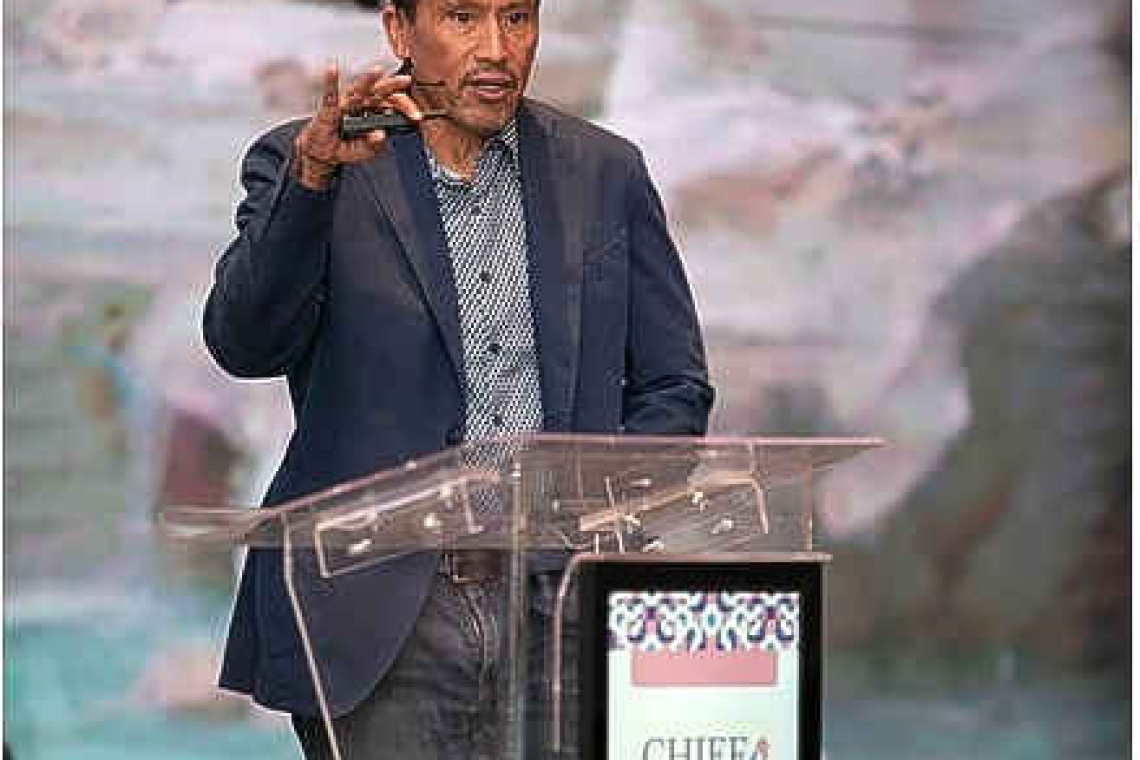
Keynote speaker Bruce Poon Tip addresses delegates at the CHIEF 2026 opening ceremony.
BRIDGETOWN, Barbados--At the Caribbean Hotel and Tourism Association's (CHTA) 2026 Caribbean Hospitality Industry Exchange Forum (CHIEF), keynote speaker Bruce Poon Tip, founder of G Adventures, challenged the region's tourism leaders to design tourism so more of its value reaches the people who live in each destination, an opportunity he placed at the center of the industry's future. Poon Tip spoke at the forum's opening celebration at Wyndham Grand Barbados Sam Lord's Castle All-Inclusive Resort.
Poon Tip was born in Trinidad, moved to Canada as a young child, and has lived in Barbados since 2021. He founded G Adventures in 1990 at age 22 and built it around community tourism. The company now welcomes travellers from 160 countries on more than 1,000 itineraries a year, and Poon Tip said its partnership with National Geographic came about because the two organizations share the same values.
Poon Tip traced how much of the industry grew around capacity and amenities, from cruise ships that once carried about 1,300 passengers and now carry 6,000 or more to hotels designed to look the same everywhere. When the experience no longer depends on the destination, he said, local cultures and communities lose their place in it, and popular places such as Barcelona, Venice, and Machu Picchu struggle with overtourism. G Adventures built its model on the destination itself. Its first brochure told travellers, “If you want the comforts of home, stay at home.” In Poon Tip’s view, the destination should be relevant, and travelers should come to take part in local culture.
That approach matters most in the places that depend on tourism. Citing the United Nations Environment Programme, Poon Tip noted that of every $100 a traveler from a developed country spends on a vacation in a developing country, only around $5 to $10 stays within the local economy.
Every trip creates a value chain, Poon Tip explained, and the hotel, transportation, meals, and local operators a traveller chooses can each change lives. He shared examples from G Adventures’ own trips. In Hoi An, Vietnam, the Oodles of Noodles program with STREETS International turns a lunch stop for about 18,000 travellers a year into an 18-month culinary training program for former street youth, and Poon Tip said every graduate goes on to work in food and beverage. On Caye Caulker, Belize, Bikes with Purpose gives young people paid work as cycling guides as long as they stay in school, and school enrolment on the island rose to 90 percent within 18 months. In India, Women on Wheels trains women from shelters for 18 months, then provides each graduate with a car and work handling G Adventures’ airport transfers. “That one service of being picked up at the airport can change the lives, future, and the fortunes of communities and people,” he said.
“Bruce Poon Tip reminded us of the responsibility and the opportunity we share,” said CHTA President Sanovnik Destang. “Tourism’s impact reaches well beyond our hotels to our farmers, fishermen, taxi operators, entertainers, and entrepreneurs. The Caribbean can keep far more of every $100 at home, and our objective is to ensure that more Caribbean people and businesses grow with tourism. CHTA is already advancing this agenda through its work to develop a domestic capture rate to measure how much of each tourism dollar remains in Caribbean economies and its collaboration with Florida International University on a regional tourism demand study to identify opportunities for local and regional suppliers.”
Poon Tip also described how G Adventures measures its impact. Each trip carries a Ripple Score, the percentage of trip spending that stays in the local economy, based on suppliers that are locally owned and managed and staffed by people who live within 50 kilometers. Through its Trees for Days program, the company plants a food-bearing tree in a community in need for every day a traveller spends on a trip, with more than 6.5 million planted in three years. Planeterra, the nonprofit foundation Poon Tip established, is building 300 new community projects through Project 300 to bring people living in extreme poverty into the tourism economy.
Traveller expectations are shifting as well. Many travellers live by their values at home and set them aside on vacation, Poon Tip said, and he sees younger generations closing that gap. “As people match their values to their travel decisions, that’s when things change,” he said. Social media has turned marketing into a two-way conversation, he added, and the brands that endure are the ones that make people’s lives better and build community.
Poon Tip closed on an optimistic note. World Bank figures show the number of people living in extreme poverty fell from about 2.3 billion in 1990 to about 831 million in 2025, and he sees travel as a force to continue that progress because it brings visitors and their spending to many of the world’s developing destinations. “Travel can be one of the most transformational industries in the world,” he said, adding that it takes only a small change in business models.
CHIEF 2026 took place alongside Taste of the Caribbean from November 16 to 18 under the theme “Caribbean Tourism 2030: Resilient, Regenerative, Ready.”
CHIEF Partners
CHTA thanks its partners for their support of CHIEF 2026, including host hotel Wyndham Grand Barbados Sam Lord’s Castle All-Inclusive Resort. Platinum partners were ABA Global Marketing, Alliants, GAIN Advisors, Interval International, Maestro PMS Solutions, Mastercard, Miles Partnership, and Silverware. Gold partners were MyBookingRewards.com and taConnect. Supporting partners were Amadeus, Carnival Corporation, Courts Business Solutions, Lighthouse, Monday.com, Reefstarter, Revinate, and SecureWorld Corp. Airline partners were interCaribbean Airways and Winair, and media partners were Breaking Travel News and Caribbean Journal.
For more information on CHTA, visit www.CaribbeanHotelandTourism.com.