





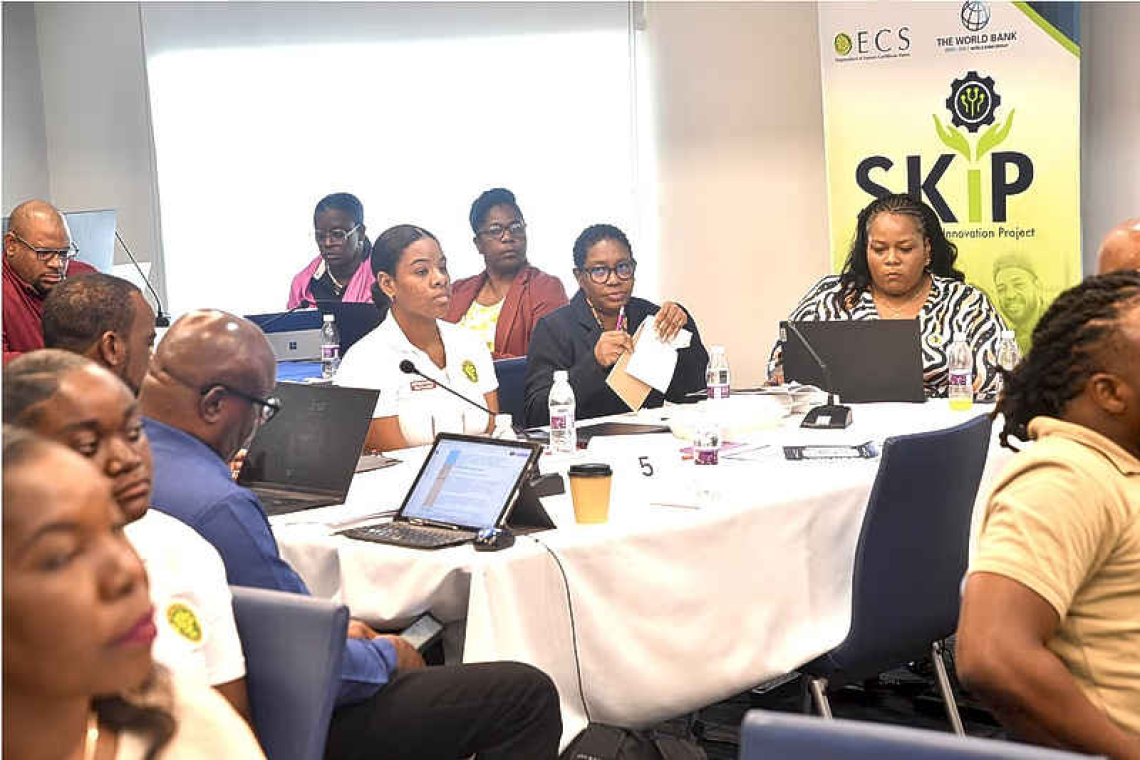
A scene during the workshop.
~Ten-year plan aims to improve regional access, skills and coordination~
CASTRIES, St. Lucia--The Organisation of Eastern Caribbean States (OECS) has validated a regional strategic framework aimed at strengthening and coordinating post-secondary education across its Member States.
The framework was endorsed during a Regional Strategic Framework and Gap Analysis Validation Workshop held on October 28 and 29, 2026. The event brought together regional post-secondary education leaders, accreditation officials, private sector representatives, disaster management agencies, technical experts and student leaders.
The workshop validated two key deliverables under Component 1 of the World Bank-funded OECS Skills and Innovation Project (SKIP): a revised assessment report on the post-secondary sector, including a comprehensive gap analysis, and the Regional Strategic Framework (RSF), supported by a 10-year operational plan, sub-operational plans and a monitoring and evaluation framework.
The initiative seeks to improve regional collaboration, quality assurance, innovation, workforce alignment and equitable access to post-secondary education, guided by the vision “Every Learner Succeeds”.
Speaking at the opening ceremony, Director of the OECS Commission’s Human and Social Division Sisera Simon said that improving learners’ educational journeys was central to regional integration. She noted that cooperation among island states could create opportunities that individual countries, with their limited resources, might not be able to provide independently.
The sector assessment provides an evaluation of post-secondary education across OECS Member States, examining institutional structures, governance models, accreditation frameworks and cost barriers. The regional approach is intended to reduce duplication and make better use of shared resources.
Among the framework’s key priorities are the development of Regional Centres of Excellence to share specialised technical expertise and resources across islands, and the alignment of technical and vocational education and training (TVET) and tertiary curricula with sectors facing high demand for skilled workers.
These include technology, innovation, climate resilience and skilled trades.
The framework also seeks to improve the recognition and portability of qualifications, including the Caribbean Vocational Qualification (CVQ), to support the movement of students and workers across Member States.
A further priority is the development of an integrated digital learning system, incorporating a shared Virtual Campus, a Knowledge, Technology and Innovation Platform (KTIP) and a regional Education Management Information System (EMIS).
OECS SKIP Project Manager Francillia Solomon said participants were asked to review the proposed reports and contribute their experience and recommendations to make the findings more practical and easier to implement in the short to medium term.
Following the workshop, technical feedback, agreed revisions and recommendations were compiled in a Master Validation Matrix. The matrix has been submitted to the Regional Project Steering Committee for final project-level validation and to guide the next steps towards regional implementation.