





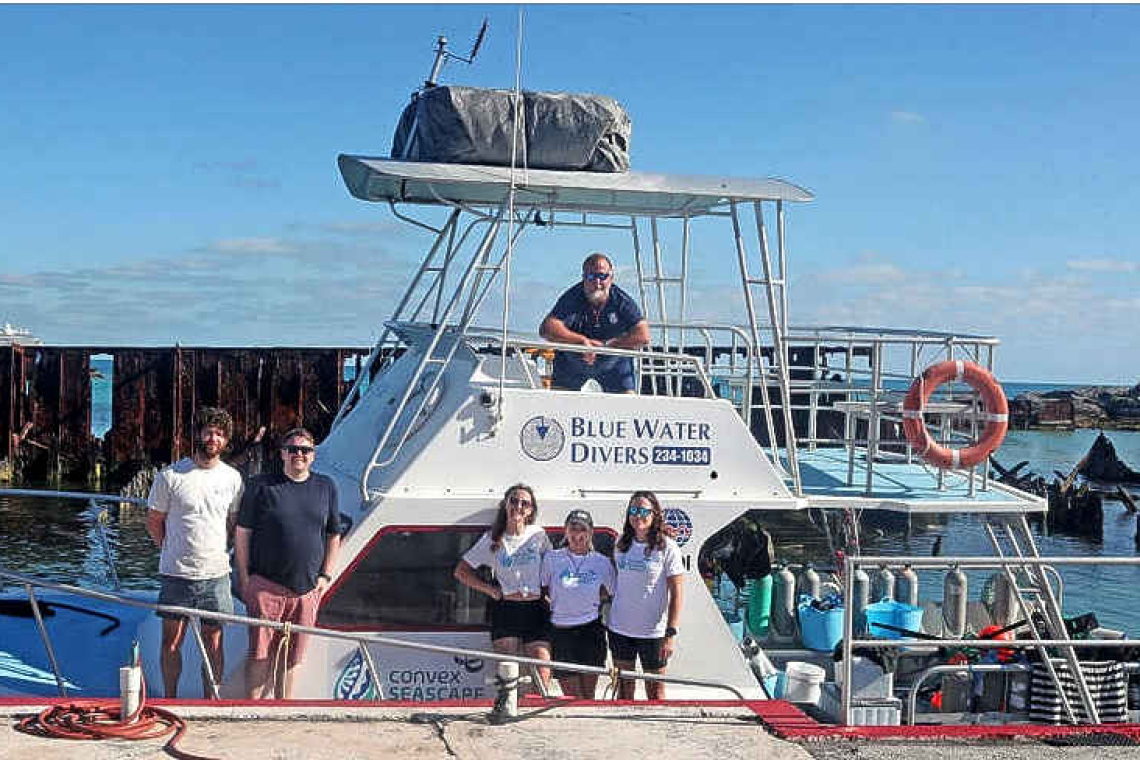
On the water: The Royal Gazette spends the day out on the water with scientists and doctoral students involved in the Convex Seascape Survey (Photograph by Blaire Simmons)
HAMILTON, Bermuda--An ambitious global study of the ocean seabed’s contribution to climate change mitigation through carbon capture has made its way to Bermuda, the source of the project’s $15 million budget.
The five-year Convex Seascape Survey has enlisted a team of more than 100 scientists who have been visiting locations around the world collecting sediment from the sea floor for analysis.
Its research could provide crucial data, lacking at present, to make a case for restrictions around destructive fishing practices such as bottom trawling and other human activities that kick up the sediment resulting in the carbon being released back into the atmosphere contributing to climate change.
The Convex team said as such, there is an “urgent” need to collaborate and build scientific consensus that leads to informed policies regarding sediment habitats.
Unlike seagrass, salt marsh and mangroves, marine sediment is not recognised by global policy frameworks as a habitat for blue carbon – organic carbon captured and stored by the ocean.
The Convex survey studies the importance of the ocean in the global carbon cycle, the historical impact and spread of human influences on the seabed, and the role of life and biodiversity on seascape carbon stores.
Backed by Bermudian-headquartered speciality reinsurer Convex Group, founded by Stephen Catlin, the science is being led by one of the world’s leading marine scientists, Callum Roberts, Professor of Marine Conservation in the Centre for Ecology and Conservation at the University of Exeter, in England.
The Royal Gazette was invited to spend a morning on the water with some of the scientists who were in Bermuda including Ben Harris, the postdoctoral research fellow for the project.
Dr. Harris, who identified locations appropriate for the project criteria and created sampling methodologies, explained that the study is focused on areas within the world’s continental shelves which accumulate mud containing organic carbon.
These relatively shallow areas, which extend to about 200 miles off shore, are most affected by human activity, not least bottom trawling – an industrial fishing method that scrapes up the sea floor.
“We have been interested in these areas as they accumulate a lot of mud that has a lot of organic carbon content,” Dr. Harris explained.
“Over time as it settles into the seabed, it gets stored. That is essentially a way of sequestering carbon from the atmosphere into the seabed.
“The trouble is, when we come through with building infrastructure or bottom trawls, it kicks it back into the water column and, through a microbial process, that organic carbon can get released into the atmosphere.
“The challenge right now is climate change and a lot of that is driven by rising Co2 levels.”
Dr. Harris said the continental shelf covers about 27 million square kilometres, equal to about 7 per cent of the surface area of the oceans. The study seeks to discover how much carbon is there, how long has it been there and what the historical impact of humans is on that store.
He added: “We are looking at areas that are heavily impacted by trawling but also areas that have been protected for some time so we can compare and contrast.
“I’m also interested in the ecology – when you come in with a trawler, you rip all the stuff that is living in the seabed. What role does that play in this cycle? If you destroy the ecology, will that have an impact on the carbon as well?
“We think the organisms are also contributing to the carbon burial.”
The project collects samples in plastic cores showing the organic carbon make up, in some cases over millennia.
Study locations span from the tropics to the poles including Scotland and Jersey, Canada, New Zealand, Australia, Patagonia, South Africa and the Antarctic.
While these locations are on the continental shelf, Bermuda is the exception as an oceanic environment.
Dr. Harris explained: “We wanted to have one site to compare and contrast all that continental muddy environment; a different place to have that reference point.”
Dr. Roberts said that most fishing catch – about 95 per cent – comes from shallow coastal seas and that nearly all seabed disturbance is in those shallow seas.
“Some of the carbon gets sequestered in the sediment and there it should stay, and would if it were not for people stirring it up,” he said.
“The carbon stored in the seabed is important in keeping the atmosphere and climate change in check.”
Dr. Harris said the study presents an opportunity to make a significant contribution to mitigating climate change impact.
“If the ocean is storing as much carbon as we think it is, and we are disturbing that carbon as much as we think we might be, then that gives us a massive opportunity to reduce that impact over time,” he said.
“We can create large marine protected areas based on carbon. It is globally relevant.
“In Europe we have loads of MPAs but most are trawled. We are asking, what is an MPA if it is trawled?”
He explained that Bermuda does not have bottom trawling in its waters.
Once the science is completed, Dr. Harris said project partner the Blue Marine Foundation will take the open-source data and use it to ensure that informed decisions are made going forward on sustainable ocean use. ~The Royal Gazette~