





moham
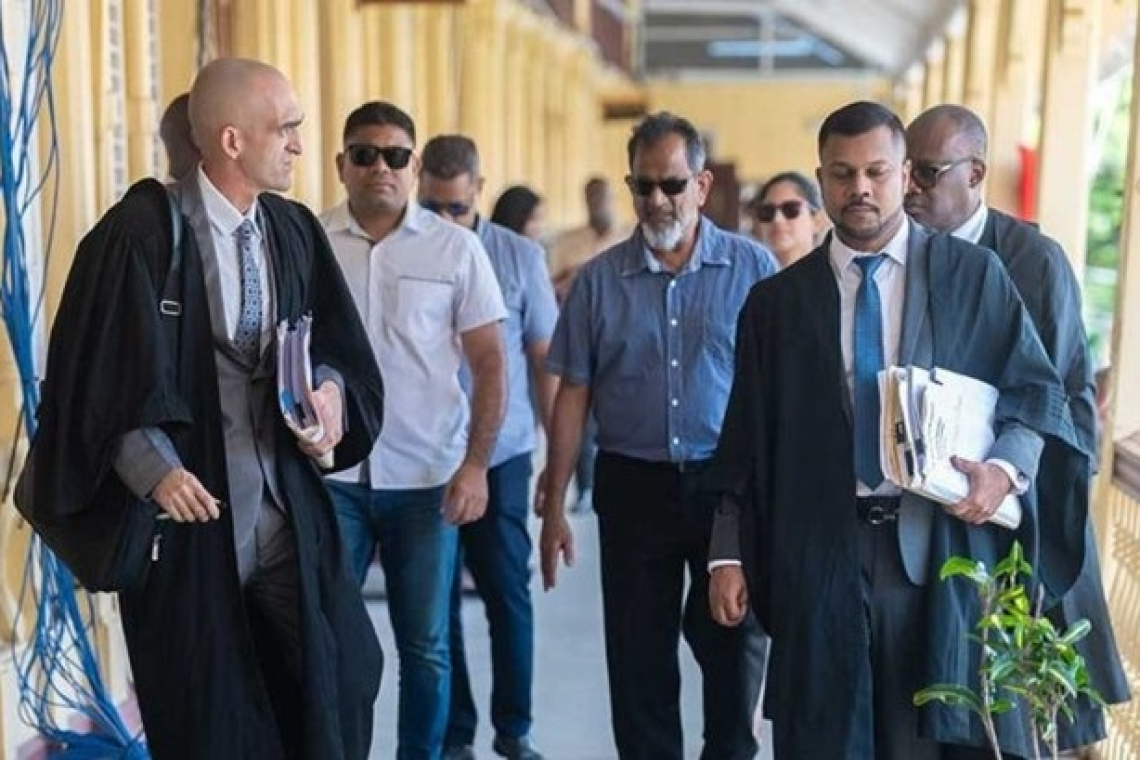
Nazar and Azruddin Mohamed leaving the High Court in Demerara accompanied by their legal team following the refusal of their application to stay extradition proceedings (Delano Williams photo)
GEORGETOWN, Guyana--A judicial review to Guyana’s extradition process unfolded in the High Court on Wednesday, placing senior Trinidadian attorney Douglas Mendes, SC, and the Attorney General’s Chambers at the centre of a legal debate over bias, politics and the limits of ministerial power.
US-indicted businessmen Azruddin Mohamed and his father, Nazar Mohamed, both of whom were present in court, are contesting the issuance of the Authority to Proceed, issued by the Minister of Home Affairs, under the Fugitive Offenders Act in 2009, under which they face extradition to the United States.
In a separate filing, they are also challenging the constitutionality of amendments to the Act.
The proceedings are being heard before acting Chief Justice Navindra Singh, who said the matter under judicial review deals with “very narrow issues” though lawyers spent almost the entire day making oral presentations on the matter.
The Mohameds, represented by Attorneys Roysdale Forde, Siand Dhurjon and others, argue that the process leading to the issuance of the Authority to Proceed (ATP) for their extradition was tainted by political bias involving both the Minister of Home Affairs, Oneidge Walrond (first respondent), and the Attorney General (second respondent).
Opening submissions for the applicants, Dhurjon said the issues strike at the heart of constitutional fairness. He argued that bias in the case is two-fold, affecting both the Minister of Home Affairs and the Attorney General.
According to Dhurjon, the minister was closely associated with a political body that acted as a pressure group, publicly portraying the Mohameds as criminals guilty of extraditable offences long before the ATP was issued.
Dhurjon cited approximately 15 public statements made between June and August 2025 by political leaders – including the President, Vice President and the Attorney General – asserting that the State had evidence supporting sanctions against the Mohameds. These statements, he said, were made while local investigations into alleged tax evasion and gold smuggling were still ongoing.
“The timing is critical,” Dhurjon argued, noting that the ATP was issued in October, shortly after the public pronouncements. He submitted that although the minister was not named in the US indictment, her political alignment and role in initiating the extradition process rendered her “akin to a prosecutor.”
Dhurjon further contended that about 90% of the alleged criminal conduct occurred in Guyana rather than the United States, which, he argued, should bar extradition under the law. He also maintained that the minister failed to demonstrate that she had put prejudicial political statements “out of her mind” when issuing the ATP, stressing that bias may be unconscious.
Turning to the Attorney General, Dhurjon tendered three public statements which he said demonstrated bias. He accused the AG of assisting in the issuance of the ATP while remaining silent about his role, and criticised the AG’s affidavit in reply as speculative and dismissive, characterising the statements merely as political rhetoric.
Responding for the Minister of Home Affairs, Senior Counsel Douglas Mendes, appearing with Clay Hackett, rejected the bias allegations and urged the court to dismiss the application.
Mendes acknowledged that the minister was aware of public political statements but argued that uncertainty about which statements were being referenced did not translate into dishonesty or ignorance. More fundamentally, he submitted that the rule against bias does not apply to the minister’s decision to issue an ATP.
“Our case,” Mendes told the court, “is that the decision being challenged is not judicial or quasi-judicial in nature.”
He argued that the minister’s role under the extradition framework is inherently political, arising from Guyana’s international treaty obligations. The issuance of an ATP, he said, merely initiates a process and does not determine guilt, extraditability, or the final outcome.
According to Mendes, the extradition process moves through the magistrate’s court, the High Court, the Court of Appeal and potentially the Caribbean Court of Justice, before returning to the minister, who then considers statutory prohibitions before making a final decision.
“She makes no binding decision at this stage,” Mendes argued. “Her decision is far removed from the outcome.”
He further contended that the applicants waived any right to object on grounds of bias by engaging with the minister during the extradition process without raising objections at the time.
On the issue of delegation, Mendes questioned to whom such a decision could realistically be delegated, stressing that extradition decisions must be taken within the executive.
“The authorities cited by the applicants all concern judges or adjudicators,” he said. “The minister is none of those.” Appearing for the Attorney General’s Chambers were Solicitor General Nigel Hawke, Darshan Ramdhani, KC, and Attorney General Anil Nandlall, SC. Senior Counsel Goosai appeared for the third-named respondent, the magistrate.
In substantive oral submissions, Nandlall described the proceedings as premature, an abuse of process, and devoid of merit.
He argued that extradition is an executive, government-to-government process and that the law does not permit the disruption or fragmentation of that process through satellite litigation.
While judicial review is allowed, Nandlall said it does not permit the waste or duplicative use of judicial resources. Quoting case law, he submitted that the policy of the law is to avoid entertaining prior challenges and instead allow the committal proceedings to conclude before any constitutional challenge is mounted.
“These applicants want to take this matter all the way to the CCJ in a plan that could last five years,” Nandlall argued. “Your Honour has evidence before you to that effect.”
He warned against allowing satellite litigation to derail the main extradition proceedings, leaving them “stillborn.” Nandlall said the applicants’ case is fundamentally premised on the argument that the government cannot extradite them because they are political opponents of the administration.
“If that is extradition law,” he argued, “then politics becomes a safe haven for fugitive offenders.” According to Nandlall, the Mohameds entered politics knowing extradition was coming, criticised the government, and the government responded as politicians typically do – by making statements to explain matters, including sanctions, to the voting public.
“Respectfully, those matters have nothing to do with the minister’s ability to issue an ATP,” he said, adding that there is no allegation that the minister breached the statute.
He stressed that bias is a concept rooted in natural justice and does not apply at this stage of the extradition proceedings. “Even if you allege conscious or unconscious bias,” Nandlall submitted, “it simply does not matter here.”
Representing magistrate Judy Latchman, attorney Goosai argued that Latchman had no power or authority to question the validity of the ATP. Once the ATP was received, she was bound by law to proceed, a fact the applicants themselves accepted in their affidavits.
In rebuttal, Dhurjon rejected the argument that the applicants should have awaited the outcome of the committal hearing before objecting. He said that reasoning was flawed and that the law permits interruption of extradition proceedings where the ATP itself is unconstitutional.
He also maintained that the claim that bias does not apply to ATP proceedings is legally unsound. At the conclusion of submissions, Chief Justice Singh directed that all authorities cited by counsel be filed and exchanged by Monday, January 19, with all parties agreeing to the timetable.
The Chief Justice indicated that he will deliver his ruling on February 2. ~News Room~