





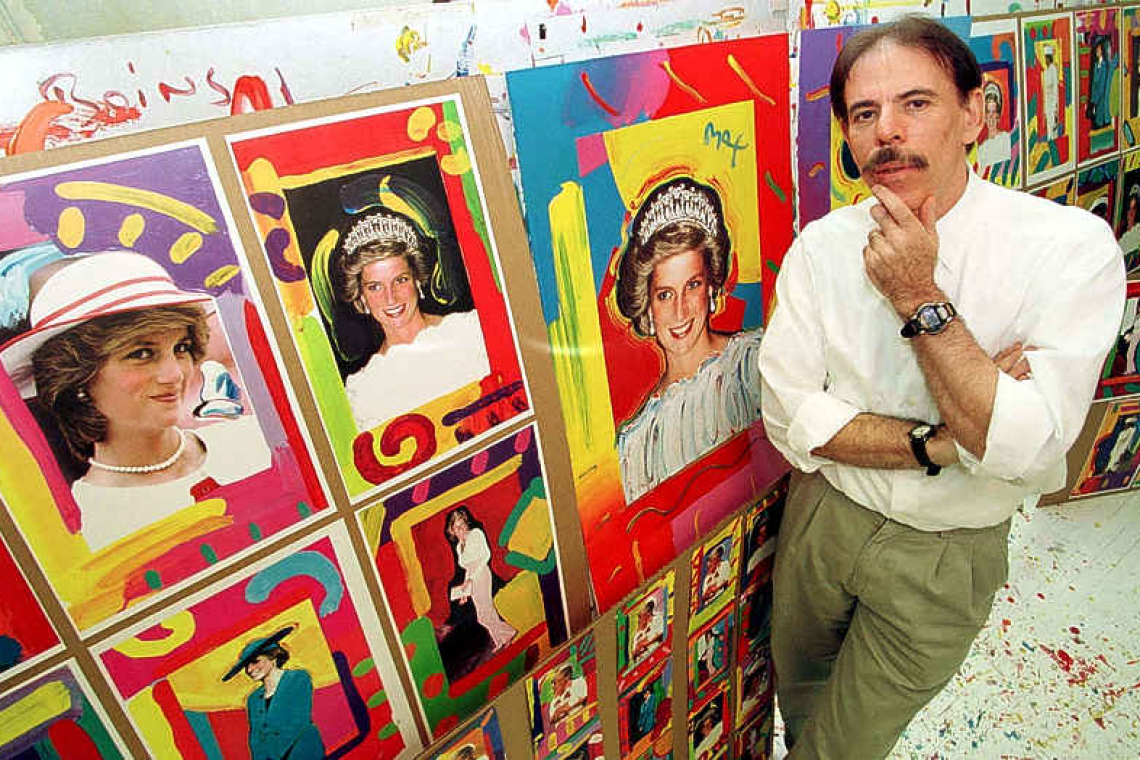
NEW YORK--Pop artist Peter Max, whose dreamy, boldly colored works provided an artistic backdrop for the 1960s U.S. hippie movement and made him a commercial art powerhouse, died on Monday at the age of 88 following a long illness, a spokesperson for his family said on Wednesday.
Max's visions – often influenced by his love of astronomy – were everywhere in the '60s and '70s and almost as much a part of the decade's youth culture as sex, drugs and rock 'n' roll. They were like artistic renderings of an acid trip and were, in the vernacular of the time, really groovy.
The colors were vibrant and the images surreal - cosmic landscapes and starbursts, doves and floating peace symbols, kaleidoscopic butterflies, puffy clouds and other flower-power imagery. Rock stars such as the Beatles, Jimi Hendrix and Mick Jagger were Max's portrait subjects, as well as his friends.
Former President Ronald Reagan was a fan and Max donated a painting of the Statue of Liberty to the Reagan Presidential Library. "His decorative posters show Max to be a visionary fascinated by time, space and evolution," a 1967 Village Voice critique said. "A psychedelic skyline prophesizes the day when skyscrapers may be temples, when the Rockefeller Center's Rainbow Room may be used for meditation."
Max died in a hospital in Manhattan and is survived by his daughter Libra and son Adam. "My father was my best friend," his daughter said in a statement. "I feel incredibly blessed to have been so deeply loved and to be his daughter.
"I hope that alongside his remarkable artistic legacy, people will remember his kindness, his gentleness, and how much he genuinely cherished putting joy into the world," she said.
In his prime, Max mixed art and commerce as easily as he combined colors on canvas. He licensed his work for some 70 products and it ended up on airliners, cruise ships, bed sheets, eyeglasses, women's swimsuits, chess boards and more.
"Such an explosion was monumental," Max told Reuters in 2007. "I could have never gotten that kind of explosion just being in galleries."
To those who said he was a sell-out, Max said he was simply finding outlets for his artistic zeal. He told the New York Times that if Matisse and Picasso were still around, they too would be trying to rush the market.
"In our era, if an artist is not seen in the media, he doesn't exist," Max told the Times. "The myth that an artist is not pure if he makes money is the wrong myth... What have I got to apologize for? I make art people can afford. And that makes them happy."