





Dear Chairman and members of the Committee on Kingdom Relations (TK and EK),
To get straight to the point, I present to you the following case study. Suppose, per the next opportunity (let’s say: next month or from January 2023, or something like that) we do it as follows. The inhabitants of the province of Drenthe are no longer entitled to unemployment benefits where they were until now, and the inhabitants of the province of Limburg who are on welfare will receive only half of their benefits. It is, of course, only a thought experiment, but still. You would probably think of me that I have gone beyond reality and am just babbling nonsense.
Nevertheless, this course of action is similar to what our government is doing with the Dutch Caribbean. For your understanding I will dwell on the concepts of CAS and BES. CAS stands for the countries of Curaçao, Aruba and St. Maarten.
These countries have a far-reaching duty of care for their own residents. Only Defense, Foreign Affairs and the issuance of Dutch passports are areas where these CAS countries are not responsible but where the (European) Dutch government has primacy. But for the policy fields of Education and Social Affairs, for example, the governments of these countries have their own responsibility. If more money is spent than is brought in, then it is primarily their own (national) responsibility to cut their coat according to their cloth. The European Netherlands, or rather: the Kingdom of the Netherlands (with a Kingdom government) sees to it that this “playing with own responsibility” does not get out of hand. A “game” in which boundaries are sometimes touched or even crossed.
It is different with the BES islands (Bonaire, St. Eustatius and Saba). These islands have the status of a “public body”, just as the Noordoostpolder and Rijnmond were “organized” at the time. The public body is a construct that is defined in the Constitution and, based on national (Dutch) legislation, additional rules can be set for public bodies. There is a slight problem here, because when do circumstances on the islands, which are sometimes essentially different from those in the European Netherlands, give rise to their own laws and regulations?
It is my firm belief that great restraint should be exercised in determining that certain circumstances are “different”. I am also convinced that the Dutch government currently easily embraces the “other” circumstances in order to introduce its own independent (but especially lower quality) legislation for the BES islands. However, and this is not at all the case in the European Netherlands, the Bonairean, the Statian and the Saban are just as much Dutch as the inhabitant of Drenthe or Limburg.
And so my case from the first paragraph is not so much out of the blue after all: the social safety net on the last three islands mentioned (so for the record: not the CAS countries, but the BES islands) is of a different (lesser) order than in the European Netherlands.
I have touched on this point more often in my letters, but when I walk around in the European Netherlands and read the newspaper, all kinds of things come to mind, but the fact that there are also Caribbean Dutchmen who are just as much Dutchmen as the European Dutchmen seems to be completely unknown here. I think that almost no inhabitant of the European Netherlands (and with that I am also referring to you, our parliamentarians, so also those of the Caribbean Dutch) is aware of the fact that our government does little else than institutionally discriminate against the Bonairean, Statian and Saban.
And so the poverty on these three islands is easily “reasoned away” by the European Netherlands (sometimes referring to an almost criminal discussion around a fictitious subsistence minimum that is supposed to be a benchmark for the distant future). And so, you can wipe your own European Dutch street clean with a completely misplaced sense of justice.
I would like to make one remark in this regard and that concerns the legislation. I do not exclude – but simply do not know exactly – that precisely the legislation that gives content to the functioning of the three public entities Bonaire, St. Eustatius and Saba (such as WOLBES and FINBES) “stands in the way” of the full equality of these “municipalities” with municipalities in the European Netherlands. But if that is so, it is a matter of eliminating precisely those obstacles. Moreover, when this is the case, the government should be clear and transparent about this and not send a new set of officials and/or researchers to the islands to “further study” an already known “problem”.
I would like to mention some more substantive points in this letter, but on second thought I will save them for a later letter. The realization that the Caribbean Dutchman and the European Dutchman together populate the (Caribbean and European) Netherlands and would actually like to derive the same rights from this status, seems to me too important a notion not to dwell on.
Hence this letter. An important notion that could, or even should, lead to consequences within each of the policy areas.
I wish you much wisdom to allow this notion to have an effect on you in your ongoing political actions.
Kind regards,
J.H.T. (Jan) Meijer
Dear Editor,
Which Minister of Government does not need the cooperation of the Minister of Justice? I am asking this because it is a while now that I am constantly hearing that the police are not working. People might say that because I was one, I am coming out in their defense. No such a thing. There is a lot more that they can do, but whose fault is it?
I blame the police brass for just sitting back and folding their arms waiting for things to happen. I also blame the Prosecutor’s Office for not getting together with the police brass and asking them what is wrong? Why are there no parking tickets, etc.?
The police cannot work if every Minister of Government, instead of governing according to the law, is governing according to their policy.
As a young boy I did not quite understand what my father meant when he would let my mother know that he did not always agree with her policies of correcting the children but because he was not at home all the time and things were not so bad, she could go ahead.
As I grew older my father, who at one time or the other would always explain to us the use of certain words, among the other things that he explained was the use of the word “policy”. He said policy can lead to corruption because policy is too often adopted by politicians based on one’s selfish desires and not necessarily in the interest of the public.
Two questions. 1) Why are residents of St. Maarten being harassed by their own immigration on their return to St. Maarten? And why are the Governor and the prime Minister accepting this policy? There is a word in workforce called “Arbeid contractant” and for the longest of while now that six-months contract has been used to the detriment of thousands of people. Never anything personal, but government has to stop this malpractice, because one cannot stop a resident with a Dutch passport from coming back home. One should not have to be literally harassed to get back to their own country. When we deport foreigners we send them back home. We don’t put conditions.
2) The former Afoo supermarket has a parking lot which spans between E.C. Richardson Street and Cannegieter Street. This parking lot is manned by a security guard who makes sure that the parking lot is only used by shoppers of the supermarket. Next to the supermarket on Cannegieter Street there is an area destined for stopping and eventually parking for everyone. It has become common practice that at the end of the day the proprietor of that supermarket has the employees stack up a whole lot of pallets in that special place for stopping or parking so that during the evening and night no one else could stop or park in that area.
Formerly people going to Anglican church could find a space to park. Of late the whole area is cordoned off so that people going to church have to park in the parking lot next to Nisbeth Road. I am aware of the fact that several people have questioned the police on this behavior. The last information that I got is that the police told some people that the owners of that supermarket got permission from government to cordon off that area, whereas the supermarket has its own parking lot and its own land warehouse space near the supermarket.
This is very difficult for me to swallow because police do not work that way. VROMI [Ministry of Public Housing, Spatial Planning, Environment and Infrastructure – Ed.] is in charge of that. I am inclined to believe that the supermarket owners feel themselves empowered to do as they like because they are constantly getting away with murder here in St. Maarten.
This is why I mentioned “policy” in my letter to you, because this is not the only place where such a practice is carried out. When one drives from Bernhard Bridge via A.Th. Illidge Road to Madame Estate, on that stretch there are along with other businesses 13 supermarkets of which only one has adequate parking while by all the others the traffic is constantly stagnated because of motor vehicles reversing from the front of those supermarkets or delivery trucks unloading freight.
Equally as there is a time frame stipulated for heavy equipment to be on the road, so also we used to have those delivery trucks deliver early in the morning or after six o’clock in the evening.
It is time for every Minister of government to start working according to what is stipulated by law and forget those policies. It is no secret that people in government are continually investigated and we have seen videos on WhatsApp where names of politicians who were locked up and are on their way to jail were mentioned.
Since I’m busy let me mention this. It is time for I believe it is the TEATT [Tourism, Economic Affairs, Transport and Telecommunication] Minister to oblige especially those supermarket cashiers to give the shoppers a receipt.
That is the law. Prices in supermarkets vary constantly and every week there is an increase in price even though the products are taken from the same container. Without a receipt the shopper cannot verify anything that was bought. And there are also products which do not have the price on them. Is this the way we say we are taking care of the citizens of the country? Really? Are we?
I would suggest giving those employees at the airport who are checking EHAS [Electronic Health Authorization System] a course in price control. I believe that when that system is righted the correct taxes would be paid, and the people would have a little more spending power because the money would be distributed in the right way. What should I think when I’m standing in the row to be checked in and I hear someone saying in Papiamento, “I wonder if St. Maarten and Aruba are sharing that money that we have to pay for these tests?” Honesty is still the best policy. I know it, I was there. There are a lot of those who got caught, who would admit that crime does not pay.
By the way, I believe that measures should be taken to have those GEBE bills rectified without threatening people to cut the light and water.
Already the consumers are not protected by the price-gouging of the supermarkets and hardware stores. Now we have to contend with GEBE’s guessing game because of cat-and-mouse behaviour with the people’s property among the employees, who, by the way, got paid because that portion of the grid could be retrieved.
Russell A. Simmons
Dear Editor,
Paul Kroll said oil makes the world go round. Long time ago coal and oil producing countries were not involved in selling energy for huge profits. Nowadays oil has become a political instrument. A country either plays by the rule, or faces the risk of losing its business. Such unpleasant behaviour pressures government and businesses to pay more for electricity and fuel power. Coal, oil and natural gas provide energy power for most electricity plants in operation today. Petroleum and natural gas provide energy for automobiles, households and businesses.
Natural is a combustible gas that forms naturally in the earth and consists of methane and hydrogen and other gases. Methane is colourless and flammable and is used as fuel. It is formed from the decomposition of plants and other organic products. Propane is a flammable colourless and heavier gas. It is also used for fuel. Fossil fuel is coal and oil. It is one of the best sources of energy power dating back to the 1930s to produce clan energy. It was formed from the decomposition of animals, plants and other organic products over millions of years ago.
Renewable energy sources include solar power, wind farming, hydro-electricity power, nuclear energy, gas and electrical energy power. Solar power is excellent for countries with plenty of sunshine. Solar batteries should be fully charged for continuous functional operation. This source of energy is for every household and business. Installation fees can be costly but operational cost is usually low. Dead batteries no longer used must be carefully disposed of and destroyed to protect the environment. Recondition batteries should be protected and stored in a safe place at all times.
Wind power is vital for every sector of the community. This energy source can be used commercially to reduce the cost of producing electricity to the public. The problems with wind power technology are the rotating blades on the units causing destruction to birds in their path. During hurricanes, the units can be destroyed by hurricane-force winds. This energy source is commercially important to the population for daily power supply. Hydro-electric power using dams, river and lakes is also an important cheap source of clean energy. This source does not need a huge maintenance cost. During natural disasters, dams may be broken by rivers bursting their banks and cause lakes to overflow and damage the energy producing equipment.
Electrical energy and natural gas are still the cleanest and best sources of energy for the environment, households and establishments until now. The flow of these types of energy usually depends on demand and supply. Nowadays both economics and politics are driving forces for high energy cost and for creating high rate of inflation around the world.
The sun is getting hotter these days. This is because of the Green House Effect. Many countries around the world are experiencing severe weather conditions due to global warming. When fossil fuel such as coal or oil is burnt, they release carbon dioxide into the atmosphere along with other poisonous gases. These gases trap the heat of the sun and cause the earth’s surface to become warmer. This process is causing devastated hurricanes, wildfires, floods, drought, and the ice in the Artic to melt. In addition, smoke from motor vehicles, factories, and air-condition units are also contributors of air pollution which increase global warming. In summary, the choice of supplying affordable energy power sources to the population will depend on stability, reducing electricity cost, increase in demand and maintenance of equipment.
Coal, oil and natural gas provide about 80% of energy power produced by electricity plant. Renewable or alternative energy power provides about 15% source for general consumption use. Nuclear and hydro-electric power provide the other 5% use. Factors affecting the environment using fossil fuel: We have seen how off-shore drillings of crude oil caused death and destruction to fishes, birds and other sea creatures. A broken pipeline for example, or blowing up pipelines under the sea could be detrimental to humans, sea-creatures, birds and animals.
Repairs and clean-up costs are usually in millions of dollars to governments and plat form entrepreneurs. Coal mining is also a dangerous operation. Extracting coal from beneath the earth surface usually involve the cost of human lives and high-tech drilling equipment, also the release of dangerous carbon gases into the air which pollute the environment. We should help protect the environment by using more renewable and clean energy power to prevent global warming. Trees are important in the carbon cycle. They help to decrease carbon-dioxide in the atmosphere which is responsible for Climate Change.
Deforestation is also a major cause of global warming. Renewable energy is the ideal source for cleaner power to promote a healthy working environment.
Joseph Harvey
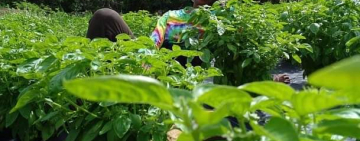
Local agriculture. Photo compliments of Sxm Fisheries NV.
Dear editor,
After reading the article “St. Maarten looking to lease land abroad for sustainable agriculture”in The Daily Herald dated September 7, I was struck with disbelief.
From December 2021 through June 2022 my company, Infinite Observations, based in Delft, The Netherlands, executed the project “Pilot Study On Price Ceiling On Staple Items – Foodstuffs” for the Ministry of Tourism, Economic Affairs, Traffic and Telecommunications (TEATT) of the Government of Sint Maarten, see https://infinite-observations.com/pilot-study-on-price-ceiling-on-staple-items-foodstuffs-2021-2022/ . The project consisted of (1) collecting data on more than 650 commodity food items, (2) developing a “Market Place Mapping Dashboard” for the duration of the project to monitor market prices and (3) a written report.
In Chapter 6 paragraph 9 of our report named: “Subsidies To Increase Farmers incomes and Lower Consumer Prices To World Price Levels”, we advocated specifically for “Domestic Agriculture” for the following reasons:
Domestic agricultural (, livestock, fishery, etc.) production is the only long-term sustainable response program to price increases stemming from food shortages as a result of human induced and man-made catastrophes, see chapter 2 | Conceptual Framework, on page 16, of the entire report. During the pandemic years and the ongoing war in Ukraine the agricultural sector has been performing very well as the shift to small scale subsistence (or at-home food preparation [essentially all farmers on Sint Maarten]) was fuelled by a strong demand from consumers. Any government agricultural policy framework will have to be an approach that will better enable (small scale subsistence) [essentially all farmers on Sint Maarten] and the food sector to simultaneously improve productivity, increase competitiveness and profitability, improve resilience, access markets at home and abroad, manage natural resources more sustainably, contribute to national food security, and deal with extreme market volatility, while avoiding trade distortions. The (or any current or future) agricultural policy framework must consist of the following: (1) macro-economic governance, (2) agricultural research and development, (3) markets, (4) land management, (5) climate change, (6) public expenditure, (7) policy priorities, (8) farmer knowledge, organization, awareness and education, (9) financial services, (10) technology and (11) taxation.
Macro-economic Governance: A government agricultural policy framework should have a holistic approach and cover the whole food supply chain, well-functioning markets, a sound regulatory and policy environment that are key to foster innovation and improve productivity, sustainability and resilience. Such a framework needs continuous improvements. Digital technologies and ICT can play important roles in the design of an innovation and policy framework. Policy coherence deserve special attention when applying such a frame framework. An encouraging macro-economic surroundings promotes the stability that is required for a well-functioning of market and investment decisions.
Agricultural Research & Development: How much has government invested in agricultural research and development over the past decade? How many full-time equivalent (fte) agricultural researchers does government employ? Has government thought about establishing an agricultural research fund, and reallocating revenue from commodity food taxes back to agricultural research and development?
Before the minister engaged in talks about leasing parcels of land in other countries did he seek advice on what that would mean in terms transportation costs of that produce and products from those countries back to Sint Maarten? We have seen how (fossil) fuel costs have skyrocketed in the past months and what effect that have had on commodity food prices. Can the minister substantiate his decision with data?
Markets: This surge created by the shift to small scale subsistence, however, coupled with logistical bottlenecks, created supply disruptions resulting from the pandemic and the war in Ukraine led to higher commodity food prices, drawing special attention to the vulnerabilities of existing global supply chains, see chapter 5 | Examining Factors That Influence Price Fluctuations, on page 64, of our report. To safeguard against future catastrophes, to meet increasing food security demand and resiliency in agricultural supply chain, Caribbean agricultural industry needs to adapt and evolve.
Will the supply chain disruptions resulting from catastrophes be mitigated by leasing parcels of land in other countries to develop sustainable agriculture? By cultivating and expanding the agricultural sector on Sint Maarten supply chain disruptions to our local market resulting from catastrophes will be zero. Because all produce and products will be locally grown and the time and distance from farm to market on Sint Maarten is negligible. When production is done in other countries, it can take weeks or more under normal circumstances and in the event of a natural or man-made catastrophe the challenges will be insurmountable. Sint Maarten needs to become more resilient in economic, employment, educational, etc. -terms. Outsourcing agricultural production to other countries will make us more vulnerable and dependant on others than we are right now.
Climate Change: Changes in the variability of rainfall (or drought) are expected to have a more significant impact on agricultural production and hurricane winds are so strong enough to break and uproot crops, wave and water action can be catastrophic to land environments causing erosion. However, there are several land management practices, adaptation and mitigation strategies to reduce climate risk in the agricultural sector and improve growth and productivity while boosting yields and increasing revenue.
Did the minister research what land management practices can be used on Sint Maarten to reduce climate risk in the agricultural sector and improve crop growth and productivity?
Farmer Knowledge, Organization, Awareness & Education: Network of actors and institutions participating in research, education, capacity building, training, extension, long-term productivity and sustainable farming, input supplying, regulatory policy, marketing, processing and consuming. Some of these actors come from outside of the agricultural sector, and they can influence innovation from any point in the value chains.
Did the minister consult with our local farmers on this matter? By leasing parcels of land in other countries to develop sustainable agriculture will Sint Maarten organizing, encouraging, educating our local farmers and young people in the agricultural sector? No!
Financial Services: Agricultural financing, credit to finance inputs and capital investments, effective market information systems, reliable infrastructure, such as electricity for cold storage facilities and water for irrigation are necessary to cultivate the sector and help it to grow. However, farmers at or below subsistence levels have low assets, are often outside formal credit markets, and have high degrees of risk aversion that make it difficult for them to make even the initial investments that would increase production. Through innovations in agricultural infrastructure and technology, investment opportunities exist to optimize and boost value creation from every part of the supply chain in a sustainable manner. This type of transformation requires capital. In the European Union funding is available in the form of grants, subsidies and incentives for sustainable resilient agricultural projects among member states.
Is the minister aware that be outsourcing our much need domestic agricultural sector it will make it much more difficult to access the necessary funding from the European Union and other international bodies for local agricultural projects now and in the future?
Land Management & Population: Population growth and urbanization in recent decades has led to the steady decline of farmland and other natural resources. Land distribution (or lack of) and land disputes, plot inclination (or slope) poses many challenges to open-field agricultural farming, which is limited to specific growing seasons and is sensitive to climate change and the prevailing weather patterns. On the other hand, (single and multilevel) Controlled Environment Agriculture (CEA) offers numerous advantages to open-field farming. CEA creates an environment, by using innovative technology to control lighting, humidity, and temperature levels, conducive to almost year-round growth for certain fruits and vegetables with limited exposure to weather conditions. The advantages of CEA farming include: (1) improved and more consistent crop yields, (2) if greenhouses can be located closer to end markets [greenhouses on Sint Maarten] it reduces supply chains and carbon emissions associated with transportation to get produce from farmer to the consumer, (3) more efficient (meaning less) use of fertilizers and no use of pesticides, (4) efficient irrigation methods and recycling of water and nutrients leads to water conservation.
Did the minister explore the development of this option of sustainable farming on Sint Maarten before engaging in discussions to lease parcels of land in other countries to develop sustainable agriculture? The investment in (multi-level) greenhouses on Sint Maarten will be much lower than leasing, producing and transporting produce from other countries to Sint Maarten.
Technology & Innovation: Technology and innovation allow farms to do more and better with less. By transitioning to renewable energy sources, of which solar is one of the fastest-growing alternatives, presents the opportunity to reduce carbon emissions. Solar panels allow farms to power farm equipment such as water pumps, lights, electric fences, and storage. Farms can become more energy self-sufficient and improve operating profit margins. Excess solar energy generated on a farm can be sold to local utility providers. This in turn can help local communities reduce their carbon footprint, but it can also provide farms with a secondary source of income. Farms can streamline operations, creating greater operational cost control and building production resiliency by transitioning toward energy self-sufficiency.
Does the minister realize that cultivating and expanding the agricultural sector on Sint Maarten will expose the entire population and especially our youth to technology and innovation in the farming industry? Domestic farming will create opportunity to work universities and institutions in the food production industry. Sint Maarten will not have these opportunities if land is leased in other countries to develop sustainable agriculture. The much needed knowledge, technology, innovation and experience will by going elsewhere.
For the time being it is highly likely that market prices will go down, as in 2008, since farmers are archetypal price followers. However, natural resource scarcity, supply chain vulnerabilities and more frequent extreme natural and man-made events as well as population growth in the coming decades will put more and more pressure on food production capabilities. To be able to meet future demand both public sector (government) and institutional investments should be concentrated at the small scale or level, small scale irrigation and extension services for example. Much of the world’s farming activity, including the Caribbean, occurs on smallholder farms, with production at or below subsistence levels, see Figure 36 on page 104, of our report. Technology exists to boost productivity on these farms. However, further research is required to identify best practices in innovative farming systems as well as agricultural and economic policy to meet growing food demand with fresh, locally sourced, sustainably produced products at affordable prices, (IMF 2008 & 2012, Krivonos & Dawe 2014, Kruythoff 2020, OECD 2020, DG ECHO).
Conclusion: Leasing parcels of land in other countries to develop sustainable agriculture and importing the products to Sint Maarten is a bad idea from all the abovementioned perspectives. It is no different than the current situation, where we import products from abroad. It does not contribute to the economic, employment, technological and educational development of Sint Maarten and it’s people. Furthermore, it comes from a minister who ran his political campaign on the slogan “Only We Can Save We”, who have approached PJIA, Bellast Nedam and the cruise ships that frequent the island the hire locals. Now he himself is has the opportunity to cultivated and develop a much needed agricultural sector on Sint Maarten but he is advocated an idea to outsource much needed local agricultural employment opportunities to other countries.
Wladimir T. Kruythoff,
CEO & Founder, Infinite Observations, Delft, The Netherlands.
Dear Editor,
To begin with, the basket of goods concept should be in line with inelastic demand before government begins to set policy on tariffs and taxation for businesses, consumers and public enterprises. The price of goods in the basket are based on supply and demand, distribution chains and government control. Any change in prices in the basket will have an effect on suppliers and the receivers of goods. Items such as bread, milk, flour, cornmeal and rice have no close substitutes, and people will have to buy them even if the price is high or low.
Regular monitoring and control of the basket of goods is necessary to protect the purchasing power of the low wage earners. The price of goods for hygiene purposes such washing soaps, Clorox, toilet-paper, dish liquid, toothpaste and other cleaning materials must be affordable to the public as low-price control items. The basket should also be in line with the Consumer Price Index. The CPI is a statistical collection consumer spending on certain goods over a certain period of time. It usually shows an increase or decrease in the cost-of-living figures for the period. The cost-of-living Index is an important measure in setting policy for taxes and tariffs for businesses and customers. The total invoice of goods in the basket plays a significant role in calculating taxes on goods in reference to the amount paid by the customers to government regarding who pays or who doesn’t.
In regard to the consumer price index, reference should be made to the amount of the invoice including trade and cash discounts if any, and the channels of distribution for the goods in basket. The basket of goods helps keep items at control price and protect consumer spending. Who pays for the goods in the basket? Please see the demonstrated example of the purchasing power of two families. Here is a typical example of consumer spending for one month on selected items in the basket of goods. Family A monthly spending amount total is $200. Goods in the basket were subject to 10% trade discount on reaching the retailer from the manufacturer or the wholesaler, i.e., 0.10 X 200 = $20. The real cost now $180. Let’s say the retailer adds 3.5% Turnover tax to the $180, i.e., 0.035 X 180 = $63. The price for the basket of goods for A will now be $245. So, $63 will go for tax.
Family B invoice total is $150. Trade discount from the manufacturer/wholesaler is 10%, retailer adds 3.5% tax on the items. Based on policy for example government might add 10% to the goods as tariff. B’s budget can also be calculated. See A’s information above. Final consideration: Who pays the burden of taxes in the basket of goods? From the wholesaler to the retailer and to the customers, and even if we
bypass the middleman, the business usually passes on the burden to the innocent consumers.
Government must take a firm stand with its policies to protect the poor people.
Joseph Harvey
Copyright © 2025 All copyrights on articles and/or content of The Caribbean Herald N.V. dba The Daily Herald are reserved.
Without permission of The Daily Herald no copyrighted content may be used by anyone.