





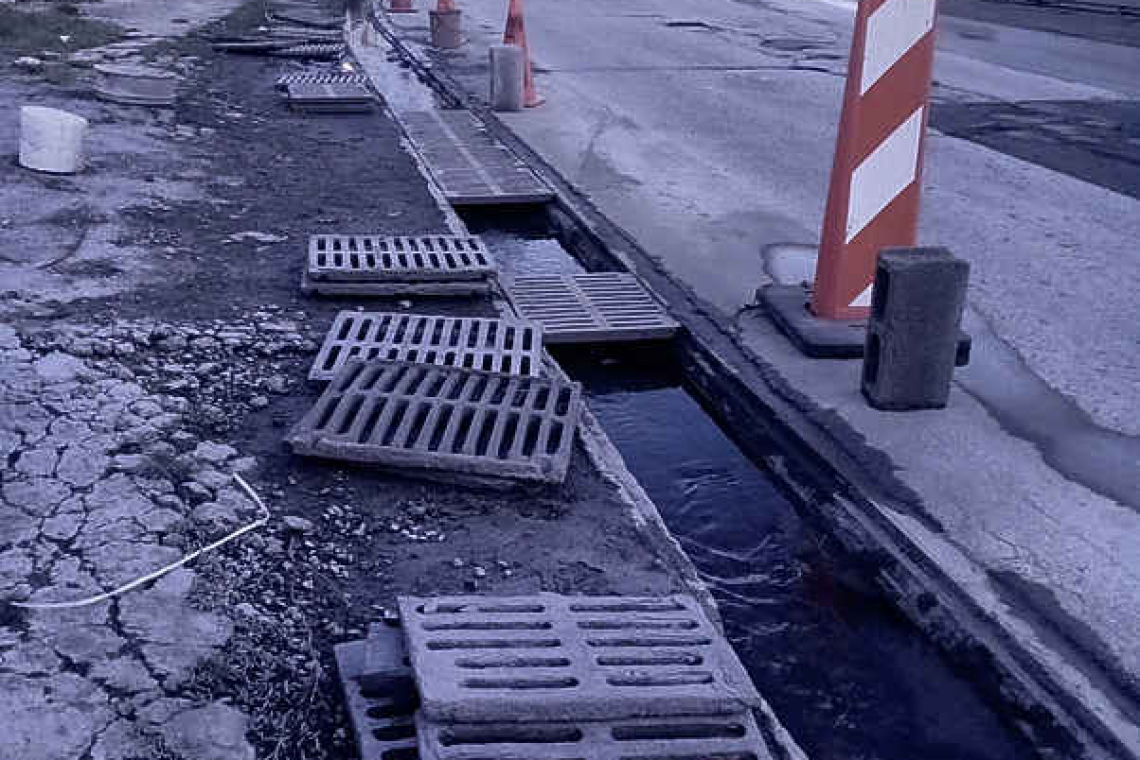
One of the many drains in Cole Bay that are missing grates and tend to overflow after heavy rainfall.
PHILIPSBURG--Minister of Public Housing, Spatial Planning, Environment and Infrastructure VROMI Patrice Gumbs outlined plans to address long-standing drainage and road infrastructure problems, pointing to limited financing as one of the main obstacles to carrying out repairs across St. Maarten.
Gumbs explained that the ministry had identified numerous areas requiring attention following a country-wide inspection of public infrastructure conducted the previous year. The inspection covered drains, trenches, roads and sidewalks, as well as guardrails, traffic signs and mirrors.
He said many of the problems had been known to the ministry since the summer of 2025, but the available budget had restricted its ability to address them. He stressed that the ministry’s approach therefore needed to go beyond individual repairs and include longer-term planning and sustainable financing.
Gumbs traced some of the island’s infrastructure challenges to the rapid development that began in the late 1950s. As the economy expanded, roads originally built to accommodate far less traffic were increasingly used by thousands of vehicles, tourists and heavy machinery. The growing demand for housing also led to extensive construction, both legal and illegal, placing additional pressure on drainage and sewage systems.
He said infrastructure had not kept pace with the rate of development, while outdated legislation, fragmented policies and unsupported deviations from established regulations had created further difficulties for the ministry.
Among the drainage problems identified was the need for underground drains along Orange Grove Road, as development in the Cole Bay Hill area had increased demand on the existing system. Similar work was planned for Union Road, including drainage from Poplar Drive towards Orange Grove Road.
The four major culverts along A.J.C. Brouwer Road had also sustained severe damage. One had already been condemned, while the ministry was working towards condemning and repairing the remaining three. Other areas requiring attention included Well Road, Octavius Richardson Drive, Richardson Road, Arnell Road and L.B. Scott Road, where drain pits and grates needed to be repositioned or adjusted.
The ministry had also identified drainage problems along A.Th. Illidge Road, between the traffic lights and the Lions Club roundabout, as well as flooding along Beacon Hill Road. Gumbs further highlighted the cost and challenges involved in maintaining the Great Bay Channel, which served as an outlet for water from the ponds into the sea.
In Fort Willem, complaints about undersized drainage pipes had led to plans for their replacement during the coming year.
Several trenches also required repairs. Rolando’s Canal had deteriorating natural stone embankments, with cleaning activities contributing to the undermining of foundations. Belvedere Trench was identified as having insufficient capacity for the volume of water passing through it, while Coralita Trench was collapsing and required its final section to be hard-surfaced.
Erosion along MPC Trench posed a potential threat to the foundations of Milton Peters College (MPC) if left unaddressed. In Pointe Blanche, stones were falling from a smaller trench, contributing to erosion, while the hard surfacing of the trench area near Lake and John Cooper Ball Park also required attention.
At Soualiga Trench, severe erosion in front of Melford Hazel’s property required reinforcement with guardrails and retaining walls to improve the safety of pedestrians and motorists.
Guardrail improvements were also being considered along Welgelegen Road, where the ministry was exploring the removal of existing guardrails and their replacement with a low wall. Gumbs said this could help prevent vehicles from falling into the trench while allowing easier maintenance. Cole Bay Hill and the area around the airport were also identified for future guardrail installations.
The inspection further identified problems involving traffic signs, mirrors, road dividers and turning restrictions, particularly along Bush Road. Deteriorating sidewalks and exposed manholes were among the pedestrian safety concerns raised with the ministry.
To address the infrastructure problems, Gumbs outlined several project-based and financial solutions. One initiative involved a memorandum of understanding signed with the land registry “Kadaster” earlier in the year to assess the island’s infrastructure both above and below ground.
He explained that road and infrastructure projects were sometimes delayed because the ministry lacked a comprehensive overview of what was located underground. Unidentified pipes and other infrastructure could complicate work once excavation began, resulting in delays and additional expenses.
The proposed assessment would use drone and Light Detection and Ranging (LiDAR) technology to map infrastructure across the country. Discussions with the Kadaster had reached the stage of determining the project’s cost, with implementation expected in 2027 after being delayed from its original schedule.
The ministry was also examining ways to improve the assessment and maintenance of the road network. Gumbs said discussions had included the Pavement Condition Index (PCI), used in the United States, and the model of Dutch infrastructure institute CROW to assess road conditions and determine when particular interventions were necessary. The aim was to establish a more reliable basis for prioritising repairs and planning long-term road maintenance.
Public-private partnerships (PPPs) were another option being explored to help address the financial gaps. Gumbs referred to examples in Aruba, where private entities had financed infrastructure projects through partnerships with the government. While he said St. Maarten was not necessarily looking to adopt the same arrangement, the ministry was exploring how partnerships could help fund critical infrastructure improvements.
He also pointed to the need for more consistent funding from road taxes. The minister said the island had received a road budget of 1.1 million Caribbean guilders over the previous two years, much of which had effectively been consumed by Cg. 1.2 million in outstanding bills dating from 2019 to 2024.
As a result, the ministry had been unable to use those funds to address many of the infrastructure problems identified during its inspections. Gumbs argued that revenue collected through road taxes needed to be directed towards maintaining the road network.
The proposed road fund was also being reconsidered following critical feedback from the Advisory Council. The ministry was examining whether the fund should instead function as a long-term investment instrument for major infrastructure developments rather than serving primarily as a source of funding for daily road operations.
The minister said discussions on the fund’s structure and purpose were continuing, with the intention of moving towards implementation in 2027 or 2028.
Another proposal involved the establishment of an urban environmental development fund. The ministry had finalised an amendment to the existing fee ordinance that would introduce a third charge for building permits, calculated according to the value of a construction project.
Under the proposal, the additional fee would be directed towards the development fund to finance roads and other infrastructure. The amendment was undergoing a review of its potential social impact, as the introduction of an additional fee would affect construction cost.
Gumbs said the cost of development could no longer be carried solely through existing building permit fees or the government’s general funds, stressing that sustainable development required additional financing.
He also reported progress on flood management, announcing that the floodwater management project involving the Cul de Sac and pond areas had been completed and that the flood ponds were functioning.
The ministry had further strengthened its enforcement capacity through the introduction of additional enforcement mechanisms, including the ability to issue fines. Two additional employees had also joined the inspections department during the previous two to three months.
Gumbs said addressing flood management, drainage infrastructure and the road network required an integrated approach, as the three areas were closely connected. He maintained that the ministry’s plans needed to combine immediate infrastructure projects with long-term financial solutions to ensure that repairs and improvements could be sustained.