





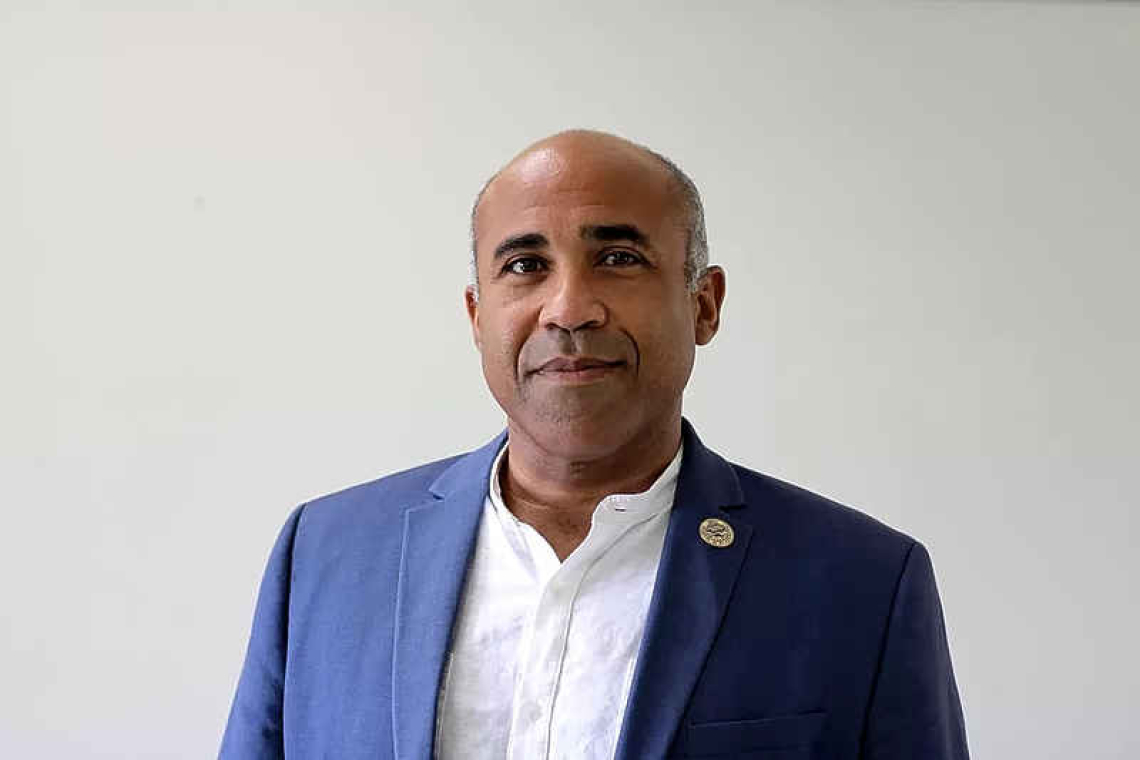
USM President Dr. Antonio Carmona Báez.
POND ISLAND--University of St. Martin (USM) President Antonio Carmona Báez said there is a need for stronger structural government funding and coordinated investment to ensure the long-term sustainability and growth of the country’s sole higher education institution.
“At this critical juncture, USM requires stronger and more consistent structural funding from government,” Carmona Báez told The Daily Herald in an interview.
“While the University has demonstrated prudent financial management and resilience, sustainable growth cannot occur without predictable operational support. Increased funding would allow USM to recruit additional full-time faculty members who can balance teaching, research, and grant writing – thereby generating new revenue streams and elevating academic quality.”
He said a transparent reassessment of national study financing is also essential. “If substantial public funds are allocated to overseas education, a portion could be redirected to strengthen domestic higher education capacity. This would create a more balanced system that invests not only in individual mobility but also in national institutional development.”
The USM President said that USM has demonstrated resilience, but requires predictable operational support to expand responsibly. Following the devastation of Hurricanes Irma and Maria, the university temporarily closed its doors. When new leadership assumed responsibility in 2018, the mandate was to restore academic stability and secure financial sustainability.
Since then, USM has achieved six consecutive unqualified audit reports, which he described as a significant accomplishment reflecting transparent governance and sound fiscal management. He noted the institution now serves as a model for educational institutions across the Dutch Caribbean, crediting the dedication of the Business Department and Finance leadership.
Despite this progress, structural funding remains insufficient. Carmona Báez stressed that USM must recruit additional full-time faculty who can teach, conduct research and secure grants. Alumni engagement and private-sector partnerships were also identified as critical components of long-term financial sustainability.
With the implementation of the National Ordinance on Higher Education and Research, USM is preparing for institutional and programmatic accreditation in close collaboration with the Ministry of Education, Culture, Youth and Sport. Accreditation, ideally through the Nederlands-Vlaamse Accreditatieorganisatie, will require significant investment, but is essential for academic credibility and regional competitiveness.
Carmona Báez noted that education accounts for nearly a quarter of the national budget and advocated for more efficient allocation through coordinated planning and reduced fragmentation. By working collaboratively with government and Kingdom partners, he said, USM aims to secure the financial stability necessary to fulfil its national mandate.
At the Kingdom level, he said engagement is vital. Dialogue between the Minister of Education, Culture, Youth and Sport and the Dutch Minister of Education in The Hague could unlock additional collaboration and funding opportunities. He pointed out that USM already provides teacher training for Saba and Statia and developed their Academic Foundation Year programme, demonstrating the university’s broader regional mandate.
Carmona Báez underscored the indispensable role of the community and private sector in supporting USM’s mission. Currently, many companies and public institutions design short-term training initiatives for employees. While useful, he said these often function as temporary solutions rather than comprehensive professional development pathways. A more sustainable approach would involve partnering with USM to design accredited training programmes that integrate theory, critical thinking and contextual understanding.
He noted that sectors such as hospitality and tourism could collaborate with the university to ensure workforce development aligns with evolving industry demands. Rather than outsourcing training or improvising internal programs, businesses could invest in curriculum development at USM to strengthen both academic rigour and sector competitiveness.
Greater philanthropic contributions, internship placements and mentorship programs would further deepen ties between students and local enterprises. Official recognition from institutions on both sides of the island would also help solidify USM’s standing as a binational academic resource.
Highlighting recent accomplishments, Carmona Báez said USM has intentionally focused on mobilising local expertise and international partnerships to advance the socio-economic and cultural development of St. Martin and the wider Caribbean. A standout achievement was the April 2025 Regional Conference on Climate Policy, Coastal Protection and Vulnerable Communities, which brought together scholars and policymakers from Cuba, Curaçao and St. Kitts and positioned USM as a convening hub for dialogue on climate resilience in Small Island Developing States.
He also pointed to the SXM Climate Impact Atlas, developed in collaboration with VROMI, the Collectivité, the Prefecture of Saint-Martin and Kingdom partners. The Atlas and its Climate Adaptation Options Database provide evidence-based guidance to inform future planning, lay the groundwork for a National Climate Adaptation Strategy and strengthen Kingdom cooperation while helping make the population more climate literate.
USM recently launched the Caribbean Academic Foundation Year (CAFY) in partnership with the Strategic Education Alliance and NIPA, serving St. Martin, Saba and Statia. The program is designed to expose secondary school graduates to vocational tertiary as well as academic higher education and has helped identify systemic gaps in primary and secondary education while fostering a culture of continuous improvement.
Additionally, the June 2024 Orange Economy Symposium organised by Dr. Gale Rigobert catalysed new initiatives, including plans for a Creative Industries Hub and prospective programs in Film and Television. Together, these efforts reinforce USM’s role as a driver of innovation, policy development and nation-building.
Among the university’s most transformative milestones, Carmona Báez highlighted the Bachelor of Arts in Social Work delivered as a joint degree with the University of the Virgin Islands. In June 2026, the program will celebrate its first graduate, demonstrating that students can earn a professional accredited degree while remaining on island. Designed with input from local practitioners, the curriculum reflects St. Martin’s multicultural and multilingual society and includes additional language development to strengthen graduates’ professional reach.
Another major breakthrough is USM’s recognition by the Dutch Research Council, qualifying the university to host doctoral candidates across the sciences beginning in 2026. This builds on five years of intensive research engagement, including the Island(er) at the Helm project, which culminated in USM’s first Ph.D. depends on sustainable, climate-resilient housing. During the COVID-19 pandemic, USM also led ZonMw-funded studies on food security, economic diversification and the pandemic’s impact on vulnerable families in Curaçao, Aruba and Sint Maarten.
Carmona Báez stressed that USM stands as the sole institution for higher education and research on St. Martin, serving both the North and South sides of the island, with work that extends beyond classrooms into policy dialogue, workforce development, cultural preservation and regional scholarship. He said the university has demonstrated resilience despite natural disasters, financial strain and systemic fragmentation, achieving clean audits, expanding academic offerings, strengthening research capacity and building meaningful partnerships.
However, sustained progress requires unity. Carmona Báez said that educational reform must move beyond rhetoric and called for investment in local institutions, transparent study financing and coordinated planning to ensure public funds yield measurable social and economic returns. He concluded that higher education is foundational infrastructure no less critical than roads or hospitals, and that supporting USM represents a shared commitment to intellectual growth, professional excellence and the island’s long-term resilience.