





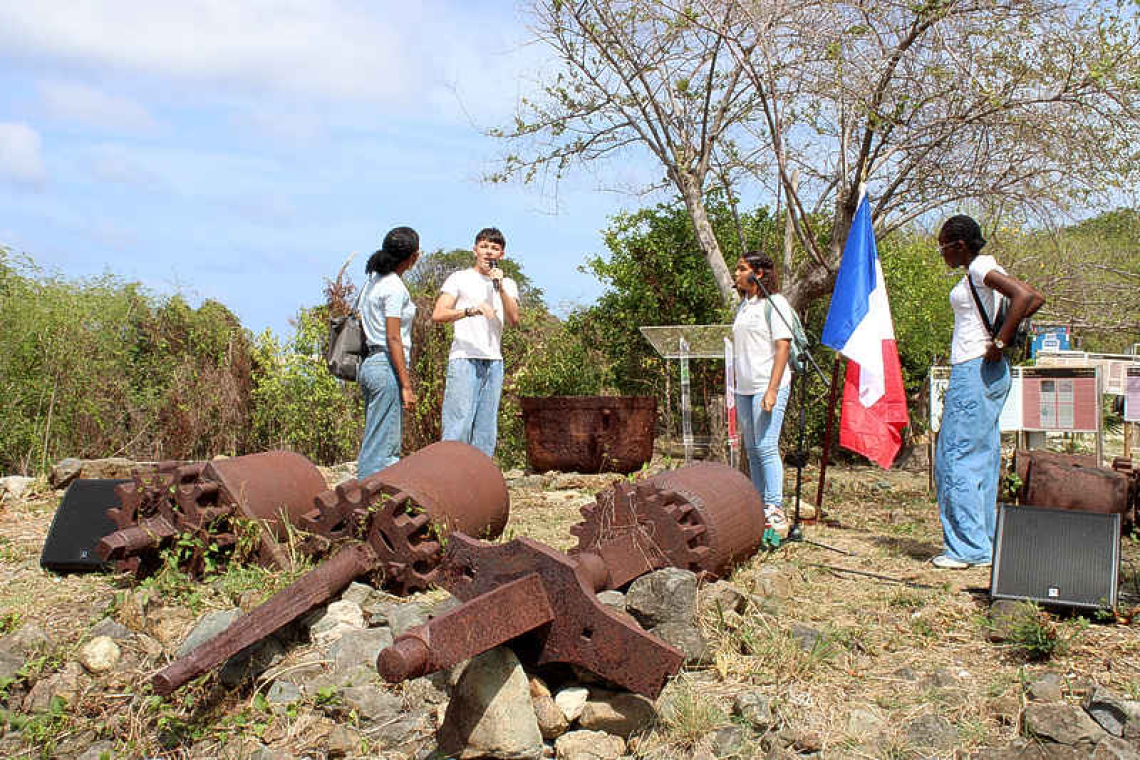
Junior Territorial Council members gave a presentation on the sugar cane rollers, seen in the foreground. (Robert Luckock photo)
FRENCH QUARTER--The 178th anniversary of the abolition of slavery under the theme “Years after Emancipation – The making of a Country” was held Thursday at the Old House in French Quarter, with a programme divided into two segments.
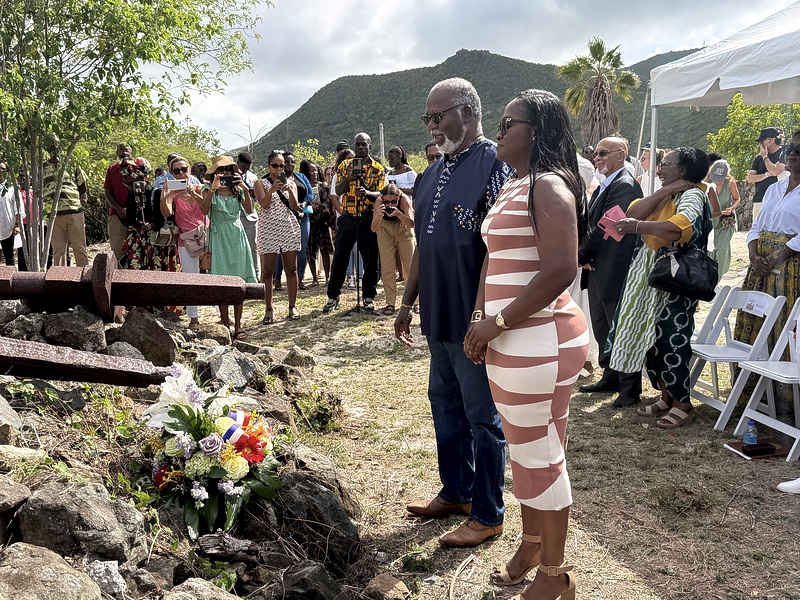
President Louis Mussington and Culture Commission President Valérie Damaseau reflect on the past after laying a wreath. (Robert Luckock ph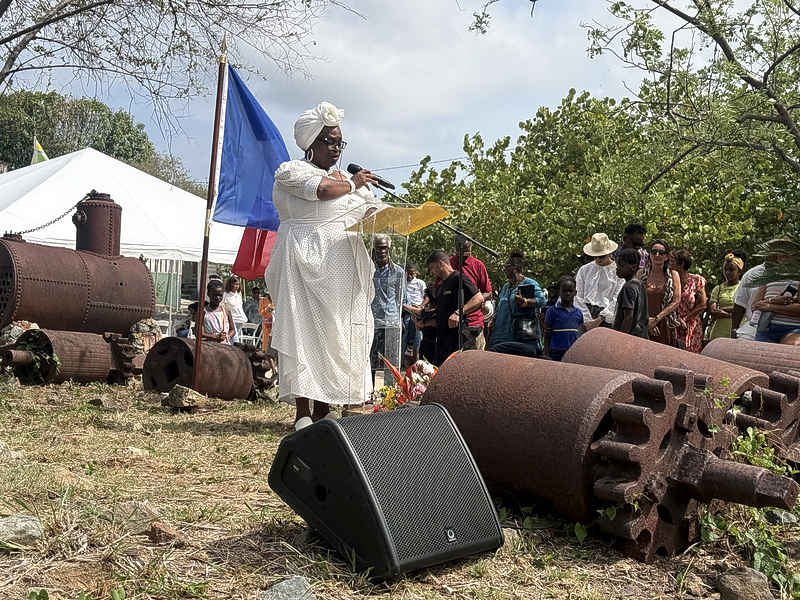
Agnes Alexander from French Quarter district council giving her speech (Robert Luckock photo
Amyra Ottley sang “Oh Sweet Saint Martin Land” (Robert Luckock photo)
Préfet Cyrille Le Vély lays a wreath at the ceremony. (Robert Luckock photo)
The first segment, the official ceremony and speeches, took place at the entrance to the Old House and began with blowing of the conch shell by Lastisha Stephen followed by a presentation of the sugar mill rollers by four members of the Junior Territorial Council.
The iron rollers were used by the slaves to crush sugar cane and the original mill was located across the road from the Old House. It was dangerous work for slaves with the risk of getting caught in the rollers and losing one’s life.
“Oh Sweet Saint Martin Land” was sung by Amyra Ottley, before speeches were given by District Council One (French Quarter) representative Agnes Alexander, President of the Collectivité Louis Mussington, and Préfet Cyrille Le Vély. After the speeches two wreaths were laid, the first by President Mussington and President of the Culture Commission Valérie Damaseau, then by the Préfet, followed by a minute of silence.
“French Quarter is a land deeply rooted in history, culture, resilience and memory,” said Alexander in her speech. “Every corner of French Quarter is characterised by our ancestors, their struggle, their strength and determination to overcome oppression. The making of a country reminds us that emancipation was not the end of the journey but the beginning of a people, and identity, a nation founded on courage, unity and hope.
"Today we honour the memory of those who came before us. Let us continue to teach our children where we come from, preserve our traditions, and keep our history alive for future generations.”
Said Mussington in his remarks: “The Old House has been a silent witness to pain, resistance,
courage, and survival. We are here today not just to commemorate Emancipation Day but to honour their courage, their humanity, their struggle for freedom. We also have a duty to transmit this history to the young generation, not to reopen wounds but to teach the truth, not remain prisoners of the past but to build a stronger and united future.”
Mussington reminded that celebration of the Haitian Flag on May 18 is important to remember as this event marked the beginning of the liberation of enslaved black people throughout the world due to the Haitian Revolution in 1804. “We are descendants of those who paved the way through their sacrifices to liberate the black man,” he said.
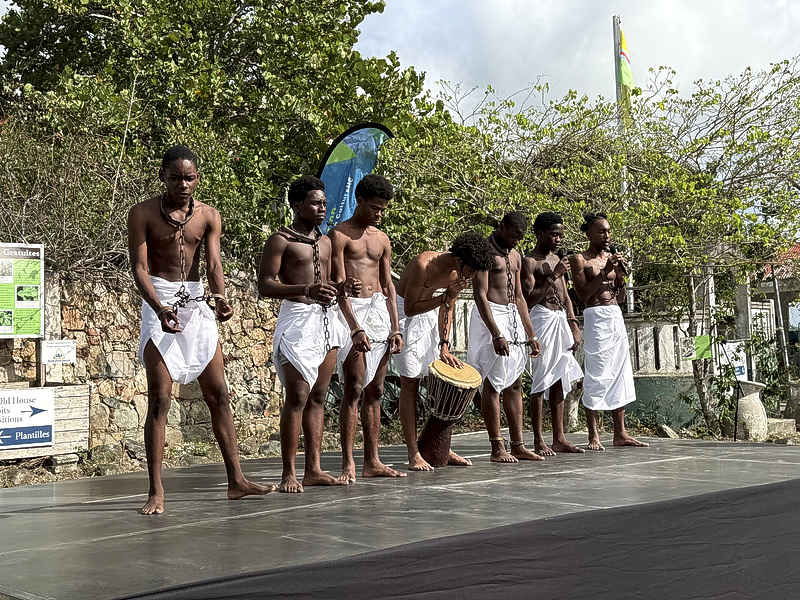
The cultural segment began with an audio-cultural history by Audrey Claxton to choreography by a dancer from the O&Co company. Culture Commission President Valérie Damaseau gave her speech and paid homage to the men and women who built French Quarter.
Author Jocelyne Arnell read extracts from her third book “New Moon for Quashiba.” Charlotte Brookson Academy students sang “Oh Freedom” followed by students from music school Pianissimo with a song “4 women”. Both performances were directed by Natisha Hanson’s Vocal Lab. The ceremony closed with a dance performance by folkloric group Grain D’Or.