





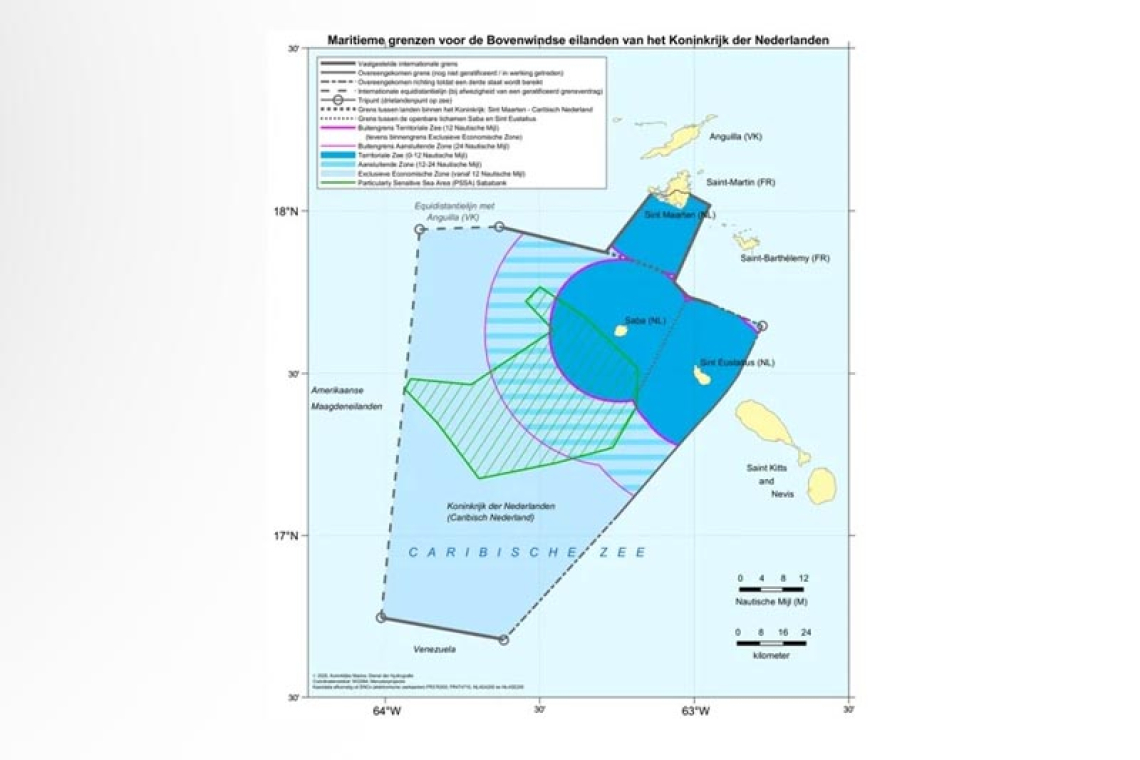
WILLEMSTAD--The Parliament of Curaçao has received a proposal for a Kingdom Act to approve a treaty that establishes the maritime boundary between the Kingdom of the Netherlands and St. Kitts and Nevis. The treaty was signed in Basseterre on April 4, 2024.
On October 19 of this year, Dutch King Willem-Alexander submitted the proposal for Kingdom-level approval to the Parliaments of Curaçao, Aruba and St. Maarten, as well as to the House of Representatives in The Hague. Governor of Curaçao Mauritsz de Kort forwarded the documents to Parliament on November 4.
The treaty defines the maritime boundary between the Kingdom and the Federation of St. Kitts and Nevis. The boundary concerns maritime zones to which both parties may lay claim.
Negotiations began with technical discussions in 2013. In September 2014, an agreement on the text was reached, and it was initialled by the negotiators from both sides.
Signing was initially planned for 2016 but was delayed due to internal decision-making processes within St. Kitts and Nevis. In 2023, the Caribbean country indicated that it was ready to proceed with the signing.
The demarcation was established in consultation with the public entity of St. Eustatius, which is located just over 10 kilometres northwest of St. Kitts and Nevis. According to the explanatory memorandum, the boundary provides clarity regarding the geographical scope of jurisdiction at sea, including matters such as fisheries management and the protection of the marine environment.
The agreed-on demarcation spans approximately 140 kilometres, or 75 nautical miles. On the northern side, the line connects to the previously established maritime boundary with France in the vicinity of Saint-Martin. On the southern side, it links to an existing demarcation with Venezuela.
Definitive demarcations are still pending with the United Kingdom (regarding Anguilla) and the United States (regarding the Virgin Islands). According to the explanatory notes, negotiations on these matters are ongoing.
The treaty also includes provisions for consultations concerning marine management and potential future cross-border oil or gas fields. Should a dispute arise between the
parties regarding the interpretation or application of the treaty, they are required to first engage in consultations.
If this does not lead to a resolution within a reasonable time-frame, the matter shall be referred to the dispute settlement procedure under the United Nations (UN) Convention on the Law of the Sea.
By its nature, the treaty will apply to the entire Kingdom. The related law will enter into force on the day following its publication in the Dutch National Gazette (“Staatsblad”).