





Do you have US $7? Then you can go online and purchase six ounces of dirt.
Yes, dirt for railroad modellers is selling for just US $7 a bag. And there are two different types of dirt. You can choose from Orange Clay or “Just Dirt Road Grit.”
The Mine Mount Models advertisement reads, “It is made from REAL DIRT that has been sterilized and sifted to a variety of grades.”
Well, I have to admit I have never sterilised my dirt or sand. I just dig a little hole, put the dirt in the bag and take it home.
I do use a sifter. I actually have one just for modelling. Yes, that means my wife caught me using her good kitchen sifter, had a few words for me, gave me that sifter, went out, bought a new one and explained that it is for food only.
The ad continues to explain that dirt is available in two colours and comes in four grades: fine, medium, coarse and rubble.
So I went online and guess what? Other companies do sell dirt. Woodland Scenics sells it by the bag or bottle. They sell it according to the area the dirt should cover. For just US $4.95, you get enough dirt for 21.6 inches.
And yes, they too offer the dirt in different colours and textures.
I continued my search and in less than five minutes found several other companies that sold a variety of dirt in different sizes and colours.
Then YouTube popped up. There are even videos on the best types of dirt for model railroads and tutorials on the best ways to glue it around the track.
One modeller just suggested going to a baseball field with a small brush and a plastic bag ... and harvesting your own.
All recommended placing the dirt on a cookie sheet – not one for food – and baking it.
“You would also need to bake it in an oven at around 400°F to make it sterile. Otherwise, you’re going to find all kinds of bugs and weeds growing on your layout,” explained one modeller.
The baking time is about one hour.
Once you are ready, it is time to spread the ballast.
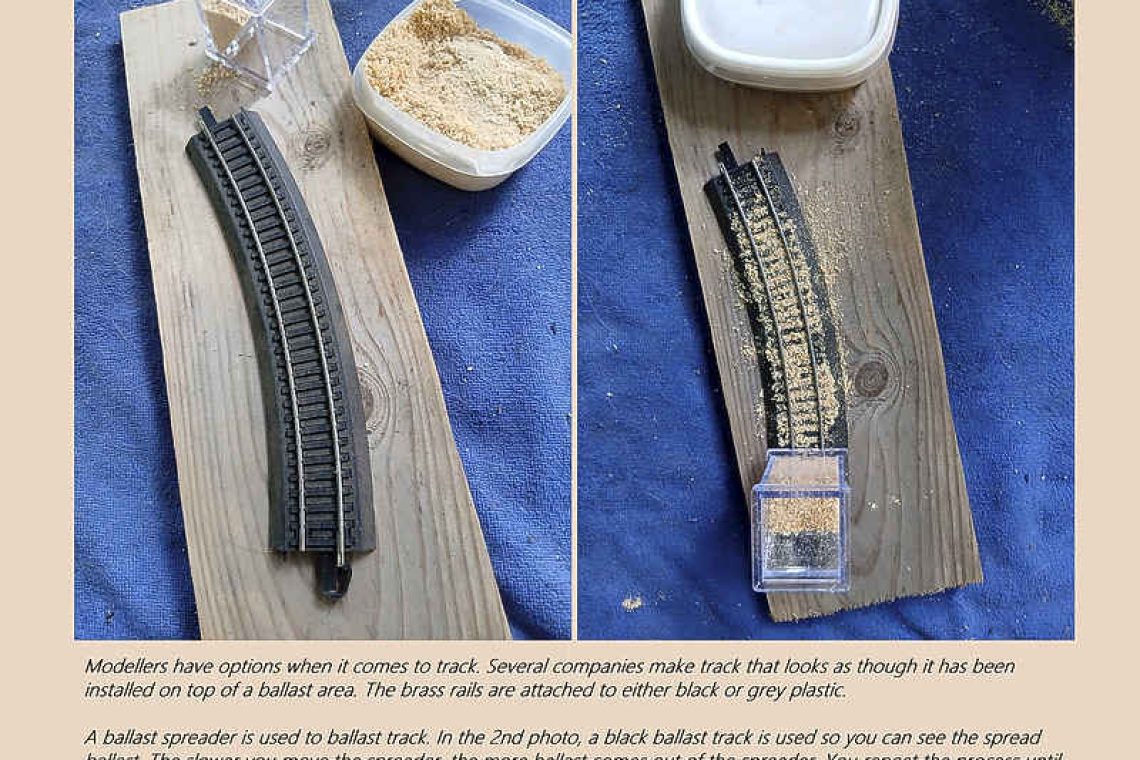
A spreader can be used to ballast track. The spreader is little more than a cube with a cut across the bottom. The slower you move the spreader, the more ballast comes out of the spreader. You repeat the process until you are happy with the results.
Spreaders can range from as little as US $3 for a no-frills, manually operated spreader to US $35 for a motorised spreader.
Some people worry dirt will eventually get into the trains, clog the gears and shut the operation down.
Some modellers use ground-up foam to simulate dirt. They believe it sticks to the glue better and is less likely to clog a train.
Scenic Express sells its CLAY – FINE – 48oz. ECO-PAK dirt to cover more area for US $14.99.
Still, other companies sell rolls of mat that simulate everything from dirt to water. You just roll the mat out, cut it to fit, glue it down and you’re done. It looks good, and there are no worries about clogged wheels.
Whatever method you decide on, take your time so you will get years of enjoyment out of the finished layout.
Until next time, I hope to see you around the tracks with lots of dirt but shiny rails.