





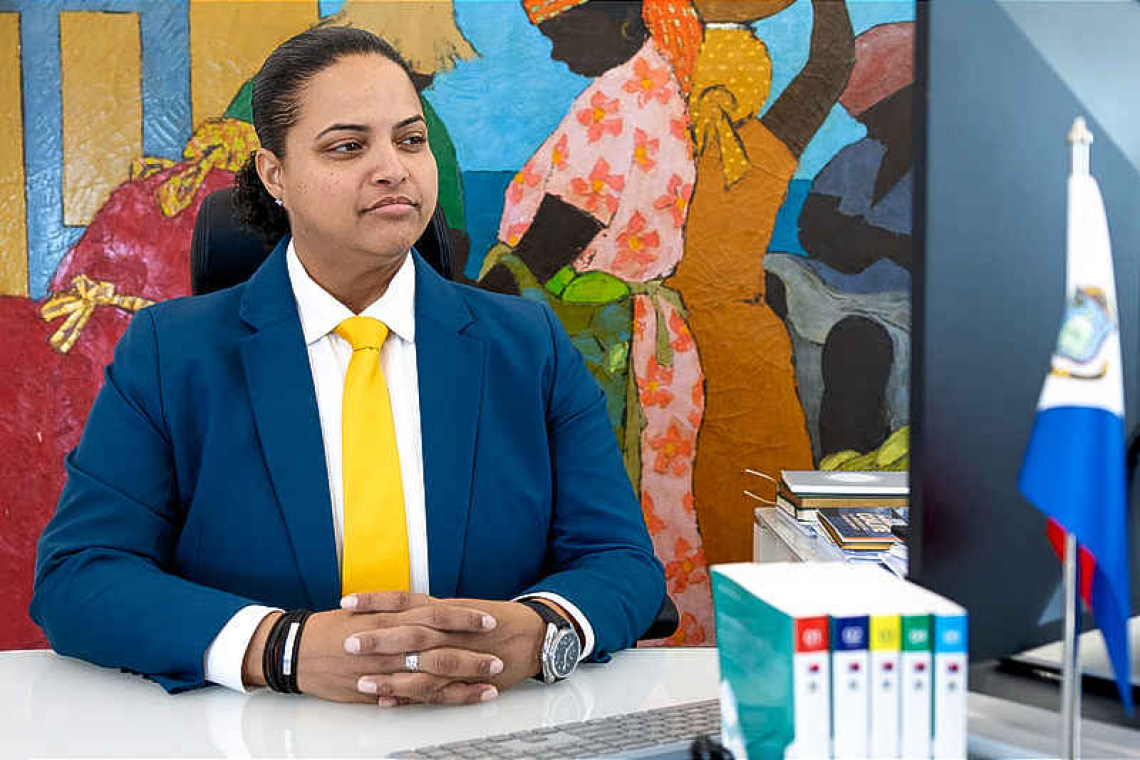
PHILIPSBURG--Minister of Education, Culture, Youth and Sport (ECYS) Melissa Gumbs says the Foundation Based Education (FBE) Exit Exam will not be scrapped as removing the test would not fix deeper challenges within the education system.
Speaking during her "MECYS Matters" livestream on Tuesday, Gumbs addressed feedback she received “both directly and indirectly” regarding the FBE review and report, as well as comments she made during a previous broadcast.
“I think the main message that I want to continue to impart on St. Maarten is that knee-jerk reactions, even at this stage, don’t help anybody; they are not actually going to solve anything,” she said.
Responding to calls to do away with the exam, the minister made clear she does not intend to take that step. “Doing away with the exam doesn’t actually fix anything about the system; it doesn't actually improve how children are learning,” she stated.
According to Gumbs, the report highlights above all the importance of the roles parents and teachers play in ensuring children have the best opportunity to learn. She noted that while much of the burden is often placed on teachers and government, certain foundational skills must be developed at home before children even enter the classroom.
“Key to note is that the report highlights more than anything else the role of parents and teachers in ensuring children have the best opportunity to learn,” she said, pointing to the need for young children to develop fine motor skills and practical abilities such as using their hands, tying shoelaces and properly handling a knife and fork.
Gumbs also revealed she would be participating in “a very interesting session” on Thursday at Hillside Christian School focused on the development of motor skills in young children.
She explained that the core issue is not the exam itself, but that students may be missing “key lessons and key experiences” along the way that affect their performance not only on the FBE but on any assessment. While acknowledging that the FBE exam “has been crafted to be a certain level of difficulty,” she added that there have been reports that the academic level is sometimes lowered in the first form to compensate.
“That’s not what we want to see,” the minister said, adding that students in the second and third grades should be mastering skills that earlier generations may not have been taught at that stage.
She cautioned against eliminating the exam simply to ease frustration. “Just doing away with the exam to appease the frustrations around it is another band-aid on a bullet wound, and I’m not interested in continuing that trend,” Gumbs said.
The minister said meaningful improvement will require shared responsibility and a willingness by all stakeholders to accept discomfort. “While it might be uncomfortable to not have instant gratification, I reiterate my call that we will all be uncomfortable together,” she said, listing parents, teachers, school managers, school boards, departments, the division, the ministry and society as a whole.
Gumbs also called on the private sector to support parental involvement by allowing employees time to attend report card meetings and other school activities. Reflecting on her own experiences, she noted that even parents working two or three jobs made the effort to show up for such engagements.
“If I’m going to press on parents the significance of them playing a role in their kids’ education, then guess who else I’m pressing – the private sector,” she said, warning that limiting parental engagement could contribute to young adults entering the workforce without basic literacy skills.
She stressed that improving education outcomes is a shared duty. “Government is not the village, never has been, never will be. The village is the entirety of all of us,” Gumbs stated.
While noting that Curaçao eventually removed its version of the exam, she said that the decision followed research and did not happen overnight. The ministry, she added, is currently working internally on the short-, mid-, and long-term recommendations outlined in the report.
“It’s important that everyone realises that we are all going to have a role to play in making those recommendations a success. It’s not only going to be the ministry, but it’s also going to be everyone,” Gumbs said.