





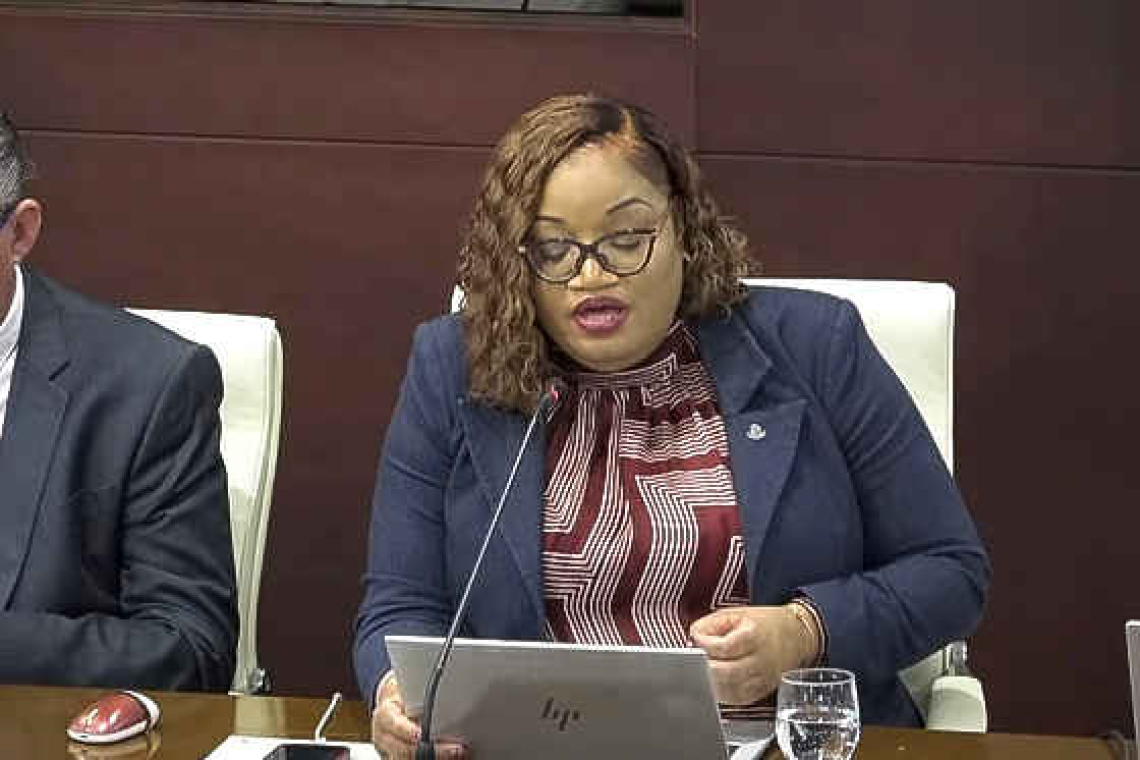
Finance Minister Marinka Gumbs.
PHILIPSBURG--Finance Minister Marinka Gumbs on Friday presented St. Maarten's first-ever policy-based national budget, projecting a Cg. 11 million surplus for 2026 while saying the government deliberately chose not to pursue a 2025 budget amendment to focus on completing the 2026 and 2027 budgets on time.
She described the budget as an important milestone in strengthening the country's public finances. She acknowledged that the budget was presented later than intended, but said the government's priority is now ensuring the country has "a sound and credible financial framework" for the remainder of the fiscal year.
According to Gumbs, the decision not to prepare a 2025 budget amendment was made in January 2026 after the Kingdom Council of Ministers prioritised the timely completion of the 2026 budget.
She said preparing another amendment would have placed additional strain on government's limited technical and financial staff while delaying both the 2026 and 2027 budgets.
Gumbs also called for a broader discussion on the purpose of budget amendments, saying they should focus on material policy changes, unforeseen circumstances, new priorities and necessary reallocations rather than adjusting budgets simply to match actual spending.
She explained that budgets are financial plans, while financial statements reflect actual results, and said differences between the two do not automatically require amendments.
The minister said the draft 2026 budget was submitted to the Council of Advice in early May. After its advice was received and the necessary adjustments were made, the budget was presented to Parliament.
A feature of the 2026 budget is the introduction of policy-based budgeting, the first time this approach has been used in St Maarten. Gumbs said the new system links government spending directly to policy objectives and expected results instead of focusing only on expenditure amounts. She said it will improve transparency, accountability and governance by allowing Parliament and the public to better understand how public funds contribute to national development goals.
For 2026, government projects total revenues of Cg. 647 million and total expenditures of Cg. 636 million, resulting in a projected budget surplus of Cg. 11 million. Gumbs noted that some expenditure tables total Cg. 637 million, but said the difference is solely due to rounding.
Compared to the 2025 budget, revenues are projected to increase by approximately Cg. 61 million, driven mainly by stronger tax revenues and project funding through programmes such as Temporary Work Organisation (TWO). Using the preliminary 2025 revenue figure of Cg. 565 million, the increase amounts to Cg. 82 million.
Tax revenues remain government's largest income source and are projected at Cg. 478 million, or approximately 74% of total revenues. The projections are based on the same percentage of gross domestic product used for the preliminary 2025 figures. Growth is expected to come mainly from wage tax and turnover tax, supported by improved compliance, modernisation of tax administration and stronger revenue collection.
Other revenues are projected at Cg. 91 million, including approximately Cg. 69 million in project grants from TWO, BZK and the Trust Fund. Gumbs stressed that these grants are temporary and should not be viewed as recurring revenue.
Revenue from licences is projected to decline from Cg. 24 million in the 2025 budget to Cg. 16 million in 2026 because fewer applications are expected, while fees and concessions are expected to remain stable at approximately Cg. 62 million.
On the expenditure side, total spending of Cg. 636 million is Cg. 58 million higher than the 2025 budget. Personnel costs increase by approximately Cg. 21 million, reflecting the filling of long-vacant positions, the 2.5% salary indexation for civil servants, and additional staff for projects funded by TWO and the Trust Fund.
Goods and services increase by approximately Cg. 39 million, mainly because of externally funded projects. Gumbs emphasised these costs are matched by corresponding revenues and therefore do not place additional pressure on the country's finances.
Compared to the preliminary 2025 expenditure figure of Cg. 545 million, expenditures increased by approximately Cg. 92 million, largely because of higher personnel costs and project-related spending.
She also warned that interest expenses are expected to increase over time as debt is refinanced and government borrows for major investments. Looking at government finances so far this year, Gumbs said provisional figures show a first-quarter surplus of Cg. 39 million, which is Cg. 36 million better than projected in the draft budget. The improvement resulted from approximately Cg. 9 million in additional revenues and Cg. 27 million in lower-than-budgeted expenditures.
She said even if expenditures had reached budgeted levels during the first quarter, government would still have recorded a surplus of approximately Cg. 12 million, demonstrating that the 2026 budget is realistic. Compared to the first quarter of 2025, revenues increased by Cg. 8.8 million, largely because tax income rose by Cg. 29.8 million, while expenses increased by Cg. 7.3 million, mainly due to payroll costs.
Gumbs said spending continues to be concentrated in government's core responsibilities. The Ministry of Education, Culture, Youth and Sport receives the largest allocation at approximately Cg. 126 million or 21% of total spending, followed by the Ministry of Justice with Cg. 114 million or 19%, and the Ministry of Public Health, Social Development and Labor with Cg. 109 million or 18%.
The Ministries of Finance and General Affairs each account for approximately 15% of government spending, while the Ministries of Tourism, Economic Affairs, Transport and Telecommunication and Housing, Spatial Planning, Environment and Infrastructure each account for approximately 6%. Government projects continued budget surpluses throughout the multi-year outlook, with surpluses of Cg. 11 million in 2026, Cg. 8 million in 2027, Cg. 15 million in 2028 and Cg. 17 million in 2029.
Gumbs said these projections are based on conservative assumptions and do not include potential new revenue-generating measures until they are confirmed. The projections also exclude funding beyond the first quarter of 2027 for the TWO programme because no extension has yet been approved. She said government remains committed to responsible budgeting, maintaining sound public finances and investing in the country's long-term development while continuing to strengthen financial management and improve resilience against future challenges.