





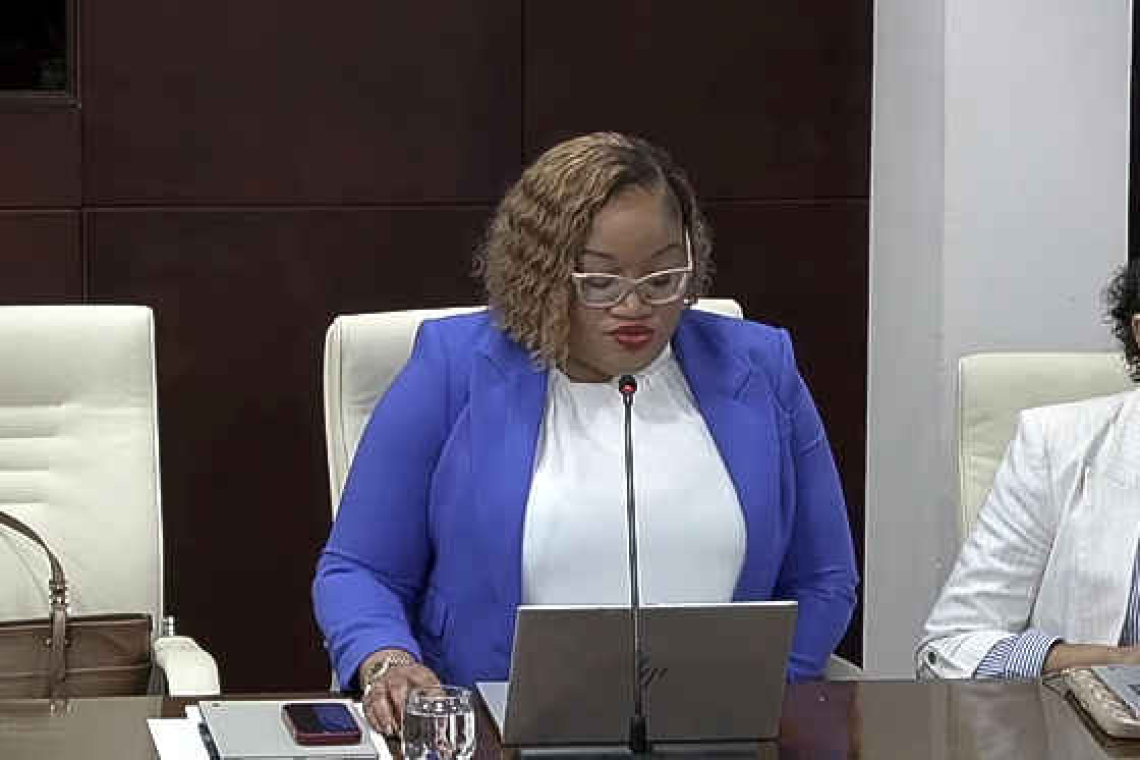
Finance Minister Marinka Gumbs.
PHILIPSBURG--The proposed National Ordinance on the Supervision of Payment Service Providers is the first step toward allowing international digital payment companies such as PayPal and Revolut to seriously consider operating in St. Maarten, Finance Minister Marinka Gumbs said on Wednesday.
The minister made the remarks during the continuation of a Central Committee meeting of Parliament on several draft laws related to financial oversight. The questions from Members of Parliament (MPs) were asked during the first round of the meeting, while the minister’s responses were delivered during Wednesday’s continuation.
Responding to questions from NA MP Darryl York about the absence of PayPal and Revolut services on the island, Gumbs said the proposed legislation would create the legal and regulatory framework international payment providers require before entering the market.
“The national ordinance creates market access for payment service providers. Without a license and supervision from the Central Bank, international payment service providers headquartered abroad, such as PayPal and Revolut, would not be willing to offer their services in St Maarten. So, this draft is the first step,” the minister stated.
Gumbs explained that although St. Maarten has a relatively small population, the country should not underestimate its strategic position and transaction potential. She said the island’s economy operates largely in US dollars despite the Caribbean guilder being the official currency, making it different from many other Caribbean jurisdictions.
She also pointed to St. Maarten’s unique position between the US dollar economy on the Dutch side and the euro-based economy on the French side, saying this creates opportunities for cross-border digital payments, tourism spending and international commerce.
In addition, the minister said the country’s value to fintech companies should not be measured only by population size, but also by the volume of transactions generated through tourism, cruise passengers, online bookings, restaurants, villas, excursions, car rentals and other business activity.
“So yes, while this legislation alone will not automatically bring companies like PayPal or Revolut tomorrow, it creates the legal credibility and regulatory certainty necessary for those conversations to even begin seriously,” Gumbs said.
DP MP Dimar Labega questioned why Revolut services appeared to have previously worked on the island before later disappearing. In response, Gumbs said her understanding is that Revolut may have initially allowed limited access through its broader international platform, even without a specific local legal framework. However, she said companies such as Revolut regularly reassess jurisdictions based on regulatory certainty, compliance requirements, supervisory frameworks and commercial viability.
The minister said there is no indication that Revolut’s services were revoked because of a single incident. Instead, she said the absence of a clear licensing and supervisory structure likely made long-term operations in St. Maarten less feasible.
Labega also suggested there may have been concerns from banks over peer-to-peer transactions reducing transaction fee income. Gumbs replied that while the perception was understandable, the main issue was the lack of a clear regulatory framework combined with the relatively small market size.
She further stated that government does not have information on exactly when Revolut exited St. Maarten, but available insights suggest commercial viability and regulatory issues were the main reasons.
Meanwhile, MP Ardwell Irion asked whether the legislation would also allow local banks or the Central Bank to develop their own digital payment platforms similar to PayPal or Revolut.
Gumbs said the proposed National Ordinance on the Supervision of Payment Service Providers is open to all market participants and creates a level playing field for any qualified institution that meets the required licensing and regulatory standards.
She said the legislation does not single out specific companies, but instead establishes a framework under which institutions can develop and offer payment systems and digital financial services within St. Maarten.