





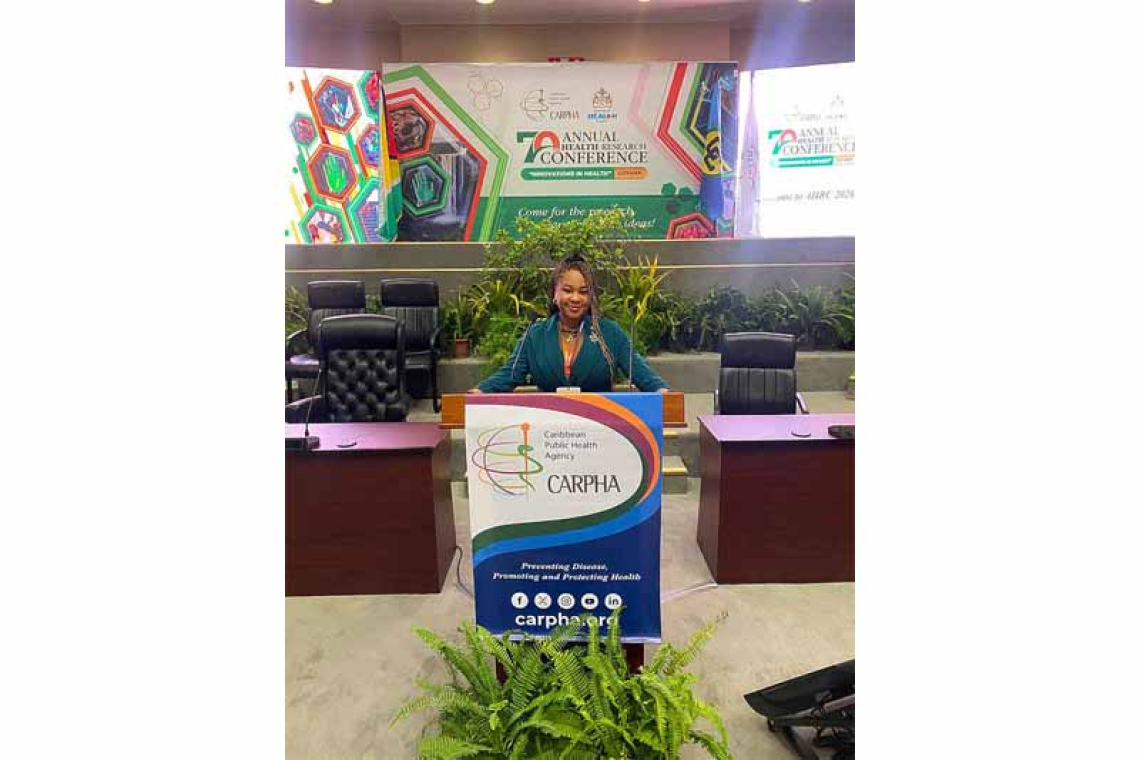
Khalisha Halley.
GUYANA--St. Maarten native Khalisha Halley recently presented research on substance use during pregnancy and its link to low birth weight at the 70th Annual CARPHA Health Research Conference in Georgetown, Guyana, placing her work before regional health leaders, ministers and international public health officials.
Halley, a doctoral student at Florida A&M University (FAMU), presented findings from her master’s thesis during the conference, which brought together ministers of health, heads of government and global public health leaders from across the Caribbean and wider hemisphere.
Her research examined whether marijuana use during pregnancy was associated with low birth weight and compared it against exposure to other substances using real-world population health records.
“A lot of people are surprised by how many women test positive for substances at birth,” Halley said. “But what matters is understanding whether there is a measurable association with outcomes like low birth weight, and what the data actually shows.”
Halley grew up in St. Maarten with a strong interest in women’s health, particularly maternal health, pregnancy and postpartum care. She later pursued undergraduate studies at FAMU, earning a bachelor’s degree in Pre-Med Biology before working at a clinic during a gap year, where she was introduced more deeply to public health.
She later entered a Master of Public Health programme, where she completed rotations through the Florida Department of Health, volunteered with public health organisations and worked as a health analyst before completing the degree.
“When an adverse health outcome repeatedly appears in a population, it takes more than personal stories to truly understand its impact,” she said. “Health outcomes should be recorded in a standardised and organised way so analysts can measure the actual burden of a disease or condition within a population. From there, you can identify associations, risk factors, trends, and insights that help guide evidence-based policies and interventions.”
Halley is now pursuing a Doctor of Public Health in Epidemiology and Biostatistics at FAMU, where research forms a central part of her training.
She said her work focuses heavily on understanding the social determinants that contribute to substance use during pregnancy, including poverty, chronic stress, childhood trauma and limited access to healthcare. She stressed that public health responses should focus on support systems rather than punishment.
According to Halley, meaningful responses should include routine prenatal screening, community outreach, mental health resources and stronger local data systems so islands such as St. Maarten can conduct their own research and track health trends more effectively.
The CARPHA conference marked the first time Halley presented research at a regional conference of that scale. Attendees included ministers of health from Guyana, Belize, Dominica, Grenada and Trinidad and Tobago, as well as the Prime Minister of St. Kitts and Nevis and the President of Guyana. Representatives from CARPHA, PAHO/WHO, the European Union and Caribbean Community Caricom also participated.
One of the presentations that stood out to Halley focused on a programme called SMARThealth, which trains community health workers to conduct screenings that combine maternity care with prevention of non-communicable diseases.
“I found it especially impactful because it connects maternal health with long-term disease prevention in a practical and community-based way,” she said.
She also highlighted discussions surrounding regional specialisation in healthcare, where certain islands could become centres for specific medical services that neighbouring islands could access rather than each territory independently trying to build capacity in every speciality.
Halley said the conference also allowed her to connect with researchers from the Bahamas, Barbados and Washington D.C., many of whom work closely with their ministries of health on research initiatives.
She noted that she has attempted to access public health data from entities in St. Maarten for research purposes and hopes to contribute to evidence-based policymaking on the island in the future. “There are public health professionals on this island who understand the value of evidence-based policy,” she said. “I believe that. I hope to contribute to that work one day.”
For now, Halley continues working toward completing her doctorate while building her future in public health research.