





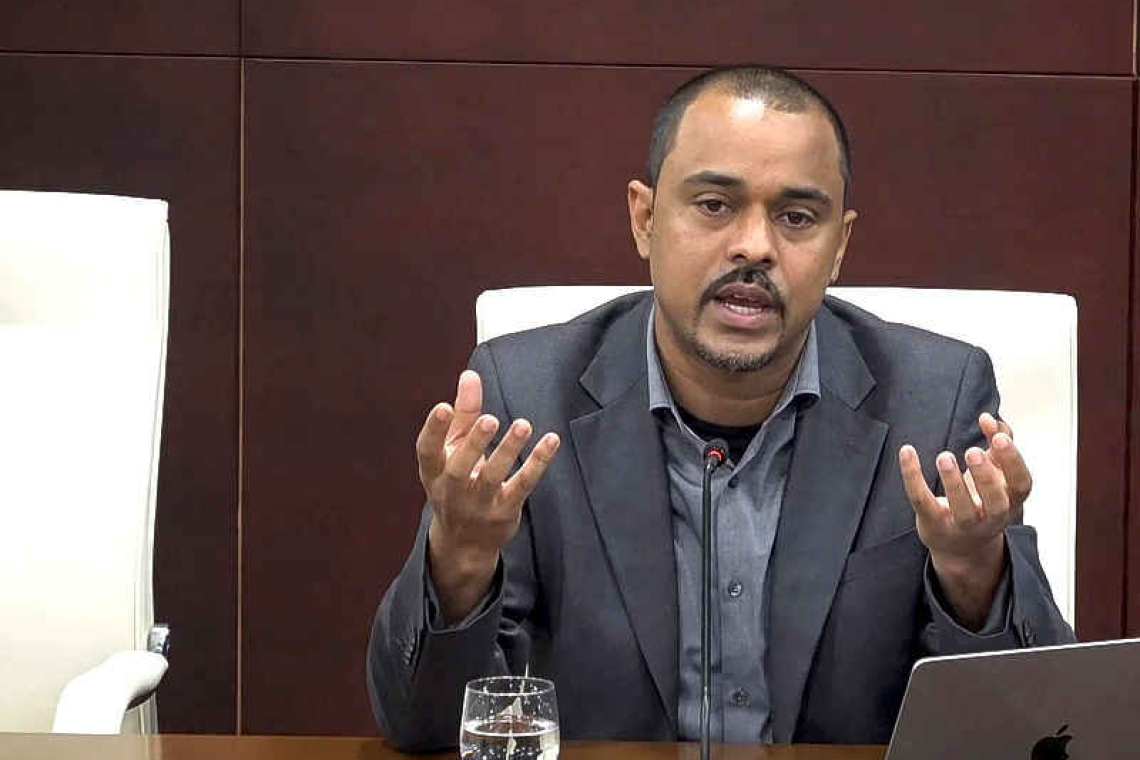
Rolando Brison
PHILIPSBURG--The International Monetary Fund (IMF) no longer recommends against St. Maarten’s proposed Financial Transaction Tax (FTT), according to Economy, Transportation, and Telecommunication (ETT) Senior Policy Advisor Rolando Brison, who told Parliament on Wednesday that work had been done to address the concerns raised during earlier discussions with the international organisation.
Brison, who was part of the team accompanying Tourism, Economic Affairs, Transport and Telecommunication (TEATT) Minister Grisha Heyliger-Marten to Parliament, said the IMF had initially strongly recommended against the proposed tax in 2021, but its position had changed following further engagement in 2025.
He said the IMF had raised several concerns, with the main one being the potentially regressive nature of the tax. Following work to address those concerns, the Government met with the IMF in June 2025 and was informed in October that it no longer recommended against the FTT. Brison said the IMF had nevertheless asked the Government to continue addressing the tax’s regressive effects.
Brison explained that the ministry had considered how the proposed tax fits within international standards, including those established by the Organisation for Economic Co-operation and Development (OECD), the IMF and the Financial Action Task Force (FATF).
He cautioned against the misconception that these organisations establish strict, codified laws that countries must follow in every detail.
Referring to the OECD’s guidance on harmful tax practices, he said: “The OECD does not seek to dictate to any country what its tax rate should be, or how its tax system should be structured.”
He also cited IMF guidance on Article IV consultations, which states that “Principles B through E constitute recommendations rather than obligations of members.” Principle E covers domestic economic and financial policies.
On the FATF, he referred to its recommendations, which state: “The FATF Recommendations, therefore, set an international standard, which countries should implement through measures adapted to their particular circumstances.”
Brison said the Government nevertheless takes the organisations’ recommendations seriously and that St. Maarten was in a good position regarding their official reports following the most recent engagements with the FTT.
Brison also addressed concerns about the proposed reduction of profit tax to zero percent, which he described as a key component of the FTT proposal. He recalled that the OECD’s main concern in 2021 was the possibility that reducing profit tax to zero percent could result in a country being considered a tax haven or facing blacklisting.
However, he said the OECD made a significant policy shift later that year through Pillar Two. Under that framework, he explained, the focus shifted to companies with a value exceeding 750 million euros, which are subject to a 15-percent effective tax rate.
Brison said the proposed FTT would therefore be consistent with the OECD’s Pillar Two guidelines, provided that companies of that size attracted to Sint Maarten are taxed at an effective rate of 15 percent.
He said this would allow the Government to introduce the FTT, reduce various existing taxes and provide benefits to local businesses without facing negative criticism from international organisations.
He argued that eliminating profit tax would help make St. Maarten more attractive for investment, improve its competitiveness with Caribbean jurisdictions that also have a zero-percent rate, simplify the tax system and increase compliance.
Addressing concerns about regressive taxation Brison said one of the recurring concerns about the FTT was whether it would be regressive. He argued that St. Maarten’s existing tax system was already regressive because of the low level of tax compliance.
Referring to figures from the Committee for Financial Supervision (CFT), he said the compliance rate was approximately 30 to 40 percent. He argued that this meant some people earned income without paying taxes, while others paid taxes on their wages and other earnings.
Brison said the proposed FTT was intended to address this imbalance by ensuring that everyone contributes through the tax system. He outlined a proposed shift in which businesses would pay less tax to the government but pay more to their employees, while workers would also pay substantially less in wage tax.
According to Brison, the proposal could shift economic gains from businesses and government directly to workers by allowing for a considerably higher minimum wage and a much lower wage tax. He also linked the proposal to the ongoing discussions about increasing the minimum wage, saying that stakeholder engagement would be difficult if businesses were not offered fair concessions to support a substantial increase.
Brison said FATF was less concerned with the particular tax system a country chooses and more focused on information sharing and combating money laundering and the financing of terrorism. He said work on those matters was underway through Government and Parliament, including the relevant laws. Brison said the ministry was prepared to provide further explanations on the international organisations’ concerns and the proposed tax if members of Parliament had additional questions.