





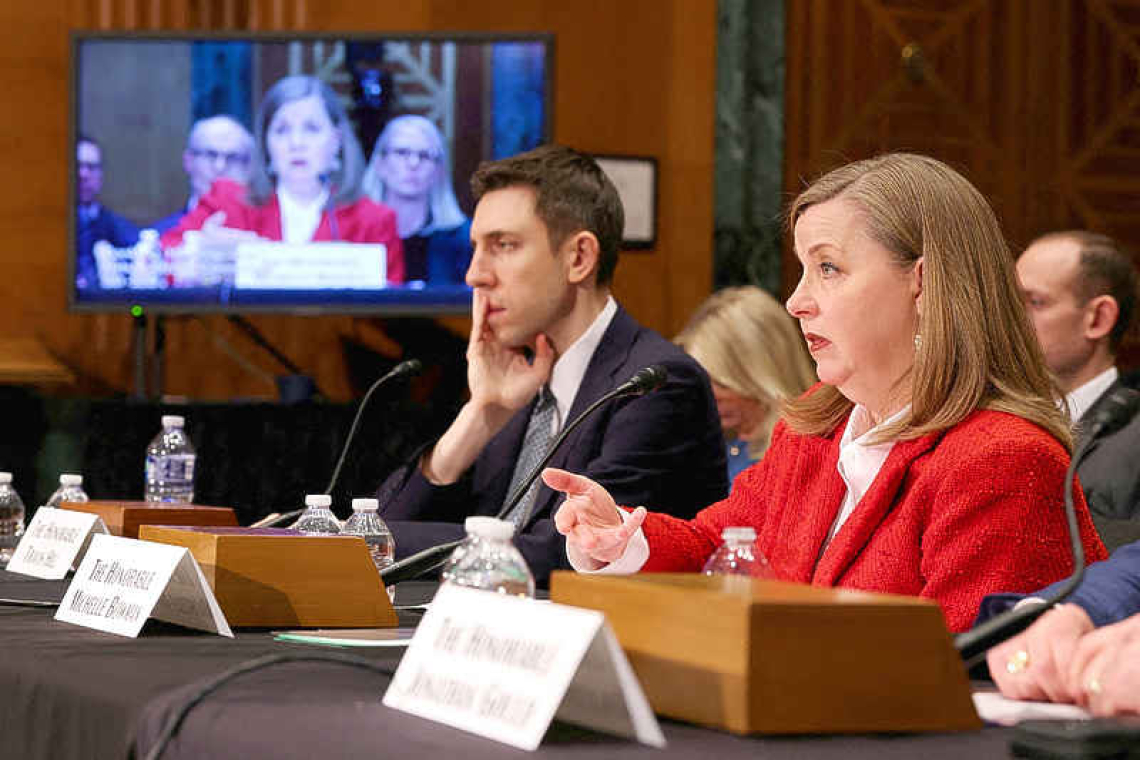
WASHINGTON--Wall Street banks are pushing the Federal Reserve behind the scenes to cement its new supervisory regime so the changes cannot easily be reversed by potential future Democratic administrations, said four people with knowledge of the matter.
As Republican President Donald Trump's regulators undertake the biggest overhaul of bank oversight since the 2008 financial crisis, they are sharply curtailing the use of "matters requiring attention," or MRAs, the primary tool bank examiners have long used to force lenders to fix risk management and control weaknesses.
Conscious that they have a rare opportunity to ease what they say has become a hostile and onerous regime, lenders are trying to lock in their wins. They are urging the central bank to formally address legal ambiguity surrounding the softer process that has replaced MRAs, to put banks on a solid legal footing long term, and the Fed plans to give more clarity, said the people granted anonymity to discuss private talks.
The effort, reported here for the first time, shows Wall Street banks are already trying to future-proof the changes, anticipating Democrats skeptical of Wall Street will seek to reverse them - underscoring what some Fed-watchers say is the growing politicization of Fed supervisory and regulatory policy.
Trump's Fed Vice Chair for Supervision Michelle Bowman, who is leading the changes, is "attempting to alter the supervisory culture of the Fed and to shift the power balance ... in favour of bank management," said Todd Baker, senior fellow at the Richman Center for Business, Law and Public Policy at Columbia University.
Bowman has said supervisors are too bogged down by catching footfaults, or small missteps, and that her goal is to focus them on real risks, not to weaken oversight. A Fed spokesperson declined to comment.
An MRA is a confidential way for examiners to identify problems they find at banks and direct the firms to address them. If a firm fails to fix the issue, it could eventually escalate into a formal enforcement action and monetary penalties. Most large banks typically have to deal with numerous MRAs at any given time.
In October, the Fed said it would reserve MRAs for material financial risks, and start leaning again on "observations," a tool the central bank scrapped in 2013, as a way to informally flag issues. In a February memo, the Fed said it may also downgrade some existing MRAs to observations.
While MRAs can lead to enforcement actions, observations are nonbinding. Although banks have cheered the new approach, they believe observations are legally ambiguous and it is unclear how supervisors will respond if banks don't act on them, the sources said. They worry future Democratic Fed leaders may seize upon that ambiguity to escalate observations they believe have not been fixed, to MRAs.
Banks are pushing the Fed for explicit written assurances that supervisors will not do that, and only escalate observations to MRAs if the facts around the issue change, the people said. The Fed has said it will amend public 2013 documentation around observations, and that could provide more clarity, one of the people said.
Banks have long complained supervisors routinely resort to MRAs for minor issues and their overzealous use can distract management. Silicon Valley Bank, they point out, had 19 open MRAs when it collapsed, most of which did not focus on the core issues that brought it down, a Fed post-mortem found.
MRAs became supervisors' primary cudgel after the 2009 crisis highlighted that lenders were mostly ignoring observations, leading the Fed to scrap them, according to two former officials familiar with the Fed's thinking at the time.
Arguing red tape is stymieing lending and the economy, the Trump administration is trying to steer softer bank rules and supervision, an effort that could gain steam under Trump's new Fed Chair Kevin Warsh.
In addition to limiting MRAs, the Fed and other bank watchdogs have scaled back the number and scope of bank exams, and this month proposed overhauling the confidential bank rating system. Bowman has also announced plans to reduce regulation and supervision headcount by around 30%, leading to the exit of long-tenured staff, and has brought in her own people, including former veteran Wall Street attorney Randall Guynn, who was recently appointed director of supervision and regulation, Reuters reported.
Democrats say the changes are weakening financial system safeguards at a perilous time for the global economy, and some bankers expect a backlash if they take the White House in 2028.While it has become typical for the regulatory pendulum to swing between Republican and Democratic administrations, that dynamic has become "supercharged" as Trump's White House has asserted more control of the regulators, said Baker.
A White House spokesperson said the Trump administration is focused on "objective and measurable risks" to financial markets.