





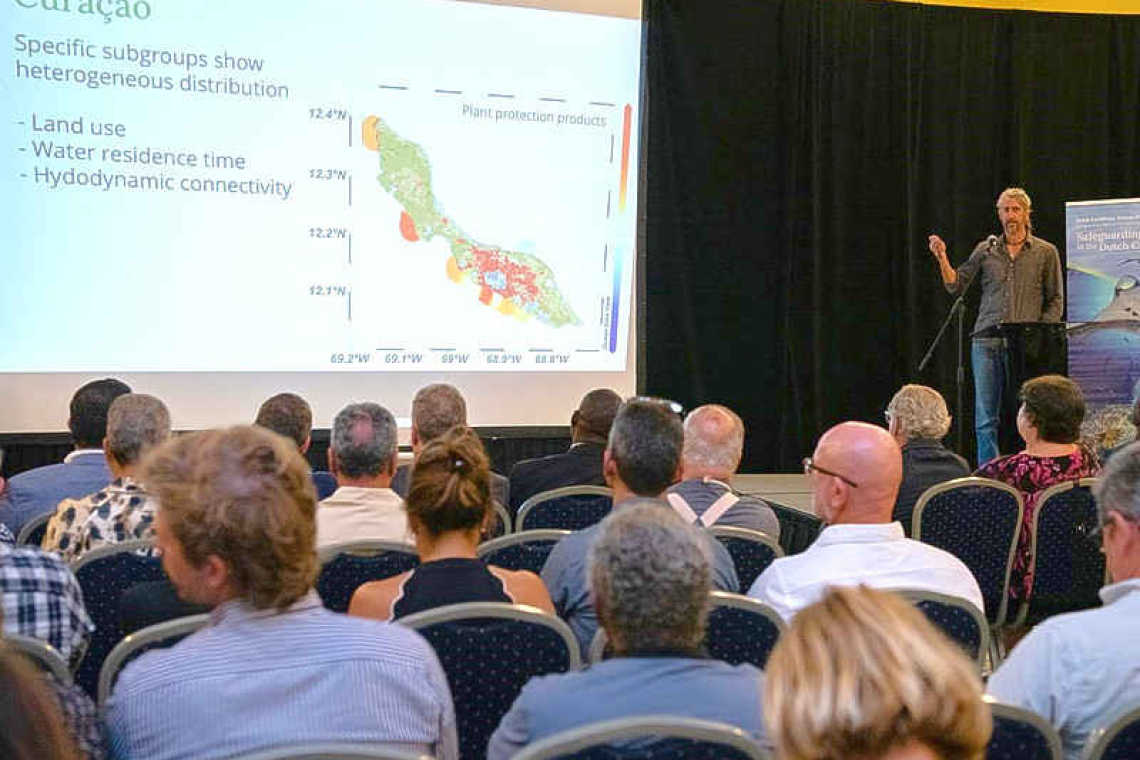
Scientists, policymakers, and conservation partners gathered on Curaçao for the Water Quality Symposium late last year, where new research shed light on how coastal water quality is shaping the future of Caribbean reefs. The event also celebrated the 70th anniversary of the Caribbean Research and Management of Biodiversity CARMABI Foundation, a milestone in the region’s scientific and conservation history.
Modern Tools Reveal a More Complex Picture of Water Quality
Dr. Andreas Haas (Royal Netherlands Institute for Sea Research NIOZ) presented new findings showing that traditional monitoring methods, focussed on temperature, turbidity, pH, and nutrients, capture only a fraction of what drives reef health. Just one millilitre of seawater contains hundreds of thousands of microbial cells and more than a million organic and chemical compounds, including xenobiotics such as pharmaceuticals, pesticides, and other human-made substances.
Haas’ work revealed that these pollutants are now widespread around Curaçao, influenced by land use, water circulation, and human activity. Using new analytical techniques, his team has been able to trace pollution sources with far greater accuracy and at lower cost. Furthermore, results from the COVID-19 tourism slowdown showed that coastal water quality can improve quickly when pressures decrease. This shows that meaningful improvements are possible on a relatively short timeline when dedicated action is taken.
Reef Changes Reflect Broader Caribbean Trends
Dr. Mark Vermeij (CARMABI/University of Amsterdam) shared long-term data showing that Curaçao’s reefs continue to shift toward algae, cyanobacteria, and microbes, especially near densely used coastlines. His analyses revealed that many contaminants, including pharmaceuticals, pesticides, and heavy metals, now occur at levels known to affect marine life, and that these chemical signals often align with areas of low coral cover and reduced fish populations. He also showed how daily nutrient levels can fluctuate tenfold, making single nutrient measurements unreliable indicators of reef condition.
While nutrients remain part of the story, Vermeij emphasised that isolated nutrient readings can no longer explain current reef dynamics. Instead, legacy impacts, chemical pollutants, herbivore declines, and land-based inputs all interact at the ecosystem level, creating a shift where microbes and algae replace corals and reef fish.
He called for monitoring approaches that prioritise ecologically meaningful indicators, such as pathogens, microbial shifts, and herbivory, rather than relying on single-parameter chemical snapshots. Strengthened wastewater infrastructure, effective enforcement, and better coastal planning were highlighted as critical next steps.
A Legacy of Science: CARMABI at 70
The symposium also marked CARMABI’s 70th anniversary, with Director Dr. Manfred van Veghel reflecting on the institution’s foundational role in marine science and protected area management. Since the 1950s, CARMABI’s research has shaped regional conservation policy, supported the creation of national parks, and built the datasets now guiding water quality and reef resilience work.
Looking Ahead
The symposium underscored the need for more meaningful, system-wide monitoring that reflects how reefs actually respond to pressure. As the COVID period showed, when major stressors are reduced, coastal ecosystems can rebound far more quickly than expected. Experts agreed that if the region acts now, and works together across islands, measurable improvements in water quality and reef health are achievable within just a few years.
The full presentations are available for viewing via the Dutch Caribbean Biodiversity Database.