





~ St. Maarten’s Backyard Astronomy for January 9 - 11, 2026 ~
Sun rises at 6:45am
Sun sets at 5:53 pm
Lunar phase: third quarter, waning half moon
Moon rises at 10:26am, Saturday
Moon sets at 10:30pm, Saturday
This weekend as the sun sets, look for Saturn high in the western sky, on her way down to the horizon. Meanwhile Jupiter is on the rise over towards the eastern sky. Both of these are worth noticing and even taking out the binoculars to see a few glorious and awe-inspiring details. For instance, Jupiter, through magnification, can reveal four of the biggest moons that orbit around that huge gas giant planet. And Saturn might just give you an impression of those famous rings! Watch out, though, you might find yourself investing in a more powerful telescope – a taste of this kind of magic can be addictive!
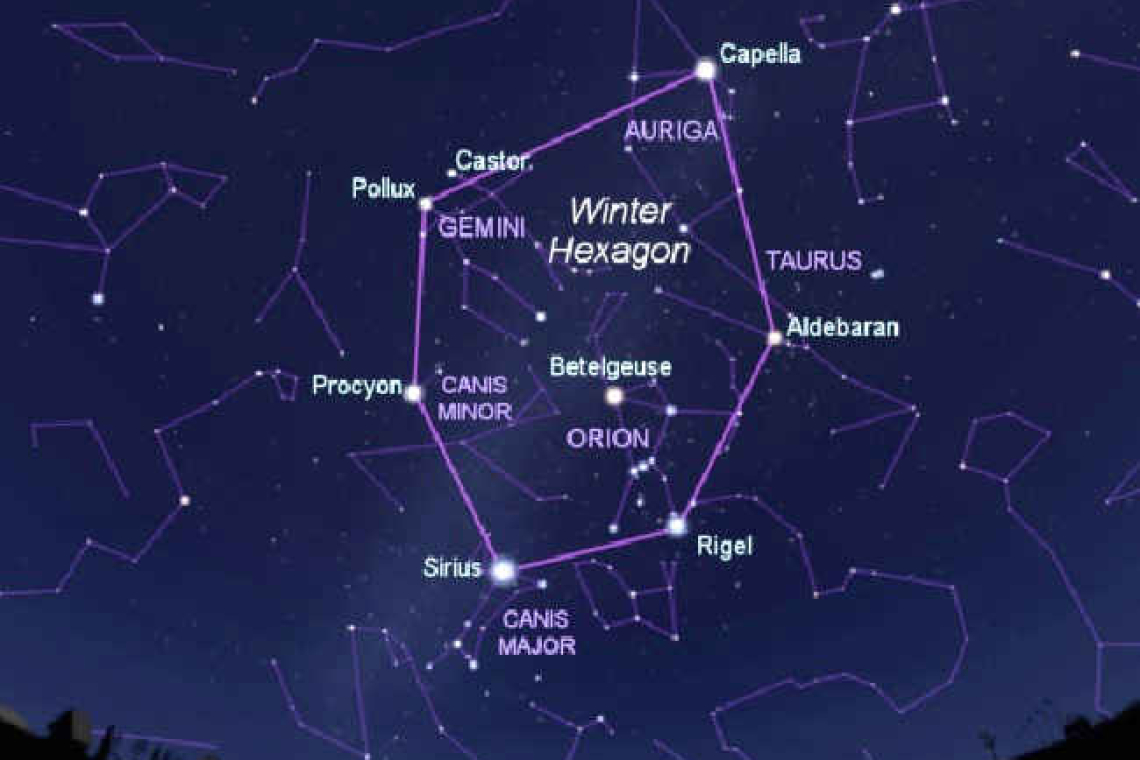
Between Jupiter and Saturn, we can locate our favorite winter constellation, Orion the Hunter. Once you find The Hunter, the entire Winter Circle of brilliant stars pops out. This large star shape is a combination of six different constellations. Use the image provided here or just google “Winter Circle of Stars” and find an image that helps you locate the key players. The whole circle will dominate the sky from about 8:00pm until about 2:00am.
Starting with Orion (his foot is the bright star Rigel), and above that star is Orion’s three-star belt; and above that, in the center of the circle, sits Betelgeuse. Work your way anticlockwise around the circle from Rigel, there is Aldebaran, the eye of Taurus the Bull. Next stop is Capella in the constellation Auriga the Goatherder. Around the circle, we next visit the twin stars of Gemini, Castor and Pollux (Jupiter is near these two this weekend). The circle is complete as we find the two dog stars: Procyon in Canis Minor and Sirius in Canis Major.
Jupiter is very bright this weekend, primarily because of the position that we on earth have in relationship to Jupiter and the Sun. It’s called “Opposition”, which means the earth is directly between the Sun and Jupiter. This positioning lends strong sunlight to the surface of Jupiter’s cloudy and thick atmosphere.
Another point of interest is the Pleiades, which are sometimes called the “Seven Sisters.” This tiny cluster of stars is shrouded in gas and dust and so appears hazy, but very lovely. More about the Pleiades next weekend!
Thank you for keeping up with the Night Sky articles, backyard (or beach) astronomy designed for St. Maarten sky viewing. FYI: If you are out later on in the week, note that each star rises about four minutes earlier each day than written here, and the moon rises 50 minutes later. Night Sky is researched and compiled by Lisa Davis-Burnett. Earthsky.org is a key resource for information and images. Questions or comments? Email This email address is being protected from spambots. You need JavaScript enabled to view it.