





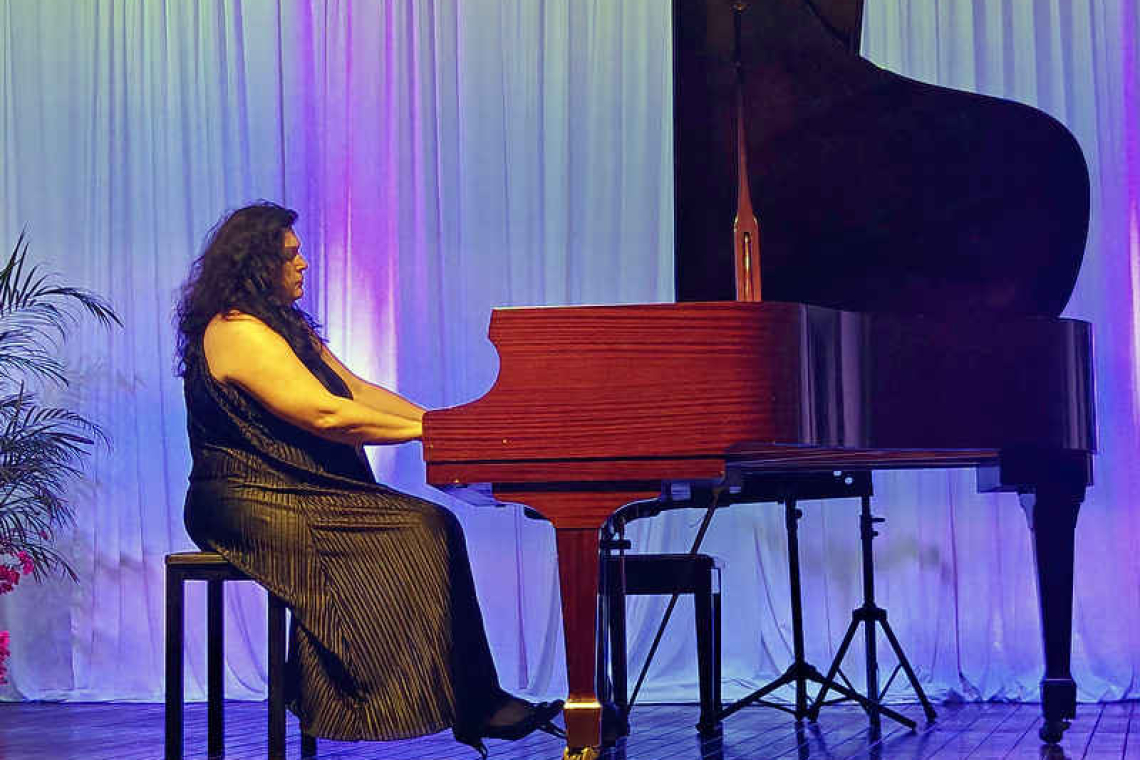
Irina Kaufman-Brookes is a performing pianist, an experienced teacher, a masterclass instructor, and a competition jury chairperson. In this interview, she tells us about her artistic journey, teaching philosophy, international career, and her connection to Sint Maarten.
1. What first drew you to the piano, and when did you realize that music was going to be more than simply a hobby for you?
It was my mother’s idea, dream, and incredible effort to introduce me to music at age five. Both my parents had musical education, and my paternal grandmother was a composer and student of Dmitri Shostakovich. At six, I was accepted to the Sverdlovsk Special Music School under the State Ural Conservatoire. With small classes and an exceptionally creative environment, we studied performance, theory, history, chamber music, and collaborative piano. Our wonderful mentors gave us tremendous care and guidance. Those early years made music not simply an education, but the foundation of my life.
2. You have performed major works by composers such as Brahms. When you approach a piece like Brahms’ C-minor Quartet, what do you look for before you even begin working on the notes?
Before approaching major works such as Brahms’ C-minor Quartet or Rachmaninoff’s Cello Sonata, I seriously reflect on whether I am ready for them at my current artistic and professional stage. For example, I have studied Chopin’s Ballade No. 1 many times but decided to postpone it for now. I believe musicians must understand their limitations and evaluate the risks of repertoire choices. I teach my students the same principle: Performing is a great responsibility, and choosing the right program is essential to creating a convincing and successful performance.
3. Your career has taken you to many different countries and musical environments. How have international performances and collaborations influenced you as an artist?
I was incredibly fortunate to study with Lev Naumov and Evgeny Lieberman. These two giants shaped my musical standards and artistic vision, and I consider myself a product of their school. Internationally, I have also been privileged to collaborate with Vladimir Chernov, Anayanci Quiros Arce, and Elena Okolysheva. In 2018, we performed a Rachmaninoff tribute at Costa Rica’s National Theatre, marking the 75th anniversary of his death. Through Rachmaninoff’s great-great-granddaughters, Nathalie and Alisen, I have also had the extraordinary privilege of playing his piano in their home. I have remained in contact with the family for eleven years.
4. You recently performed in Cremona, Italy. What was particularly memorable about that experience, both musically and personally?
This summer, I returned for my third time as faculty at the Cremona International Musical Academy, created by violinist and conductor Mark Lakirovich. He brings exceptional musicians from around the world together, and we have become a true “Cremona family,” supporting one another throughout the year. This experience constantly reminds me how much we can learn from different musical cultures. One unforgettable example was working with British cellist Joseph Elworthy. When another cellist had to cancel, Joseph learned the entire program in one day. After only one rehearsal, we performed successfully. That experience showed me the power of flexibility, trust, and musicianship.
5. What makes teaching a masterclass different from working with a student on a regular basis?
A masterclass is a quintessence of what I can give to a student. Unlike regular lessons, I have very limited time with a young pianist who may have travelled a long distance and placed their trust in my knowledge. I feel a strong responsibility to give my very best in that short time. Masterclass students are usually highly motivated, and I strive to meet their musical needs and expectations. When that connection continues, students often take additional online lessons. One of my students from Costa Rica, now studying at Mozarteum University in Austria, even travels to Sint Maarten for extra work with me.
6. When you work with a young pianist, how do you balance technical perfection with individuality and artistic expression?
A very important part of my work is what I would call “repertoire politics.” Choosing the right program is a key factor in success, especially when a student is preparing for an audition or competition. Young pianists often show interest in different pieces, and I always love to listen to their wishes and ideas. However, it is my responsibility to make sure their choices are realistic and appropriate for their current level, because young students are not always able to accurately evaluate their own abilities.
The quality of the performance is always a priority. At the same time, I spend a great deal of time helping students develop self-control, self-awareness, and a realistic attitude toward their own capabilities. I believe that when the repertoire is chosen correctly, it gives a young pianist the opportunity not only to demonstrate technical ability, but also to develop individuality and genuine artistic expression.
7. What is the most common mistake you see talented young pianists make, and what advice would you give them to overcome it?
Many children are capable, and some have genuine talent. But having talent is like having a grand piano at home – the piano cannot play by itself. The same is true of talent. It has to be developed, polished, and mastered. Only hours and hours of dedicated work can turn talent into real achievement. I would say that one of the most common problems I see is a lack of commitment and discipline.
Unfortunately, parents sometimes involve their children in too many different activities, leaving them with very little time to invest in the area where they may have the greatest potential. If a young pianist has genuine ability and truly wants to achieve something, they need time, patience, discipline, and consistent work. Talent is only the starting point.
8. If you could give one piece of advice to a young pianist who dreams of performing on the world stage, what would you tell them?
Keep your ears, eyes, and heart open. Listen to as much music as possible, travel, attend different masterclasses, and take part in summer music academies. Expose yourself to different teachers, musicians, cultures, and artistic ideas. Success comes to those who are devoted, curious, and knowledgeable. A great musician never stops learning.
9. Have you performed in St. Maarten this past year?
Yes. On June 4, I was very happy to perform in a recital organized by the Classical Delight Foundation of Sint Maarten. I am very grateful to the organization and especially to Mrs. Bernadine van Veen, who is in charge of the foundation, for the invitation. This was my fourth performance in St. Maarten, and I am always looking forward to every opportunity to perform for the public here. I have been preparing a new program for the upcoming musical season, and I hope to have the opportunity to introduce this new repertoire to audiences in St. Maarten again.
Ms. Irina Kaufman-Brookes’ WhatsApp contact for more information: +590 690 77 0680.