





At some point in time, you are going to want to change trains or at least cars. Perhaps you are ready to switch between passenger service and a freight train. The easy way is to just have a siding with the next train you want to run already on the tracks coupled together and ready to go.
Throw a switch, and the new train enters the layout as it moves away. The switch is thrown again, the old train passes the switch, the switch is opened to the siding, the origin train backs onto the siding. The switch is closed and you are ready to go.
But the real challenge is getting each car on the track. A simple box car has two pairs or four-wheel trucks. Yet a steam engine like the J class Challenge can have four drive wheels and then a pair of guide wheels in front and back – that is 12 wheels to rail. Note the guide wheels help the train go around curves.
But a GG-1 is a challenge. The GG-1 one has 20 wheels that need to be placed properly on the track. Theirs is a set of four guide wheels at the front and back of the GG1. In the middle are two pairs of six-wheel drives. All 20 wheels have to be placed on the track properly for the train to run. Otherwise, sparks can fly and the engine may not even move.
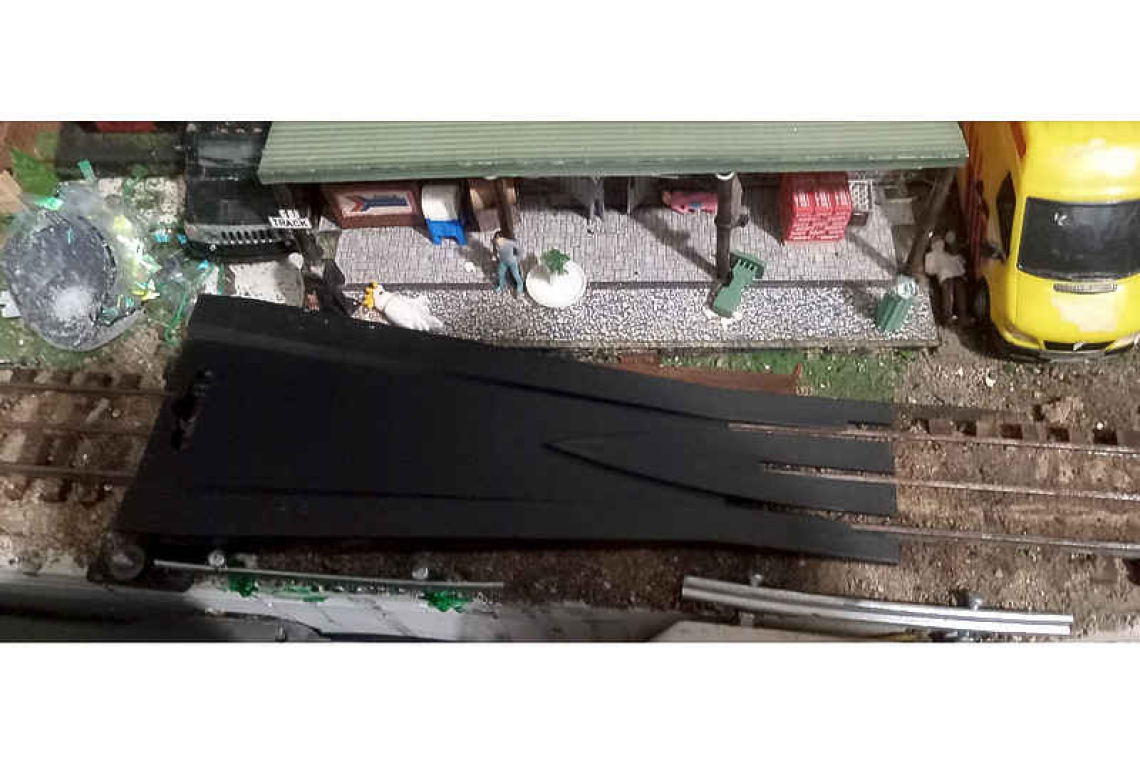
But do not worry. Models are creative. They have come up with two different approaches to solve the problem. The first is a section of track installed on the layout. It is designed to look like a railroad crossing to allow cars to roll over the tracks just like in real life. But the plastic is v shaped at either end, so a modeler just places a car or engine in front of the railer and slowly moves it back and forth until all the wheels are guided onto the track. The only disadvantage to this system is that the train must be brought to the railer.
Another option is the rerailer. This is an interesting piece of plastic you carry to the place you need to place the train. It lays on top of the track. Then you roll the derailed train onto the rerailer. As you gently move the affected piece forward, the wheels are aligned. As the train moves off the railer, the wheels, almost magically, are on the track and ready to go.
An HO rerailer usually sells for about US $10. You can get rerailers for other gauge trains too. O gauge is twice the size of HO, but the rerailer is only listed as around $12. So, get a rerailer and keep those cars rolling around the track.
Until next time, I hope to see you around the tracks.