





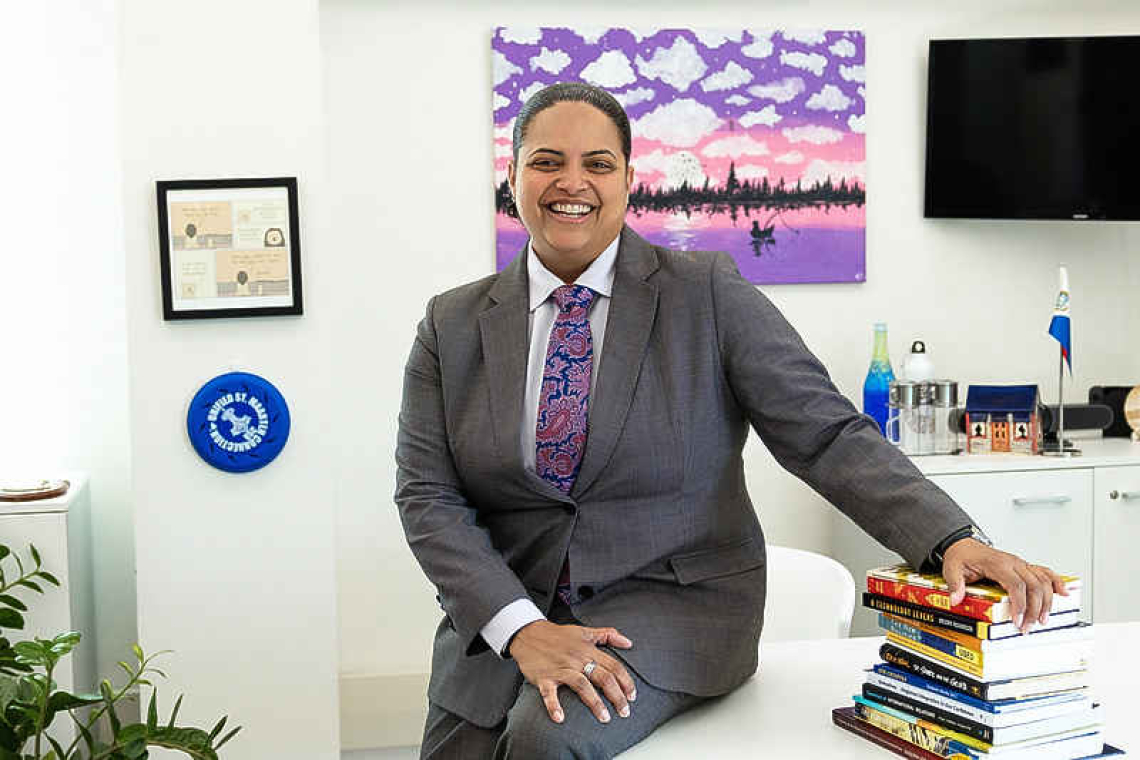
Minister of Education, Culture, Youth and Sports (ECYS) Melissa Gumbs.
~0% mastery at 4 schools~
PHILIPSBURG--Findings from the National Assessment Report: Early Literacy and Numeracy for the Group 5 cohort 2024/2025 revealed that a majority of pupils are struggling to achieve proficiency in mathematics problem-solving.
Education Minister Melissa Gumbs presented the alarming findings of the report to Parliament’s ECYS Committee on Thursday. In addition to problem solving, Group 5 pupils from 16 schools were also assessed in addition and subtraction, number and numeration, multiplication and division, fractions, measurements and geometry, listening and comprehension, oral reading fluency, and reading comprehension.
According to data drawn directly from the national report, 64 percent of pupils were classified as emerging in problem solving, 25 percent as developing, and only 11 percent reached Mastery, signalling a significant challenge across the cohort.
The report defines proficiency levels as Mastery, where learners demonstrate full understanding of mathematical concepts and procedures; Developing, where learners show partial understanding and require more practice to improve accuracy and consistency; and Emerging, where learners require significant support and remediation to acquire foundational concepts.
According to the report, problem-solving proficiency is concentrated in the lower performance bands, indicating that many pupils are not yet consistently able to apply mathematical knowledge and strategies to solve non-routine or multi-step problems independently. Only a quarter of pupils are in the Developing band, suggesting a meaningful group that could progress to Mastery with structured routines and guided practice, while the 11 percent who demonstrate Mastery show that some pupils can successfully interpret, plan, and execute solutions and could serve as exemplars for high-quality reasoning. Zero scores were most prevalent in problem solving, with 7.6 percent of females and 6.7 percent of males receiving zeros, highlighting this as the primary area of concern for the cohort.
Gender
Gender differences are modest, with 63 percent of females Emerging, 28 percent Developing, and 9 percent at Mastery, compared with 65 percent of males Emerging, 22 percent Developing, and 13 percent at Mastery. This results in 37 percent of females and 35 percent of males at or near proficiency, indicating that problem-solving is a cohort-wide priority rather than a gender-specific issue.
Dutch schools
perform more poorly
Language of instruction also plays a role, with pupils in Dutch-instruction schools performing more poorly than those in English-instruction schools. In Dutch-instruction schools, 73 percent of pupils were Emerging, 17 percent Developing, and 11 percent at Mastery, compared with 62 percent Emerging, 28 percent Developing, and 11 percent at Mastery in English-instruction schools, resulting in 28 percent of Dutch-instruction pupils and 39 percent of English-instruction pupils at or near proficiency.
Public schools
pupils struggling
The type of school further affects performance, with public schools showing especially low problem-solving proficiency. In public schools, 86 percent of pupils were Emerging, 12 percent Developing, and only 2 percent reached Mastery, resulting in just 14 percent at or near proficiency. By contrast, subsidized schools had 57 percent Emerging, 29 percent Developing, and 14 percent at Mastery, with 43 percent at or near proficiency.
Across sixteen schools in the cohort, school-level Emerging rates ranged from 46 to 100 percent, Developing ranged from 0 to 40 percent, and Mastery ranged from 0 to 20 percent, with four schools reporting 0 percent Mastery and two schools reporting Emerging rates of 96 percent or higher, including one school at 100 percent Emerging.
It recommends a range of strategies to address these challenges, including targeted short-cycle assessments to diagnose specific problem-solving sub-skills, cohort-wide explicit problem-solving routines such as Read, Represent, Plan, Solve, and Check, strengthened representation and schema-based instruction using bar models, number lines, and tables, increased opportunities for mathematical discourse and justification, and targeted small-group intervention for emerging pupils with step-by-step modelling and gradually increasing problem complexity. The report also spoke of intensive support in public schools, the use of best practices from subsidised schools, and frequent progress monitoring to adjust intervention intensity and track improvement every three to four weeks.
The assessment shows that problem-solving is a critical challenge for Group 5 pupils across gender, language, and school type. Only a small fraction of pupils demonstrate full mastery, while the majority require structured support, and systemic interventions in problem-solving routines, representation, targeted intervention, and frequent monitoring are urgently needed to improve outcomes and reduce disparities, particularly in public schools.