





~ St. Maarten’s Backyard Astronomy for Aug 14 - 16 ~
Sun rises at 5:54am
Sun sets at 6:38pm
Lunar phase: 1st quarter, waxing crescent
Moon rises at 8:34am, Saturday
Moon sets at 8:43pm, Saturday
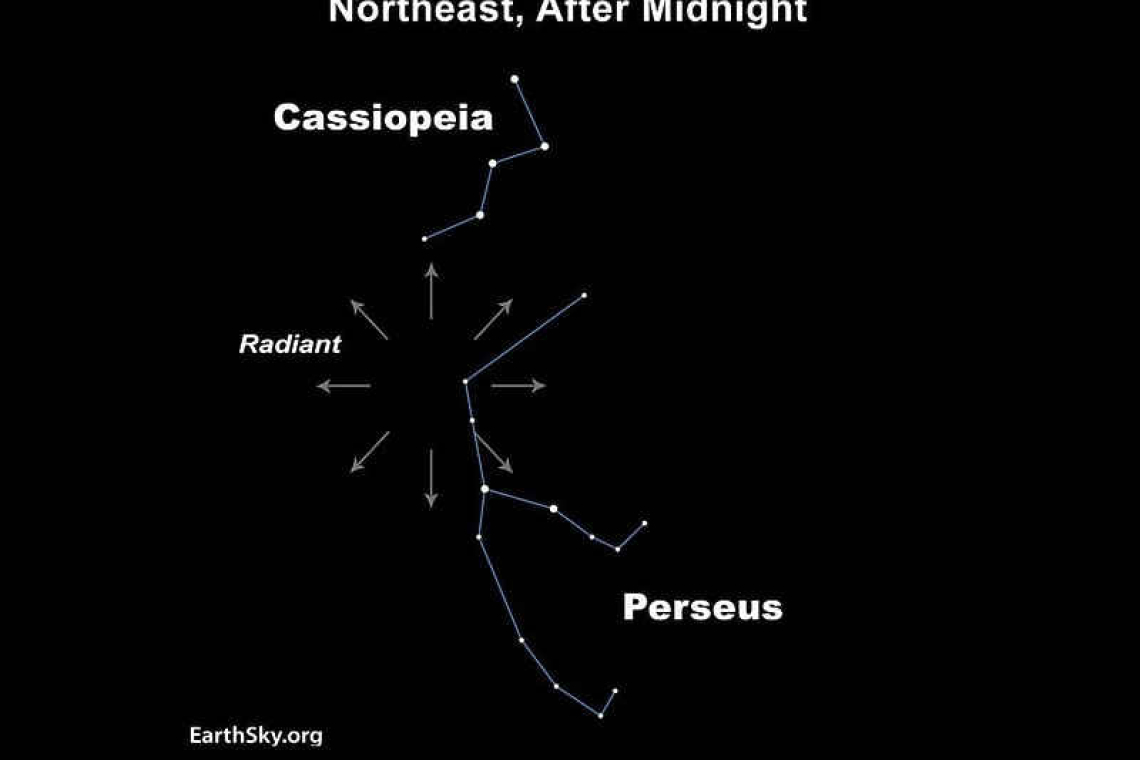
This weekend, we have just passed the official peak of the Perseid meteor shower, but there could still be some of those bright colourful shooting stars in our skies, so keep looking up – especially after midnight towards the dawn hours. That is when most meteor showers are best viewed.
The good news is that the moon is new and will have set long before the Perseids start flying. A dark sky with no moon and no ambient lights from buildings and streets is best for viewing shooting stars.
By the way, what causes this gorgeous effect? The “shooting stars” aren’t actually real stars, but tiny (usually) grains of dust or ice that burn up by running into our atmosphere. The grains of dust and ice are debris from the tail of a comet, and this debris field is more or less stationary and we on the planet Earth travel through this debris field the same time each year. Now you know!
Meanwhile, you will find Venus bright and beautiful, hanging low in the western sky after sunset. The thin crescent moon is nearby. We call Venus the Evening Star, but once again, it’s not a star. Named after the goddess of love, Venus is actually a planet with a similar size and composition to our own planet. But the truth of Venus is far from Earth’s hospitable environs. Venus is unbearably hot with a thick and oppressive atmosphere where sulfuric acid rains down from the sky. Venus represents a planet whose greenhouse effect has gone beyond tolerable – at least from our point of view.
You can locate Saturn and Mars if you stay up late waiting for those meteors! Saturn rises from the eastern horizon about 10:00pm while Mars rises from the East-Northeast horizon at about 2:45am. Jupiter is currently lost in the bright daytime sky and will be for a few more months.
While Venus is too hot, Mars is quite cold, having a thin atmosphere that doesn’t hold onto the sun’s warmth, and earth is in a zone astronomers sometimes call the Goldilocks Zone – meaning we aren’t too hot and aren’t too cold, but we are “just right.” When astronomers search for exoplanets around other stars than our sun, they look for planets that lie in those Goldilocks Zone stars, and they have found quite a few! More about that next weekend.
Thank you for keeping up with the Night Sky articles, backyard (or beach) astronomy designed for St. Maarten sky viewing. FYI: If you are out later on in the week, note that each star rises about four minutes earlier each day than written here, and the moon rises 50 minutes later. Night Sky is researched and compiled by Lisa Davis-Burnett. Earthsky.org is a key resource for information and images. Questions or comments? Email This email address is being protected from spambots. You need JavaScript enabled to view it.